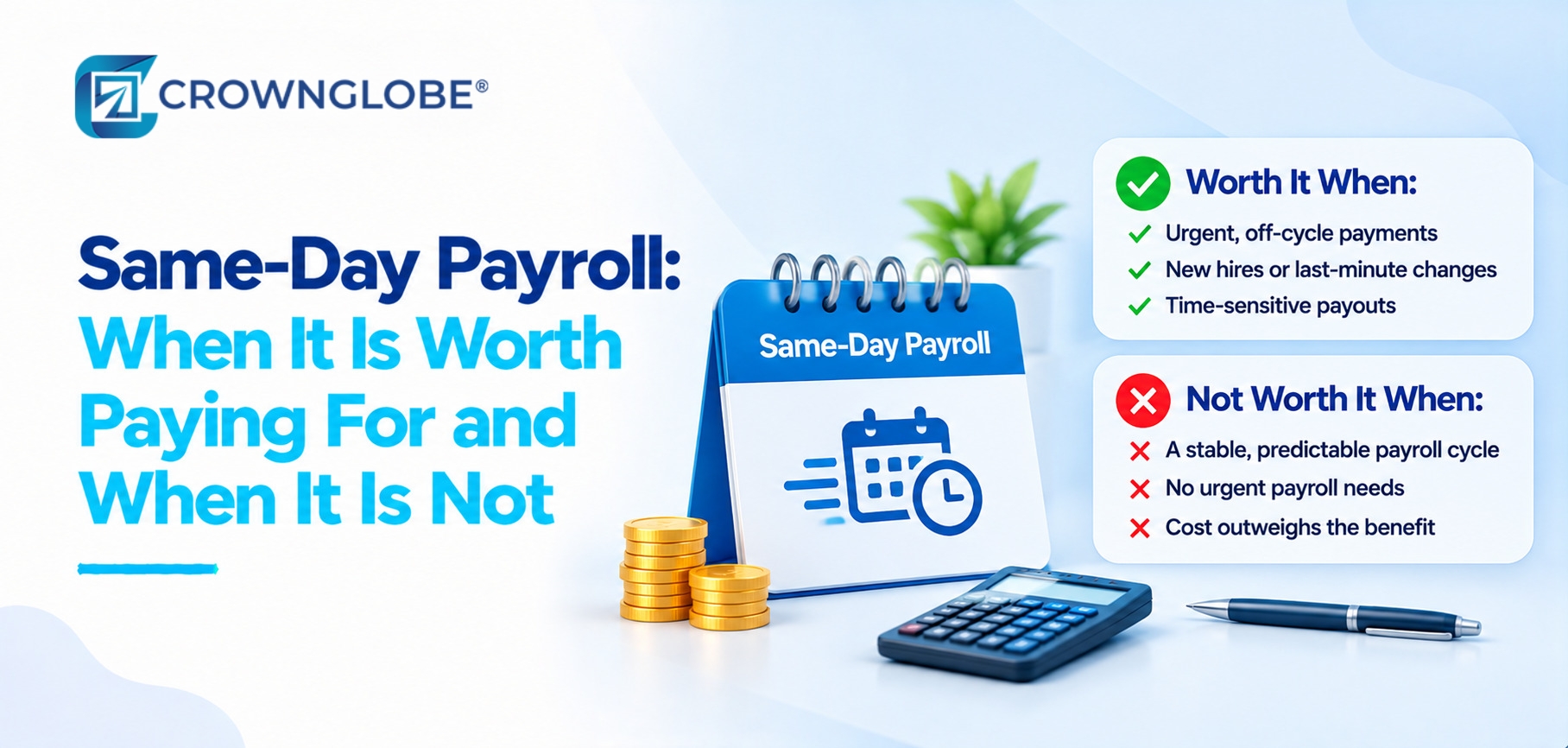
Same-day payroll can be very helpful when a regular deadline is missed an off-cycle payment can't wait or employees need their wages faster but it’s not always the choice, for every payroll run.
The real question is whether faster payment solves an operating problem because eligibility, provider cutoffs, banking days, funding, payment method, reversibility, fees and the payroll company’s own rules all influence that decision.
What Does Same-Day Payroll Mean?
Same day payroll involves transmitting the approved payroll electronically on the business day based on the cut off time of the provider for the particular mode of payment chosen.
Same-day difference is significant due to the fact that same day is not a payroll solution; one firm will provide same day ACH, another accelerated payments, and each might have their own definitions and conditions.
Payroll timing can also vary with the workforce and operating model. Businesses with different pay frequencies, staffing patterns, and payroll complexity may have different industry-specific payroll needs.
Three Meanings People Mix Together
Same-day payroll processing
A payroll run can be calculated and approved today without employees necessarily receiving their wages today.
Processing refers to what occurs within the payroll process. The employees receipt is still based on the payment method, provider eligibility, funding and the relevant cutoff.
Same-day direct deposit
Direct deposit is where employees are paid on the same business day.
Some insurance companies provide coverage through their plans or, as per the eligibility guidelines that must be reviewed for specific end date requirements by employers.
Instant pay
Instant pay could be a payment option, not only a new label, for payroll, on the same day.
Instant Pay is not the same as day Pay and the main lesson, from Gusto is that provider terminology and payment rails do not automatically match.
There is no single-day payroll cutoff, fee, eligibility rule or payment method that applies to everyone; the examples are, for illustration and not to set industry standards.
Terms You Need Before Comparing Payroll Speed
How a Same-Day Payroll Run Actually Moves
Final payroll inputs are approved
Prior to the release of the payroll, it is necessary that everything is checked such as hours, wages, bonuses, and deductions, etc.
Faster payment does not make accurate inputs or review less important.
Gross-to-net payroll is calculated
The payroll system calculates pay, deductions, taxes and net pay based on the approved information, for the run.
Accelerating the payment does not remove normal calculation and review responsibilities.
Funding is confirmed
The employer must have sufficient funds available under the payroll provider's requirements.
An accelerated option can still fail to solve the problem if funding is unavailable or does not meet the provider's rules.
The payment is released
The provider sends eligible wage payments through the applicable payment method.
Depending on the provider, that may involve Same Day ACH or another accelerated mechanism.
Employee receipt and exceptions are monitored
I see that the process is still incomplete after payments are released because failed deposits, returned payments, wrong bank details and payroll corrections all still need a solution path, for payments.
Same-day payroll is most effective when the quick payment is included in a well-controlled process from beginning to end.
When Paying for Speed Can Make Sense
| Situation | Why faster payroll may help | Alternative to compare | Verify first |
|---|---|---|---|
| Missed normal submission cutoff | May help preserve the intended payday | Next-day deposit | Eligibility and today's cutoff |
| Genuine off-cycle correction | Can get corrected wages out sooner | Next scheduled payroll | Amount, approval, funding |
| Urgent final paycheck | May help meet an applicable timing need | Manual or other permitted payment | State rules and provider capability |
| Unexpected payroll change | Provides less lead time before receipt | Adjust the regular cycle if appropriate | Accuracy and authorization |
| Keeping cash available closer to payday | May reduce how early funds leave the account | Standard payroll timing | Fee, funding, operational risk |
| Routine predictable payroll | Often offers limited additional value | Standard payroll schedule | Whether speed solves a real problem |
The Federal Reserve identifies missed payroll files and certain hourly-pay situations as examples where Same Day ACH may be useful when qualification and deadline requirements are met.
The decision is therefore less about whether same-day payroll is available and more about whether the timing problem is important enough to justify using it.
The Questions People Actually Ask
It means an eligible payroll run can result in employees receiving electronic wage payments on the same business day.
The important word is eligible. Provider rules, funding, submission time, payment method, and banking-day restrictions still apply.
Not exactly.
Payroll includes calculations, deductions, approvals, funding, tax responsibilities, and payment. Same-day direct deposit describes the employee-payment portion of that process.
No universal definition makes the two interchangeable.
Some payroll companies treat instant pay as a separate product with different eligibility, payment rails, availability, fees, or reversibility rules.
Same Day ACH allows eligible ACH payments to settle on the same banking day when they meet applicable processing requirements.
Nacha identifies payroll as one use case for ACH credits. Employers should still confirm how their payroll provider uses the ACH network and what submission deadline applies.
Yes, with some eligible provider arrangements.
The employer still needs to submit payroll on time, satisfy the provider's funding and eligibility rules, and use a payment method capable of same-day delivery.
The relevant cutoff is the one published by the payroll provider for the employer's specific service and payment method.
Same Day ACH operates on banking days rather than as a universal 24/7 payroll service. Other accelerated payment products may follow different availability rules.
No.
Current providers illustrate the variation: some document same-day or instant options, while Patriot Software currently states that it does not offer same-day direct deposit and instead describes other urgent-payroll alternatives.
That is why availability should be verified before a business depends on it.
It can.
Accelerated payroll may be included in a particular plan, subject to additional transaction charges, or unavailable altogether. Employers should ask for the exact fee and eligibility rules that apply to their account.
It is easier to justify when the timing problem is material, the payroll is eligible, the cutoff is still open, funding is available, and the payroll inputs have been properly reviewed.
The cost should be compared with the consequences of delaying payment—not treated as automatically worthwhile because the option is faster.
If payroll is predictable and the normal process already gets employees paid correctly and on time, faster processing may add little practical value.
Using an accelerated option on routine payroll can also reduce the time available for review without solving a meaningful business problem.
Start by checking the payroll provider's available alternatives.
Depending on the provider and account, those may include same-day payroll, next-day funding, another accelerated option, or a different permitted payment method. Do not assume the same fallback exists everywhere.
Potentially.
It can be useful when an off-cycle correction or final payment is genuinely urgent, but wage-payment law still needs separate attention. The U.S. Department of Labor notes that federal law generally does not require an immediate final paycheck, while some states may require faster payment.
Not by itself.
Federal employment-tax deposit timing follows IRS rules rather than the speed at which employees receive wages. IRS Publication 15 explains the applicable federal deposit schedules and special deposit rules.
For a broader explanation of wage costs and employer tax obligations, see CrownGlobe's guide to payroll expenses and payroll taxes.
Ask what “same-day” means in the provider's system, who qualifies, what the cutoff is, which payment method is used, what funding is required, and whether weekends or holidays affect delivery.
Also ask about fees, reversibility, failed deposits, tax handling, and fallback options. Then compare those answers with what full-service payroll actually includes.
Six Things That Are Not True
- “Same-day means instant.” Not necessarily. Same Day ACH and instant-payment products can operate differently.
- “There is one national payroll cutoff.” There is not. Provider and payment-method deadlines vary.
- “Same-day payroll works the same on weekends and holidays.” No. Same Day ACH is based on banking days, while other faster-payment methods may have different rules.
- “Every payroll customer automatically qualifies.” No. Eligibility, funding history, plan type, or other provider conditions may apply.
- “Speed removes the need to review payroll.” The opposite can be true. Less lead time makes accurate inputs and disciplined approval more important.
- “The fastest option is always the best value.” Speed is useful when it solves a real timing problem. It is not automatically worth paying for on every payroll run.
Accelerated payroll should be seen as a backup or operational choice, not a replacement, for the payroll schedule.
A strong process depends on inputs, sufficient money, a proper review, clear ownership and a backup plan, for when a process goes off track.
CrownGlobe provides payroll processing support. Specific accelerated-payment availability should always be verified for the payroll platform and arrangement being used.
Sources & Further Reading
- Nacha ACH Payments Fact Sheet
- Nacha How ACH Payments Work
- Federal Reserve Financial Services ACH Services for Small and Medium Business Customers
- IRS Publication 15, Employer's Tax Guide
- U.S. Department of Labor Last Paycheck
- QuickBooks Direct Deposit Funding Time
- Gusto Instant Payroll
- Patriot Software Same-Day Direct Deposit Alternatives
This article is for general business information and does not constitute payroll, tax, legal, banking, or financial advice. Provider eligibility, fees, cutoffs, funding requirements, payment methods, and processing availability can change. Federal and state wage and tax requirements may also differ. Confirm material payroll or compliance decisions with the relevant provider and qualified professional.
Get a Payroll Timing and Workflow Review
If accelerated payroll keeps becoming necessary, the underlying issue may be the payroll calendar, approvals, staffing, funding, or another part of the operating process.
CrownGlobe can help review that workflow and determine whether faster payroll belongs in the normal process, should remain a contingency option, or is rarely necessary.