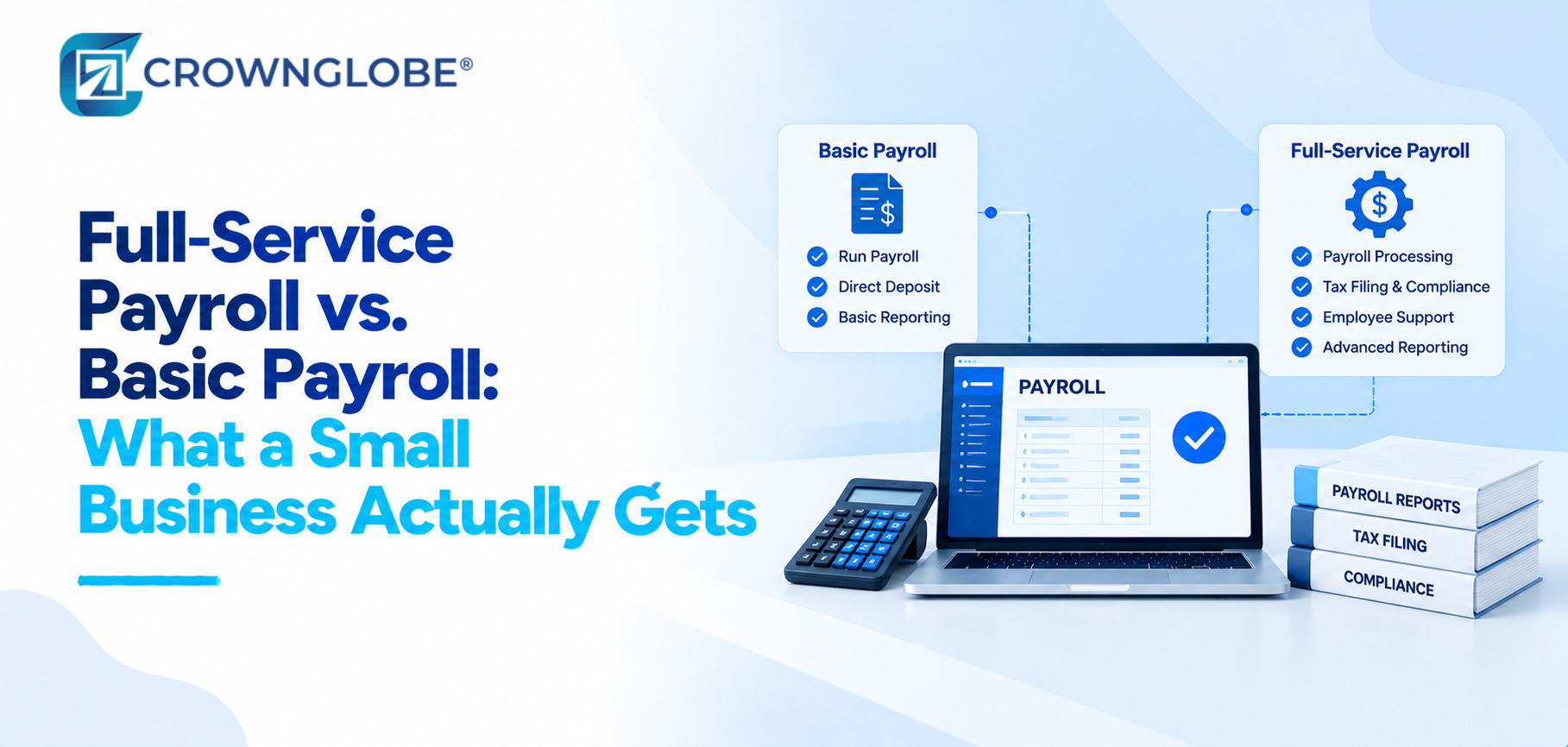
For a business the real decision between basic and full-service payroll isn't just about the software its, about who takes care of the ongoing work.
Full-service payroll costs more because the provider takes on more of the work while basic payroll is cheaper but keeps responsibility, with your teamchoose based on how complex your payroll is, how many states you operate in and how much control you want to keep.
The main point is that "full service" means things to different providers so you should check who does what instead of trusting the name of the plan.
Basic vs. Full-Service Payroll, Scored
The scorecard below is a guide for decisions, not a test of performance and five dots mean the model is stronger, in that area so focus on the dimensions that matter most to you.
| Dimension | Basic payroll | Full-service payroll | What decides it |
|---|---|---|---|
| Lower recurring provider cost | ●●●●● | ●●●●● | Plan structure, headcount, add-ons |
| Administrative handoff | ●●●●● | ●●●●● | How much work you want off your team's desk |
| Tax filing support | ●●●●● | ●●●●● | What the provider contract actually includes |
| Direct internal control | ●●●●● | ●●●●● | How much you want to approve and manage directly |
| Multi-state complexity | ●●●●● | ●●●●● | State/local coverage and additional fees |
| Human support | ●●●●● | ●●●●● | Service level, escalation process, response model |
What Basic Payroll Usually Covers
The basic payroll system revolves around dealing with the processes involved in the entry of hours, computation of payrolls according to gross salaries, deduction process, payroll reports, and payment of payroll to employees through the portal.
The employer must follow the plan and a system can manage payroll taxes while the employer team handles deposits, filings, notices and year end tasks.
Map out the tasks that people in the business still need to complete each pay period, each quarter and, at year end because the subscription cost alone doesn't show if those duties still take a lot of time.
What Full-Service Payroll Commonly Adds
Full-service payroll takes care of all the lifting, like tax deposits, filing, year-end forms and staying on top of compliance so you don't have to worry about it.
A full service payroll plan can cover these responsibilities when they are included in the provider's written scope.
Some providers might also handle state registrations notices, off-cycle payroll, corrections or bigger human resources tasks but you should check to be sure.
The service label matters less than the responsibility schedule. Please ask who is responsible, for making tax deposits, who files returns, who handles yearend forms and notices and who takes care of corrections when the source information is incomplete or incorrect.
One point should remain clear even when a provider handles tax administration. When using a third-party payroll service, the employer still remains responsible, for federal employment taxes and should actively monitor tax deposits instead of assuming the service takes full responsibility.
What Full-Service Payroll Costs a Small Business
The payroll fee charged by companies varies depending on various factors. They include the number of employees the number of pay periods the number of states and/or localities the business operates in, the level of service required the type of tax form you are filling the human resource needs year-end processing and corrections.
The cost of payroll services for small business operations depends on the responsibilities included in the plan.
Monthly provider fee + per-worker charges + state/local add-ons + year-end/off-cycle charges + internal payroll administration time
A simple arrangement involves a provider fee but still requires actual internal effort, while a comprehensive arrangement is more expensive but eliminates a great deal of ongoing administration.
The best value isn't about the priceit's, about finding the plan that matches your business needs in cost, control, support and workload.
For a clearer look at the difference between payroll cost, payroll taxes, and employer-side obligations, see our guide to payroll expenses and payroll taxes.
Why a Hybrid Payroll Model Can Make Sense
Many small businesses can find a groundhandling some payroll tasks themselves while still getting help from a provider, for others.
By having the division scheduled, management will maintain control, reduce bureaucracy, and be able to make its own decision regarding payment methods, payroll approval, employment classification, and banking authorization.
The service provider will be in a position to assist the service provider with processing, reconciliation, reporting, filing coordination, and platform management.
Keep inside the business
- Compensation and hiring decisions
- Final payroll approval
- Banking and funding authorization
- Review of unusual items
- Management accountability
Deliver through outside payroll/accounting support
- Recurring payroll processing
- Data setup and routine platform administration
- Payroll records and standard reporting
- Reconciliations and recurring exception follow-up
- Tax filing coordination within contracted scope
The way a company splits its pay can change depending on how it operates. Businesses that handle tips, commissions, seasonal workers many stores or employees in states usually have a more complicated payroll process, than a basic single-state salary setup.
Those differences are part of broader industry-specific accounting and payroll needs, not just a software decision.
What to Verify Before Choosing a Full-Service Payroll Provider
It is critical to know what will be done for you than knowing all the terminologies they use to describe their software.
Before signing ask for the service scope in writing. Then work through the questions, about the service scope.
- Which federal, state, and local payroll tax deposits are included?
- Which payroll tax returns are filed, and in which jurisdictions?
- Are additional states or localities charged separately?
- Are year-end W-2 and related filings included?
- What happens with off-cycle payrolls and corrections?
- Does the provider help with new tax-account registrations where needed?
- Who handles tax notices and how are they escalated?
- How are employees and contractors treated within the system?
- How does payroll data post to your accounting records?
- What support channels and escalation paths are available?
- What are the cancellation, data-export, and transition terms?
- What happens when incorrect or late source data comes from the employer?
The issue of cost matters, but the issue of clarity comes first; a cheaper option will prove to be expensive when there are additional costs charged for added services or when workers continue to work on something that the owner believes has been finished.
What It Costs to Change Your Mind
I realize that moving payroll providers is more, than swapping a subscription because the transition can involve employee records, yeartodate wages and taxes, deductions, funding information, tax accounts, outstanding corrections and accounting mappings.
A controlled transition follows five practical steps:
Inventory
Document employees, document pay schedules, document deductions, document tax accounts, document current provider responsibilities, document open notices and document accounting connections.
Reconcile year to date
Double check wages, taxes, deductions and balances before moving the data because any mistakes, at the start will make the first run harder to trust.
Configure
Payroll scheduling, Payroll funding, Payroll Tax Jurisdiction, Payroll Employee, Payroll Deductions, and Payroll GL Mappings have to be created in the environment.
Verify
Check the run thoroughly against past records and what was expected focus especially on year, todate totals tax settings deductions and funding.
Stabilize
Fix the corrections confirm the reporting and document the recurring task ownership.
Incomplete year, todate data, tax accounts or accounting mappings can mess up the transition.
Crownglobe Practice Note
Payroll works well when payroll is viewed as a process of compliance, documentation, and reporting, and not of computation of pay.
There will be clarity in terms of who is supposed to do what with regard to source documents, approvals, deposits, filings, documentations, reconciliations, and follow-ups with any issues that arise.
Questions Small-Business Owners Ask
Basic payroll usually focuses on calculating and processing payroll while leaving more administration with the employer. Full-service payroll generally adds services such as tax deposits, payroll tax filings, year-end processing, and broader support.
Exact scope varies by provider and plan, so compare responsibilities rather than labels.
There is no single price that fits every business. Cost can vary with employee count, payroll frequency, number of states, tax filing scope, HR features, year-end work, off-cycle runs, and other add-ons.
Compare the provider fee together with the internal time the service removes or leaves behind.
Many full-service plans include payroll tax deposits and filings, but coverage differs.
Verify which federal, state, and local obligations are included, whether extra jurisdictions cost more, and how the provider handles notices, amendments, and year-end forms.
It can be when payroll administration is consuming meaningful internal time, tax filing responsibilities are difficult to manage, or the business operates across multiple jurisdictions.
A straightforward payroll with strong internal controls may not need the same level of service.
Ask exactly which tasks are included, how tax deposits and filings are handled, what support is available, which services cost extra, how corrections and notices are managed, how your accounting system integrates, and what happens to your data if you leave.
Not automatically. In common third-party payroll arrangements, the IRS generally continues to hold the employer responsible for federal employment-tax obligations even when a payroll provider performs administrative work.
Employers should understand the arrangement and continue monitoring deposits and filings.
Sources & Further Reading
- Internal Revenue Service Outsourcing Payroll Duties. irs.gov/businesses/small-businesses-self-employed/outsourcing-payroll-duties
- Internal Revenue Service Publication 15, Employer's Tax Guide (2026). irs.gov/publications/p15
- U.S. Department of Labor, Wage and Hour Division Fact Sheet #21: Recordkeeping Requirements under the Fair Labor Standards Act. dol.gov/agencies/whd/fact-sheets/21-flsa-recordkeeping
- Social Security Administration W-2 Filing Deadlines. ssa.gov/employer/filingDeadlines.htm
- ADP How Much Does It Cost to Run Payroll? adp.com/resources/articles-and-insights/articles/p/payroll-cost.aspx
- Patriot Software Payroll Software: Basic and Full Service Payroll plan information. patriotsoftware.com/pricing
Crownglobe provides payroll and accounting services, so this comparison is not disinterested. The scorecard reflects editorial judgment rather than independent measurement. Use it as a framework for your own diligence, and verify the exact scope, pricing, responsibilities, and contract terms of any provider you are considering.
General-information disclaimer: This article is for general informational purposes only. It is not individualized legal, tax, payroll, or accounting advice. Requirements vary by business facts, worker arrangements, provider contracts, and jurisdiction. Consult appropriate qualified advisers and applicable government agencies for decisions specific to your business.
Choosing Between Basic and Full-Service Payroll?
The best payroll model is the one that makes ownership clear. When you know who approves the run, who handles tax deposits and filings, who manages corrections, and who reconciles the records, the price comparison becomes much more useful.
Bring your current payroll setup, employee/state complexity, provider scope, and pain points. Crownglobe can help you identify what should stay in-house and what can reasonably be handed off.