
Franchise Accounting and Bookkeeping for Franchise Businesses
Franchise accounting is not “regular bookkeeping.” You often need location-level reporting, standardized categories, and consistent financial packets you can share with a franchisor on a weekly/monthly cadence.
Compliance isn’t optional. Your reporting must align with your franchise agreement (royalties, advertising contributions, required statements) and, depending on your footprint, payroll and sales tax obligations.
Crownglobe helps franchise owners and multi‑unit operators run finance like a system: bookkeeping + payroll + tax readiness + CFO-level visibility + automation dashboards – built to scale location by location.
Sales & Revenue Tracking
Track daily restaurant sales, online orders, franchise royalties, and multiple revenue streams accurately.
Inventory & Food Cost Control
Monitor food inventory, supplier costs, and kitchen expenses to reduce waste and improve profit margins.
Payroll & Staff Management
Manage payroll for kitchen staff, servers, and managers including tips, overtime, and employee benefits.
Tax & Franchise Compliance
Handle sales tax, franchise reporting, quarterly filings, and year-end bookkeeping compliance smoothly.
Service mapping for franchise businesses
We help franchise businesses manage multi-location accounting with standardized reporting, organized bookkeeping systems, and scalable financial workflows. Our processes improve financial visibility across locations and support smarter operational and growth decisions for franchise owners.
Our team handles unit-level bookkeeping, reconciliations, payroll workflows, and consolidation reporting with accuracy and consistency. We also create standardized reporting structures that simplify financial management across multiple franchise locations.
With KPI dashboards, cash flow forecasting, automated reporting workflows, and year-end tax readiness support, we help franchise businesses stay financially organized and efficient. Our goal is to build reliable accounting systems that support long-term franchise growth and operational clarity.
Contact Us

Franchise Bookkeeping (Unit-Level)
Reconciled books per location with standardized categories so each unit is comparable and consolidation is clean.

Payroll and Multi‑Location Support
Payroll workflows and reporting support that scales across locations and helps reduce filing errors and surprises.

Tax Readiness and Filing Support
Organized reporting packages, cleaner categories, and year-end readiness for smoother coordination with your tax professional.

Virtual CFO for Franchise Growth
Cash flow forecasting, budgeting, expansion decision support, and KPI systems - so growth is intentional, not reactive.

Dashboards and AI Automation
Replace fragile spreadsheets with automated reporting workflows and dashboards that refresh consistently.
Industry-specific challenges franchise businesses face
Franchises face complexity that single-location businesses experience:
Multi‑location clarity (unit economics)
You need to know which locations are healthy and which are leaking margin - fast. That requires consistent, unit-level revenue, COGS/labor tracking (especially restaurant bookkeeping), and repeatable reporting.
Royalty fees and required fund contributions
Many franchise agreements include ongoing, sales-based royalties and may include other fees such as advertising/brand fund contributions. These fees and their timing create a reporting discipline that must be embedded into your books and monthly workflow.
Standardization across units
Most growing franchise groups eventually need a standard Chart of Accounts and consistent close checklists.
Compliance surface area increases with scale
As you add states, employees, and sales channels, compliance (payroll filings, sales tax workflows, and year-end readiness) becomes more operationally heavy.
Franchise Bookkeeping Services
Simplify franchise accounting with accurate bookkeeping, payroll support, royalty tracking, and financial reporting for multi-location businesses.

Royalty & Fee Tracking
Track franchise royalties, marketing contributions, and recurring franchise fees accurately across every location.

Multi-Location Bookkeeping
Maintain clean and standardized books for each franchise unit with easy consolidated reporting.

Payroll & Labor Management
Manage payroll processing, employee records, labor costs, and compliance for multi-unit operations.

Vendor & Accounts Payable
Organize supplier invoices, recurring payments, and operational expenses without missing deadlines.

Financial Reporting
Get clear profit and loss reports, cash flow visibility, and location-level performance insights.

Budgeting & Growth Planning
Plan expansion, monitor operating costs, and forecast business growth with better financial clarity.
Industry-Specific Benefits
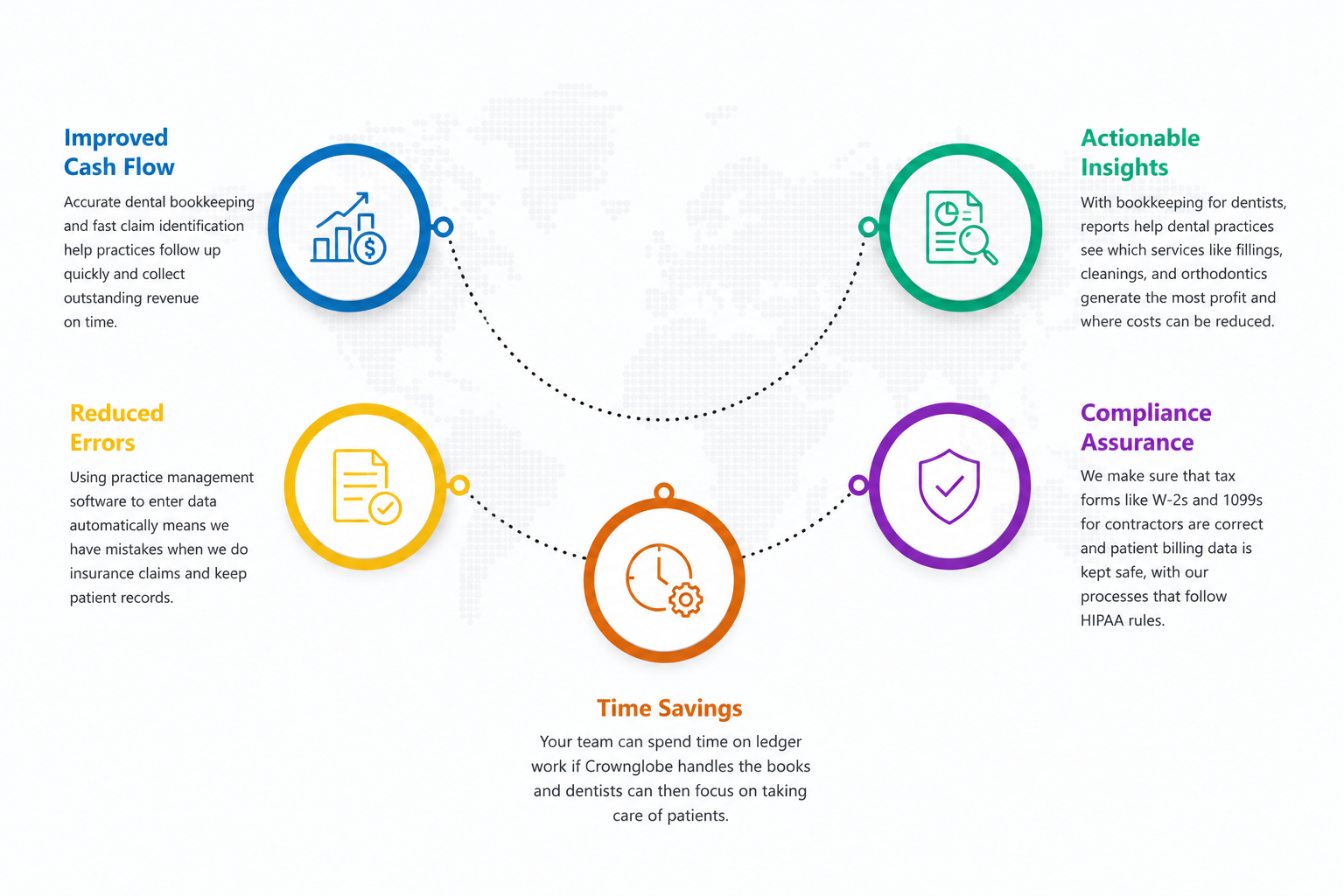
Improved Cash Flow
Accurate franchise bookkeeping and faster sales reconciliation help business owners track revenue, manage royalty payments, and improve overall cash flow.
Reduced Reporting Errors
Standardized accounting processes across franchise locations reduce manual mistakes and improve consistency in financial reporting.
Time Savings
Automated bookkeeping workflows and organized reporting save time for franchise owners and managers, allowing teams to focus on operations and growth.
Compliance Assurance
Stay prepared for payroll filings, sales tax reporting, royalty tracking, and franchise agreement requirements with organized financial records.
Actionable Insights
Location-level financial reports help identify top-performing units, control operating costs, and support smarter business decisions.
Data-Driven Financial Strategy
KPI Dashboards
Track revenue, labor costs, cash flow, and business performance with customized financial dashboards and real-time reporting.
Revenue Forecasting
Forecast future revenue, manage cash reserves, and prepare for seasonal trends or expansion opportunities with confidence.
Profitability Analysis
Understand which services, products, or locations generate the highest profit and where operating costs can be improved.
Financial Planning
Build long-term financial strategies with budgeting, growth planning, and data-backed decision-making support.
Case Study
Case study example for a franchise business
Standardized Reporting Across Locations
A franchise owner managing multiple locations faced challenges with inconsistent bookkeeping practices and fragmented financial reporting. The lack of standardized processes made it difficult to compare performance across stores and maintain accurate records. Crownglobe’s Franchise Bookkeeping specialists implemented uniform accounting procedures and cloud-based bookkeeping systems across all locations. Our team streamlined transaction management, reconciliations, and financial reporting to ensure consistency and accuracy. The centralized approach improved visibility into each store’s financial performance and simplified oversight for management. As a result, monthly reporting became faster, more reliable, and more accurate across the entire franchise operation.

Technology & Automation Solutions
Modern accounting tools and automation systems help streamline operations, improve reporting accuracy, and save valuable business time.

Practice Management Software
Integrate platforms like Dentrix, Eaglesoft, and Open Dental to simplify patient billing, scheduling, and financial tracking.

Cloud Accounting Systems
Use QuickBooks Online or Xero for secure cloud bookkeeping, real-time reporting, and multi-location financial management.

Scheduling & Payment Platforms
Connect tools like Weave and Solutionreach to automate appointment reminders, payment collection, and customer communication.

BI & Financial Reporting
Build custom dashboards with Power BI or Tableau to monitor revenue, expenses, cash flow, and business performance in real time.

Workflow Automation
Automate invoices, expense tracking, vendor payments, and reporting workflows using tools like Bill.com, Expensify, and A2X.
Engagement Models
Start with Standard $125/ Per Month Perfect for small franchise restaurants needing accurate bookkeeping, monthly reconciliations, and organized financial records.
Start with Growth $245/ Per Month Advanced financial oversight with cash flow management, budgeting, payroll coordination, and operational reporting for growing businesses.
Start with Virtual CFO $345/ Per Month Strategic CFO-level support including forecasting, profitability analysis, expansion planning, KPI tracking, and financial decision-making guidance.
FAQs
Answer: Franchise accounting is bookkeeping and reporting designed for a franchise system – meaning unit-level reporting, standardized categories across locations, and workflows that align to franchise agreement requirements such as royalties and other recurring fees. The Franchise Rule’s disclosure format highlights how central fees are to franchises (e.g., “Other Fees” examples include royalties and advertising), which is why franchise bookkeeping typically needs tighter fee tracking than a single-location business.
Answer: Restaurant bookkeeping focuses on keeping sales, COGS, and labor captured cleanly and producing a monthly (or weekly) view you can trust at each location. Restaurants often track prime cost because it’s a standard operational metric defined as COGS + labor, helping operators see margin pressure quickly.
Franchise Restaurant Bookkeeping
Answer: They’re defined in your franchise agreement and related documents, and (for franchisors) disclosed through the standardized FDD framework required under the FTC Franchise Rule. The FTC-required FDD format includes “Other Fees” disclosures (Item 6), and the rule’s examples explicitly include royalties and advertising-related fees as common fee types.
Answer: We build a repeatable workflow: tie reported sales to deposits/POS summaries, confirm the “sales base” used for the royalty calculation matches your agreement definitions, and reconcile royalty charges to the expected schedule. This is directly aligned with the FTC’s FDD Item 6 structure, which requires clear disclosure of fee amounts, due dates, and formulas reinforcing why your bookkeeping needs a tight reconciliation loop.
Answer: They are typically tracked as recurring franchise-related expenses and reconciled against sales and the franchisor’s statements/withdrawals. The FDD’s “Other Fees” framework explicitly calls out advertising and advertising cooperatives as fee types that may apply, which is why we treat these as first-class line items rather than miscellaneous expenses.
Answer: Requirements vary by brand, but the safest rule is: your franchise agreement governs the reporting packet, cadence, and definitions. The FTC’s required FDD cover language also emphasizes that the contract terms govern the relationship and encourages review with professional advisors, which is why we design reporting around your agreement not generic templates.
Answer: Because one consolidated P&L can hide one weak unit. Location-level P&Ls let you compare unit economics consistently and isolate problems quickly. Accounting platforms support this directly for example, QuickBooks location tracking is designed to categorize data across locations/outlets, reinforcing that unit-level views are a standard need in multi-location accounting.
Answer: Yes. QuickBooks Online supports Location tracking for categorizing data by outlet/location and Class tracking for deeper segmentation (like departments or product lines). This combination allows franchise restaurants to build unit-level and segment-level profitability views without rebuilding spreadsheets every month.
Answer: Yes. Xero’s tracking categories are designed for slicing results, and Xero’s own example shows a business setting up a “Location” tracking category with multiple shop options (a multi-unit use case).
Answer: In practice, yes standardization is what makes unit comparisons and clean consolidation possible. Multi-unit restaurant accounting guidance highlights that a standardized chart of accounts across locations is foundational for consistent measurement and consolidated reporting, and restaurant operators often use industry-standard COA structures to improve comparability.
Answer: Prime cost is commonly defined as COGS + labor costs, and it’s tracked because those are typically the most controllable, high-impact restaurant cost buckets. A widely cited rule-of-thumb is that prime cost should be around 60% or less of sales (though it varies), making it a useful KPI for spotting margin erosion and location-level performance problems.
Answer: We design workflows around the reality that sales tax is jurisdiction-driven. In the U.S., sales taxes are imposed primarily by state and local governments (not a national federal sales tax), so rates, rules, and filing requirements can change by location as you expand.
Answer: We coordinate payroll accounting so wages, taxes, and related liabilities are recorded correctly and reports stay consistent across units. Federal payroll compliance also has defined reporting mechanics for example, the IRS notes many employers file Form 941 quarterly for withheld federal income tax and Social Security/Medicare, and employers report FUTA via Form 940so organized payroll reporting is essential for clean books and readiness.
Payroll Services
Answer: Yes from a finance perspective. We help you model unit economics, required fees, and working capital needs using your target brand’s disclosures and your assumptions. Importantly, the FTC Franchise Rule framework includes Item 19 (financial performance representations) and requires that if a franchisor provides performance claims, they must have a reasonable basis and written substantiation and those representations must be included in the disclosure document. (We don’t provide legal advice; coordinate with qualified franchise counsel for legal interpretation.)
Virtual CFO Services
We enforce system discipline: standardized COA, consistent location tracking, reconciliation routines, and a close checklist so each unit closes the same way. Location tracking tools exist specifically to categorize activity across outlets and keep unit data separable, which supports reliable consolidation when used consistently.
Accelerate Your Business Growth
Discover our core solutions designed to streamline your financial operations and branding.
Connect with us
Franchise businesses really take off when the money side of things is organized and easy to deal with every time. You should set up a time to talk to us for free so we can go over what you need to report for your franchise, how to get each place set up and where you can make things automatic.
Schedule a Free Consultation