
Catch Up and Clean Up Bookkeeping Services for Businesses Behind on Their Books
Months behind? Years behind? We deal with this every week.
Maybe a busy season ran long. Maybe your bookkeeper left in June. Maybe a software switch stranded half your history somewhere you can’t reach it. However you got here, our catch up bookkeeping and accounting clean up service rebuilds the record. We reconcile your bank and card accounts, recover the paperwork you no longer have, fix transactions that were coded wrong, and hand you tax ready statements for every period you missed. You get a fixed price before we start, and most jobs run two to four weeks per year of backlog.
Why Catch Up and Clean Up Bookkeeping Matters
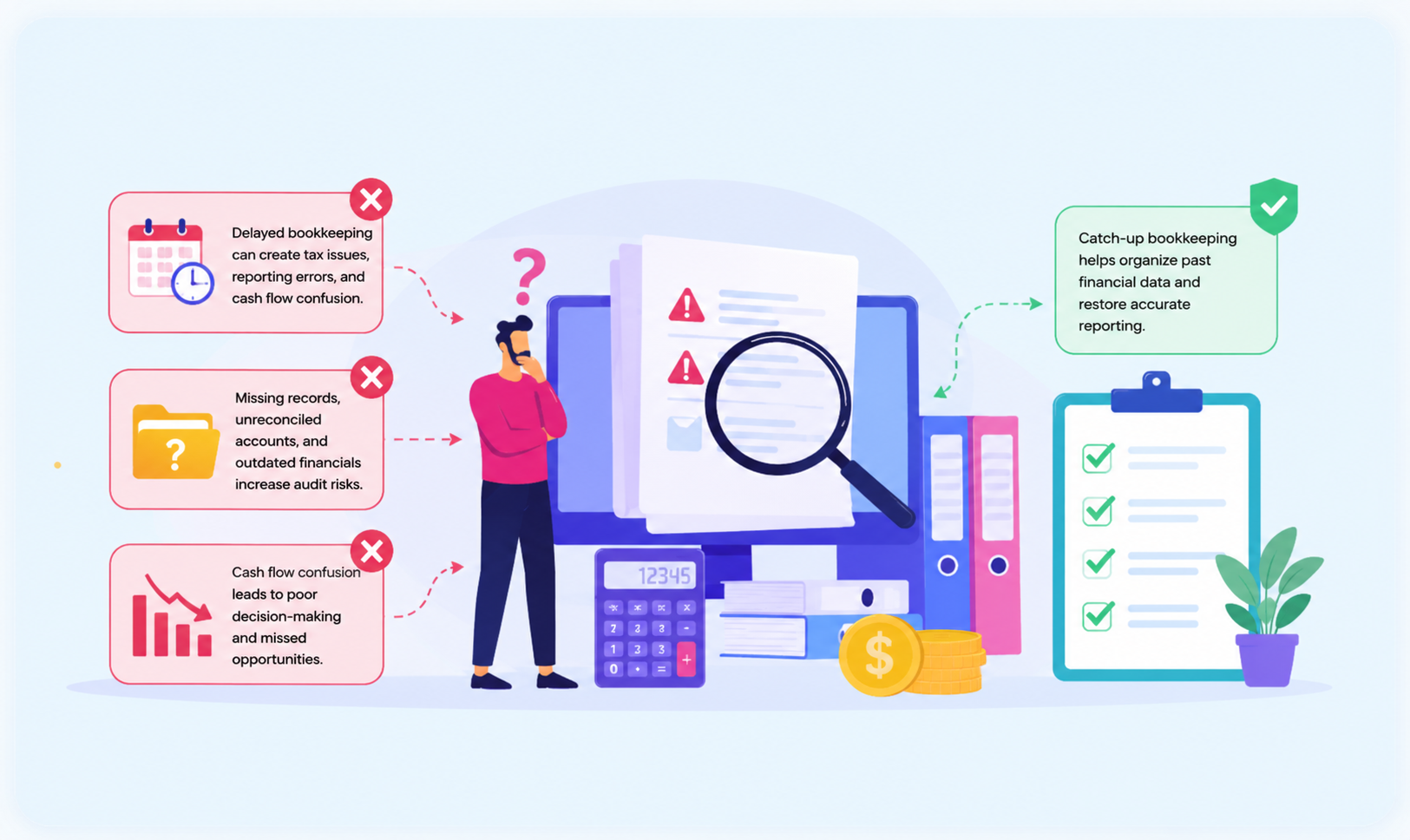
Nobody plans to fall behind. A season gets busy, a bookkeeper leaves, an accounting migration goes sideways, and suddenly you’re eight months back with no obvious way in. The backlog is the annoying part. The expensive part is everything downstream. You stop trusting your own numbers. Every filing turns into a fire drill. And when a lender asks for three years of statements, you have nothing to send.
- Tax season stops being a filing job and turns into a reconstruction job.
- Your bank and your ledger quietly drift apart, sometimes by thousands, and nobody catches it until someone looks.
- Transactions sit uncategorized, so the profit and loss tells you almost nothing useful.
- Receipts, invoices and payroll records get harder to track down with every month that goes by.
- A lender, a landlord or a buyer asks for two years of statements and you can’t produce them.
- Deductions you were entitled to go unclaimed because nobody could evidence them before the deadline.
- You start running the business off the bank balance, because that’s the only figure you still believe.
- We scope the backlog first. How many periods are open, which accounts are involved, what source data still exists. You get a fixed price before anything begins.
- Every bank, credit card, loan and merchant account gets reconciled month by month.
- Missing statements, invoices, receipts and payroll records come back from the institutions that still hold them.
- Transactions are coded against a chart of accounts built for your business, not a default template.
- Year end entries go in as each period closes. Accruals, prepayments, depreciation, owner draws.
- You finish with a full statement set for every period and a handover that keeps the same thing from happening next year.

Catch Up and Clean Up Bookkeeping Services
Catch up and clean up sound like the same job. They’re close, but they’re not identical. Catch up is a volume problem: periods that were never recorded at all. Clean up is an accuracy problem: periods that were recorded badly. Most backlogs we take on are some of each, so we look properly before quoting and price the whole thing at once.
We work one period at a time. A backlog swept into a single adjusting entry will balance, and it will still tell you nothing, so every month closes on its own before we move to the next one.
People call this different things. Catch up accounting. Accounting clean up services. Back bookkeeping services. Cleanup bookkeeping services. Or just clean up accounting books. It’s the same work either way. We provide accounting catch up and clean up services to businesses across the USA, all of it remote, inside the accounting software you already use.

Bookkeeping Cleanup
Bank, credit card, loan and merchant accounts reconciled month by month. Duplicate entries come out, uncategorized transactions get coded properly, and the opening balance on every period is proved instead of assumed.

Historical Records Recovery
Retroactive bookkeeping for the years where the paperwork has gone. We pull statements from your bank and card issuers, get payroll history back from your provider, and rebuild the transaction record from source.

Compliance and Reporting
A books clean up done to the standard a filing actually needs. Supporting documents attached, sales tax and payroll positions checked period by period, and a file your CPA can pick up without calling you first.

AP and Expense Management
Overdue supplier bills entered and matched to payments. Vendor balances corrected where the ledger has drifted. Personal spending separated from business spending, which is where most owner run backlogs come unstuck.

Financial Statement Generation
A profit and loss, balance sheet and cash flow statement for every period we bring current. That’s the set a lender, an investor or a tax preparer expects to receive, and the set most backlogs can’t produce.
Benefits

Audit Ready Books
Every period closes with its reconciliation and its paperwork attached. When a notice turns up, you answer it out of the file instead of rebuilding two years of history in a hurry.

Improved Cash Flow Visibility
Once the ledger agrees with the bank every month, the profit and loss becomes something you can act on. Pricing, hiring and spending stop being decided by whatever the account balance says that morning.

Faster Tax Preparation
Your preparer receives complete, reconciled periods with the documents already attached. Fewer questions, a shorter engagement, and every deduction you’re entitled to actually on the table.

Increased Funding Opportunities
Lenders and investors ask for two or three years of statements as standard. Being able to send them the same day is often what keeps the conversation moving instead of stalling it.

Time and Cost Savings
Catching up in house usually means paying somebody to learn a backlog they didn’t create, mostly in the evenings. A team that does this every week is quicker at it, and you agree the price up front.

Books That Stay Current
The handover is the part most catch up jobs skip. You finish with a close calendar, connected feeds and a written routine, so up to date bookkeeping becomes ordinary instead of a project you repeat next year.
Catch Up Bookkeeping Process Timeline
Six stages, run one period at a time. The first tells you what the job actually is and what it costs. The last is the one most catch up work skips, and it’s the reason some businesses end up doing all this twice.
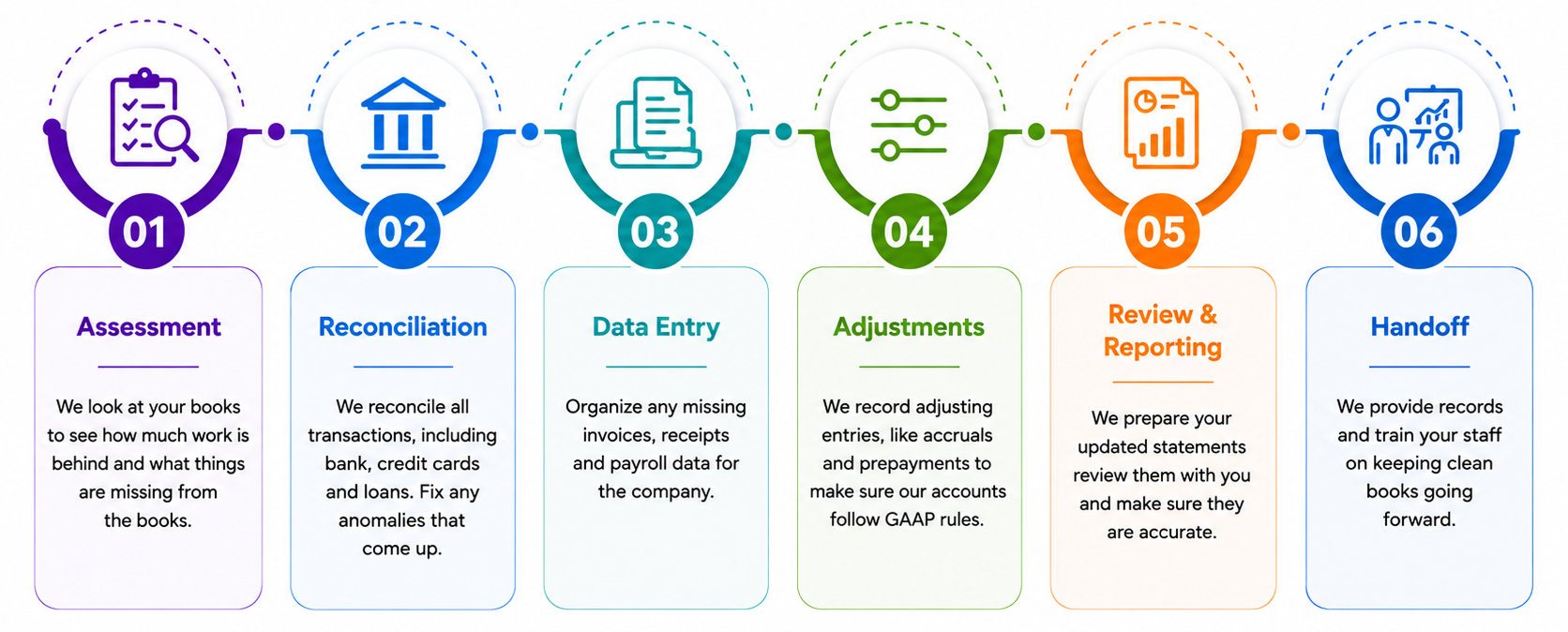
Assessment
We look at what’s there and what’s missing. How many periods are open, which accounts have never been reconciled, how much source data can still be recovered. You get the scope and a fixed price before we touch anything.
Reconciliation
Bank, credit card, loan and merchant accounts reconciled month by month. Duplicates come out, and anything that doesn’t tie gets chased down instead of parked in a suspense account.
Data Entry
Missing invoices, bills, receipts and payroll records are recovered from whoever still holds them, then entered and coded against a chart of accounts built for your business.
Adjustments
Accruals, prepayments, depreciation, loan interest and owner draws all go in, so every period closes on the same basis and the year end numbers hold up.
Review & Reporting
We produce a profit and loss, balance sheet and cash flow statement for each period, walk you through them, and settle anything that looks off before you sign off.
Handoff
You get the closed file, the working papers and a short written routine for keeping it current. Or we pick up the monthly bookkeeping ourselves so it doesn’t slide again.
Case study

Shailesh Patel, Pittsburgh, PA. Two Years of Backlog Cleared
Shailesh Patel runs a dental practice in Pittsburgh that grew faster than its bookkeeping did. More than two years of records sat unorganized, the accounts had never been reconciled, and there was no statement he could hand to anyone who asked for one.
We scoped the backlog first, then worked through it one period at a time. Historical transactions were reviewed, reconciled and organized properly instead of being swept into a single year end entry. Missing records came back from the banks and the payroll provider. Everything was recoded against a chart of accounts built for a dental practice, and each period closed with its documents attached.
With a complete and compliant set of statements in hand, the practice could go to lenders with the history they ask for as standard. It secured the financing it needed and opened a second location.
FAQs
Answer: Catch up bookkeeping deals with volume, meaning periods that were never recorded at all. Bookkeeping clean up, or accounting clean up, deals with accuracy, meaning periods that were recorded but came out wrong: unreconciled accounts, duplicated entries, transactions coded to the wrong place. Most backlogs turn out to be both, which is why we scope them together instead of quoting for one and finding the other halfway through. The same work goes by plenty of names. Bookkeeping cleanup services, catch up bookkeeping services, cleanup bookkeeping, catchup bookkeeping, bookkeeping catch up services. They all describe those two problems.
Answer: Find out how big the problem is before you do anything else. How many periods are open, and can you still pull the bank and card statements for them? That’s the assessment stage, and it’s worth doing even if you then handle the work yourself, because it turns a vague worry into a defined job with an end date. If a filing deadline is close, talk to your preparer about an extension while the catch up runs. Bear in mind that an extension to file is not an extension to pay, so estimate and pay what you can by the original date.
Answer: Yes. A books clean up for tax season is also the cheapest time to do it, because your preparer bills less when the periods arrive reconciled and documented. The real constraint is the calendar. The closer you get to a deadline, the more of the work has to happen at once, and the fewer options you have if something turns out to be missing. If you’re reading this in January about a year that closed in December, start now instead of in March.
Answer: Anyone asking how to catch up on bookkeeping quickly should know that speed comes from scope, not from effort. As a working guide, two to four weeks per year of backlog for a business of ordinary complexity. What moves that number is transaction volume, how many accounts are involved, and how much source data survives. A year with clean bank feeds and a payroll provider still in place goes far faster than a year that has to be rebuilt from paper. You get a timeline alongside the fixed price at assessment.
Answer: We price per engagement, not per hour. An hourly quote on a backlog nobody has measured is guesswork, and it only ever moves in one direction. The things that drive the number are how many periods are open, your monthly transaction volume, how many bank, card and loan accounts are involved, and whether records need recovering. We assess first, then give you one fixed figure. If you want us to keep the books afterwards, that gets quoted separately so you can see what each part costs.
Answer: We take on deadline driven work regularly. A lender waiting on statements, a filing date, a notice that needs answering, a sale or a refinance already in motion. Tell us the date you’re working to on the first call, because it changes the order we do things in. When time is tight we close the periods that deadline actually needs first, then bring the rest current afterwards.
Answer: It means recording a period after the fact, working from source data instead of from things as they happened. Bank and card statements, merchant settlement reports, payroll registers, loan amortization schedules. Done well it gives you the same closed period you’d have had if someone had kept the books at the time. Done badly it gives you one lump sum entry per month, which balances neatly and tells you nothing about your business. We work transaction by transaction.
Answer: Entirely remote, for businesses in any state. Catch up work runs on bank feeds, statement downloads and cloud accounting access, and none of that needs anyone in the room. Searching for backlog bookkeeping near me, overdue bookkeeping near me or catch up bookkeeping services near me is a fair instinct, but being local buys you very little on this kind of job. What matters is whether the team does this specific work often enough to be fast at it.
Answer: Read access to your accounting software, bank and credit card statements for the open periods, payroll reports, loan documents, and whatever invoices and receipts you’ve kept. Anything missing we can usually retrieve ourselves. The one thing worth doing before our first call is listing every account the business actually uses, including the personal card that occasionally gets used for a business purchase. That last one is where most reconciliations stall.
Answer: Most of it comes back. Banks and card issuers hold statement history well past what their apps show you, payroll providers keep their filings, and merchant processors keep settlement reports. Where one specific receipt really can’t be found, we still record the transaction from the bank record and flag it as lacking documentation. You and your preparer then decide how to treat it, which is a much better position than finding the gap in the middle of a filing.
Answer: They help you respond properly. A closed period with its reconciliation and supporting documents attached means you answer a request out of the file, calmly, instead of reconstructing history under pressure. To be clear about scope, we don’t represent you in an examination. That’s work for your CPA or an enrolled agent. What we produce is the record their work depends on.
Answer: Yes. Accruals, prepayments, depreciation schedules, loan interest splits and owner draws all get posted as part of closing each period, so nothing is left for your preparer to guess at later. Where something is really a tax position and not a bookkeeping one, we flag it and agree the treatment with your CPA before posting it.
Answer: Directly, once you introduce us. We agree the treatments they care about before closing, not after, and hand over the file in whatever format they asked for. Most preparers welcome it. A reconciled, documented set of periods takes away the part of their engagement that is least useful to bill for and most likely to hold up a filing.
Answer: Up to date bookkeeping passes three tests, and you can check all three yourself. Every bank, card and loan account reconciles to its closing statement balance for every period. The balance sheet has no suspense balance and no “ask my accountant” line sitting on it. And there’s a complete statement set for each period, not one summary covering the whole backlog. We hand over the working papers so you can look.
Answer: A monthly close with a named owner and a date in the calendar. Catch up is a project, bookkeeping maintenance is a habit, and the handoff stage exists to get one started: a written routine, a close calendar, and connected feeds so nothing depends on someone remembering. If you’d rather not carry that internally, our outsourced accounting service picks it up from the period we close.
Accelerate Your Business Growth
The services businesses usually move on to once their books are current.
Ready to fix your books?
However far behind you are, the first step is always the same. Work out how big the job really is. Book a free consultation and we’ll scope the backlog, tell you what can still be recovered, and give you one fixed price to bring every period current. Nobody here is going to lecture you about it. This is most of what we do.
Schedule a Free Consultation