LLC
A Limited Liability Company or LLC for short is a simple way to set up a business in the United States. It gives you the protection of a company but you still get the tax benefits of a smaller business. The people who own an LLC called members do not have to worry about paying off the companys debts with their money, which is a big plus. When it comes to taxes the profits and losses of the LLC are added to the members personal tax returns. Starting an LLC is not that hard. It does not cost a lot of money so it is a good choice for people who want to start their own business and have some protection for their assets. An LLC is great, for entrepreneurs who want to be taken and have room to grow without all the hassle of a big corporation.
Why Form an LLC?
Forming an LLC gives business owners a strong balance of liability protection, tax flexibility, and professional credibility. An LLC helps separate personal and business finances while providing a simpler structure than corporations. Our team guides you through every step of the LLC formation process, from registration and EIN setup to compliance support and state filing requirements.
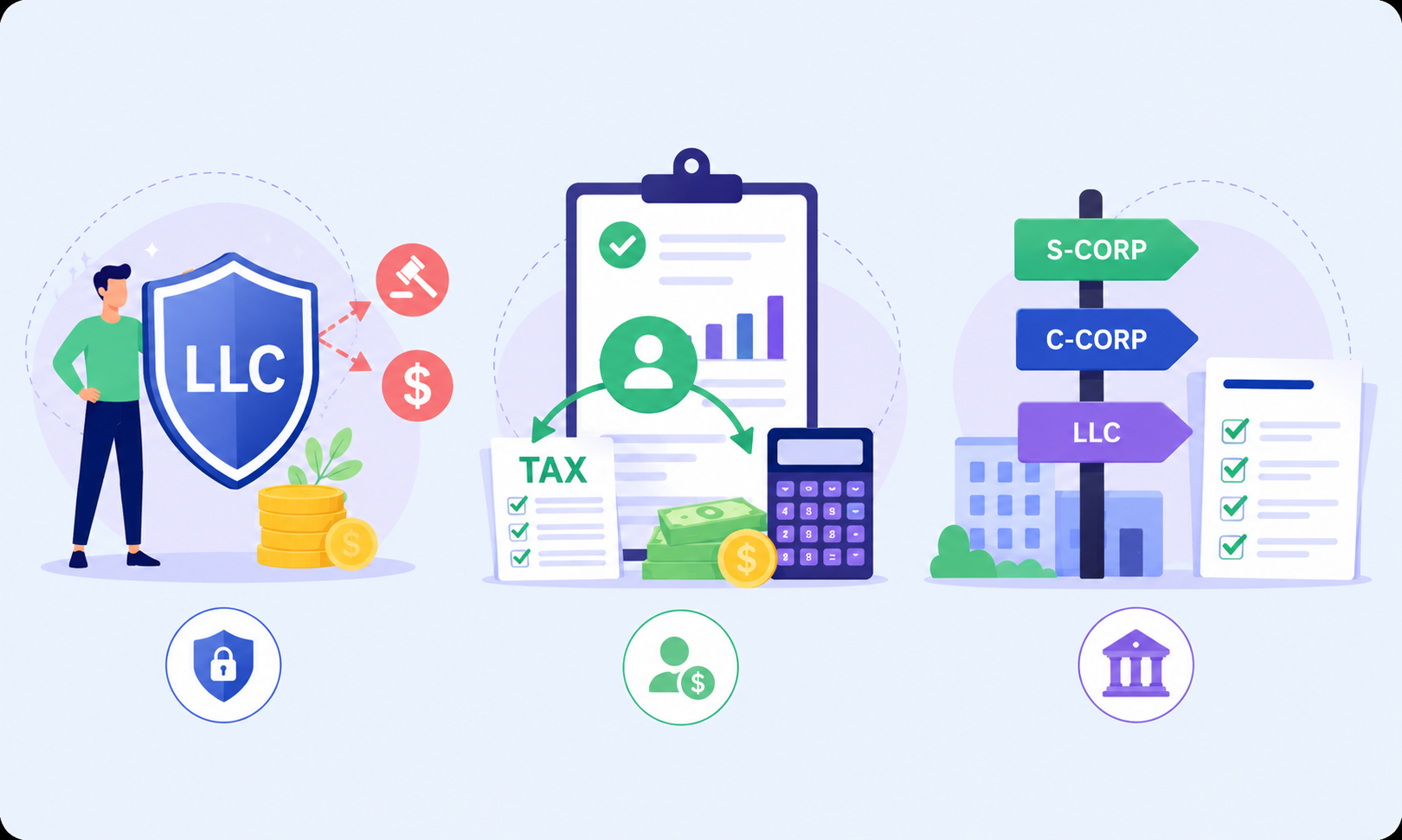
- LLCs protect personal assets from business debts and legal liabilities.
- Profits and losses pass directly to personal tax returns, avoiding double taxation.
- Business owners can choose flexible tax options, including S-Corp or C-Corp taxation.
- LLCs help protect personal assets from business debts and legal liabilities. Profits and losses pass through to personal tax returns to avoid double taxation. Business owners can choose how they are taxed, including S-Corp or C-Corp structures based on their needs.
- Business profits and losses flow directly to personal tax returns to help avoid double taxation.
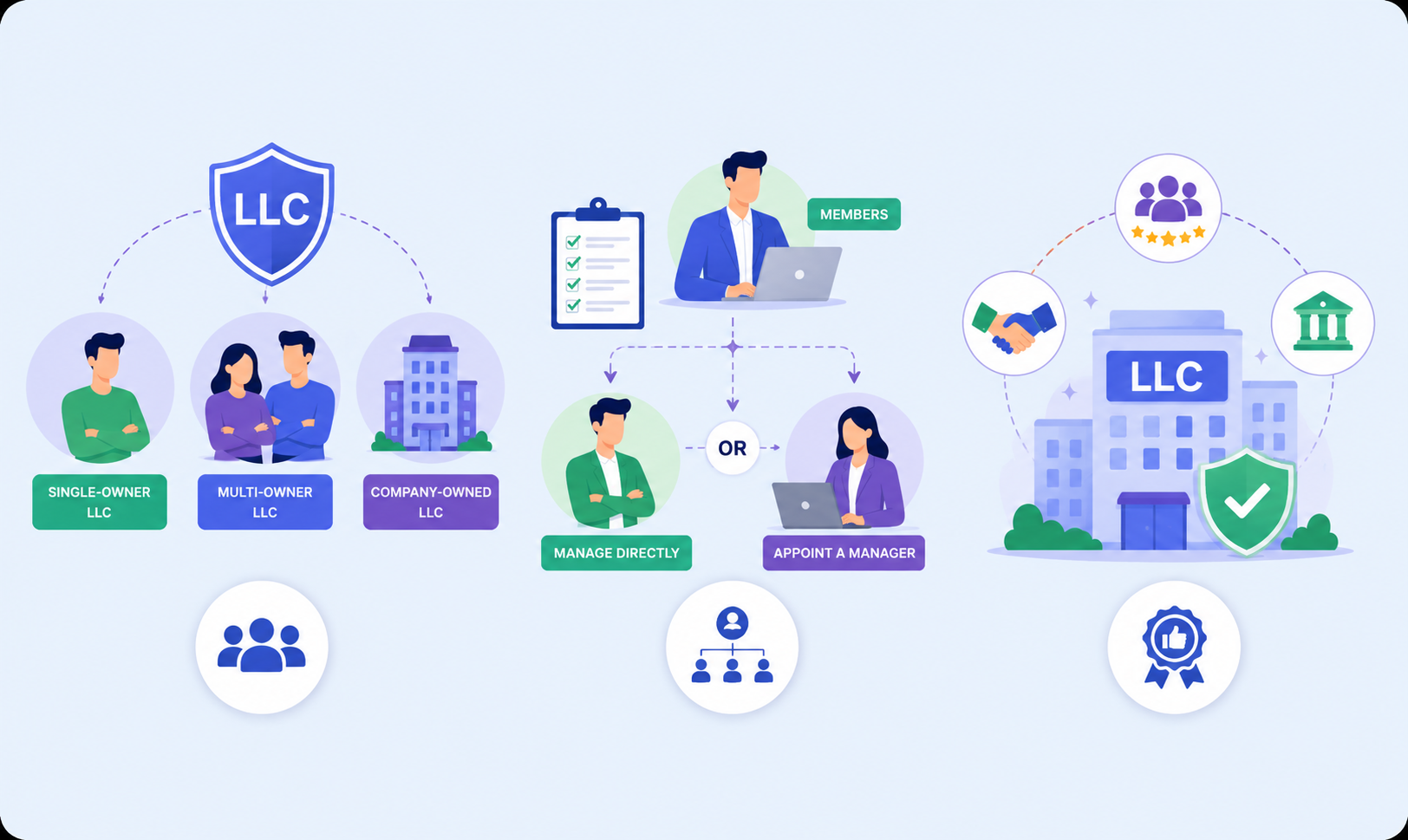
- LLCs allow single-owner, multi-owner, or company-owned business structures.
- Members can manage the business directly or appoint a manager for operations.
- Operating as an LLC improves business credibility with customers, vendors, and lenders.
- LLCs can be structured as single-member, multi-member, or company-owned entities based on business needs.
- Operating as an LLC enhances business credibility and trust with customers, vendors, and financial institutions.
- Members can either manage daily operations themselves or appoint a manager to handle business activities.
LLC Services
Our LLC services are designed to help business owners build and maintain the right business structure with ease. From LLC formation and state filing to EIN registration and tax setup, we handle the essential steps to get your business started properly.
We also provide operating agreements, registered agent services, and compliance support to keep your LLC organized and legally up to date. Our team helps simplify ongoing requirements so you can focus on running your business confidently.
Whether you need S-Corp election guidance, multi-state registration, or converting from a sole proprietorship or partnership, we offer reliable support at every stage. Our goal is to create a smooth and compliant LLC setup that supports long-term business growth.
We provide end-to-end LLC services including formation, EIN registration, tax setup, compliance support, and ongoing business structuring to help ensure smooth operations and long-term growth.

LLC Formation
We take care of the paperwork like Articles of Organization and Operating Agreement so you can start your business correctly.

Registered Agent Services
We are the agent, for your Limited Liability Company, which means we help your Limited Liability Company do what the state says it has to do.

Operating Agreement Setup
We create an Operating Agreement that clearly states ownership shares, voting rights how profits are divided and who handles management duties.

Tax & Compliance Consulting
We help people, with tax elections like choosing S-corp status. We also get them an EIN and guide them through everything they need to do every year like filing papers and getting licenses and permits.

Conversion & Expansion
Already operating as a sole prop or partnership? We can convert to an LLC smoothly. Expanding to new states? We handle foreign LLC registration to protect your brand nationwide.
Benefits
Partnering with our LLC specialists gives you:

Limited Liability
Shields owners’ personal assets from business claims. (Your home, savings, and personal investments are separate from the LLC’s liabilities.)

Tax Savings
Enjoy pass-through taxation – no corporate tax on business profits. Only members pay taxes on their share of LLC income. You also avoid the complexity of C-corp double taxation.

Operational Flexibility
Make sure your Operating Agreement includes a plan, for managing the business and sharing profits so you can easily add owners to your company later on.

Professionalism & Funding
The LLC designation helps to build trust, with banks, investors and customers. You can open business accounts and build a company credit history.

Ease of Maintenance
Fewer formal requirements than corporations. We help you set up your Limited Liability Company correctly from the start so you can focus on running your Limited Liability Company not dealing with paperwork.
LLC Formation Process Timeline
Our LLC formation process is designed to make starting your business simple, organized, and compliant from day one. From business registration and EIN setup to compliance support and ongoing guidance, we help you launch your LLC with confidence and clarity.
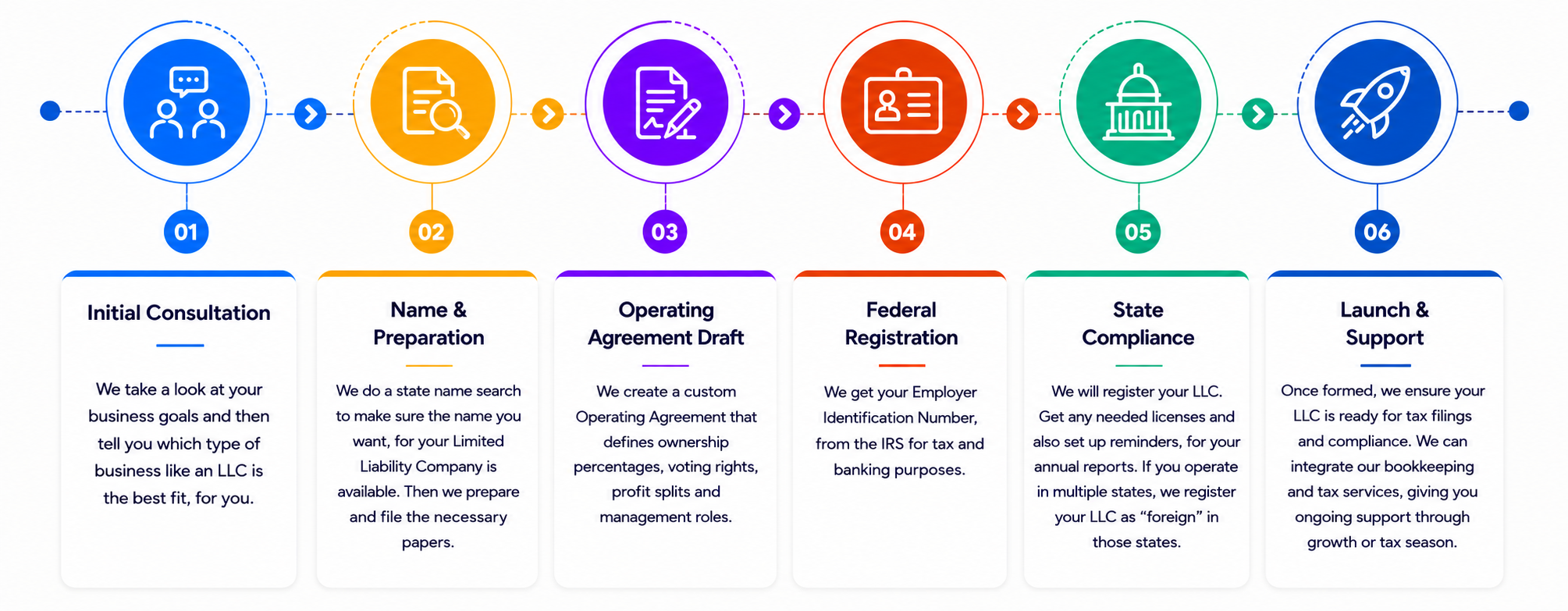
Initial Consultation
We take a look at your business goals and then tell you which type of business like an LLC is the best fit for you.
Name & Preparation
We do a state name search to make sure the name you want for your Limited Liability Company is available. Then we prepare and file the necessary papers.
Operating Agreement Draft
We create a custom Operating Agreement that defines ownership percentages, voting rights, profit splits, and management roles.
Federal Registration
We get your Employer Identification Number from the IRS for tax and banking purposes.
State Compliance
We will register your LLC, get any needed licenses, and also set up reminders for your annual reports. If you operate in multiple states, we register your LLC as “foreign” in those states.
Launch & Support
Once formed, we ensure your LLC is ready for tax filings and compliance. We can integrate our bookkeeping and tax services, giving you ongoing support through growth or tax season.
Case Study

Building the Right Foundation
A group of tech entrepreneurs in Austin was eager to launch their startup but lacked clarity on the most suitable business structure. Crownglobe provided expert guidance throughout the LLC formation process, helping them make informed decisions from the start. Our team handled state registrations, documentation, and regulatory requirements to ensure full compliance. We also advised on key legal and financial considerations critical to long-term success. By streamlining the setup process, we eliminated delays and reduced administrative complexity. The company launched efficiently with a solid legal framework and a strong financial foundation for future growth.
FAQs
The key difference is liability and tax structure. In a sole proprietorship, you and the business are legally the same – meaning you’re personally liable for any debts or lawsuits. By contrast, an LLC (Limited Liability Company) is its own legal entity. Members of an LLC are generally not personally responsible for business liabilities. Both sole props and LLCs report profits on the owners’ personal taxes (pass-through taxation), but the LLC adds liability protection. This means your personal assets (home, savings) are shielded if the business is sued or owes money.
Not by default – both use pass-through taxation. In a sole proprietorship or single-member LLC, business income “passes through” to your personal tax return, so profits are taxed once at your personal rate. An LLC avoids corporate-level tax, just like a sole prop, because the IRS treats single-member LLCs like sole proprietors by default. (Multi-member LLCs file a partnership return and each member pays personal tax on their share.) If advantageous, an LLC can also elect S-corp or C-corp taxation, but that requires specific IRS filings.
Yes. By default, an LLC is taxed as a sole prop/partnership (pass-through). However, an LLC can elect to be treated as an S corporation or C corporation for tax purposes by filing the appropriate IRS forms. As an S-corp, the LLC still avoids double taxation – profits pass through to owners just like a partnership. Electing C-corp status would subject the LLC to corporate tax rules (see next FAQ).
A C corporation pays tax on its profits at the corporate rate, then pays dividends to shareholders, who in turn pay personal tax on that income – a double taxation scenario. An S corporation avoids that: it passes all profits (and many losses) through to shareholders’ personal tax returns, so only personal-level tax is paid. However, S-corps have restrictions (e.g. 100 shareholders max, US citizens only).
Generally no. LLCs have fewer formal requirements than corporations. They are not required to hold annual shareholder meetings or have a board of directors. However, it’s prudent to keep an Operating Agreement and record major decisions. This flexibility is one advantage of LLCs – management and profit distribution can be arranged in whatever way the members agree.
An LLC provides limited liability. Owners (members) are typically not personally on the hook for business debts or lawsuits – only the LLC’s assets are at risk. In contrast, a sole proprietor has unlimited liability, meaning personal assets can be used to satisfy business obligations.
Forming a sole proprietorship is very easy (often just start doing business). Forming an LLC requires formal steps: you must file Articles of Organization with your state, pay a filing fee, and comply with any state-specific rules. It’s more work than a sole prop but typically still straightforward, and we can handle it for you. The cost is usually modest and varies by state.
In a sole prop, the single owner keeps all profits. In an LLC, profits and losses are typically divided among the members according to their ownership shares, as outlined in the Operating Agreement. This provides flexibility – you can split profits equally or in another agreed way among members. Still, all income flows through to members’ personal taxes (unless the LLC elects corporate tax status).
In a sole proprietorship or LLC taxed as a sole prop/partnership, owners pay self-employment tax (Social Security and Medicare) on the business profits. If an LLC elects S-corp status, owner-employees can take some income as salary (subject to payroll taxes) and some as distributions (not subject to self-employment tax), potentially saving taxes. But careful IRS rules govern “reasonable compensation” for that to work.
An LLC can enhance credibility and access to capital compared to a sole prop. Lenders and investors often view an LLC as more formal and credible, especially if backed by a solid Operating Agreement and clear ownership structure. Corporations have the easiest access to raising capital (issuing stock), but for most small businesses an LLC status is sufficient to open business bank accounts and obtain credit under the company’s name.
Yes. You can start as a single-member LLC and later add members or even convert the LLC into a corporation if needed. Changing ownership (adding partners or investors) is generally simpler in an LLC than in a sole prop. Converting an existing sole prop or partnership to an LLC is also a common process that can often be done smoothly by filing the appropriate paperwork.
An LLC continues independently even if members change, similar to a corporation. The Operating Agreement should outline how to handle member departures or transfers. The business itself remains intact; only ownership interests are transferred. This continuity can be more stable than a sole prop, which effectively ends if the owner retires or dies.
Yes. Most states recognize an LLC taxed as an S corp similarly to federal treatment (pass-through), but a few states tax all S corps on their income above certain thresholds. And some states don’t recognize the federal S election at all (so they tax S-corps like C-corps). Always check your state’s rules. On the other hand, a standard LLC (no S-election) pays state income tax only on members’ personal returns.
It depends on your situation. A single-member LLC with no S-election already enjoys pass-through taxation (like an S corp). The difference is S-corps allow splitting income into salary vs distributions, which can reduce self-employment taxes on the distribution portion. However, S-corps have stricter rules (limits on number and type of owners, required payroll, etc.). We can advise on whether the tax savings of an S-election outweigh its complexity for your business.
LLCs have some ongoing requirements, but usually less than corporations. Common obligations include filing an annual (or biennial) report and maintaining a registered agent in the formation state. You should also keep an updated Operating Agreement and basic records. A sole proprietorship has no formal requirements beyond normal tax filings. We make sure you stay on top of any LLC compliance deadlines so you avoid penalties.
Forming an LLC early means you get liability protection and tax flexibility from day one. If you wait, any business debts or lawsuits incurred before formation could put your personal assets at risk. Also, choosing an LLC upfront (instead of later converting) can simplify accounting and make your company more attractive to lenders or partners from the start.
Accelerate Your Business Growth
Discover our core solutions designed to streamline your financial operations and branding.
Ready to give your business the protection and structure it deserves?
Our LLC formation experts are here to help. Whether you’re a new startup or converting an existing business, we make the process seamless. Contact us today to schedule your consultation and take the first step toward incorporating your business for long-term success.
Book a Consultation