Finance Automation Services That Free Your Team and Speed Up Decisions
Less Manual. More Momentum.
Crownglobe helps US SMB finance teams eliminate repetitive work with finance process automation and AI-assisted reporting so you close faster, reduce errors, and gain real-time financial visibility.
Why Finance Automation Matters
Manual finance processes can slow down reporting, increase errors, and reduce the speed of business decision-making. Tasks like reconciliations, invoice approvals, spreadsheet management, and report preparation often consume valuable time and create operational inefficiencies. Crownglobe’s Finance Automation services help businesses streamline workflows, improve reporting accuracy, and automate repetitive financial processes using modern tools and AI-driven systems for faster, more organized financial operations.
- If your finance team is spending hours on reconciliations, assembling reports manually, chasing approvals, or fixing spreadsheet errors, you don’t just lose time you lose decision velocity. Finance functions commonly use automation for repetitive tasks such as checking/paying invoices, performing accounting reconciliations, and generating basic reports.
- Manual reconciliations, reporting, and approval workflows slow down finance teams and reduce decision-making speed by consuming valuable time on repetitive tasks.
- Automation in finance streamlines repetitive tasks like invoicing, reconciliations, and reporting, helping teams reduce errors and improve efficiency.

- Finance automation is when you use automation and AI to make finance processes work faster. This includes making workflows across finance processes more systematic. Examples of finance processes include:
- Record-, to-report
- Procure-to-pay
- Order-to-cash
- These process categories are widely used in enterprise finance automation frameworks.
- Finance automation uses AI and automated workflows to speed up financial processes and standardize key operations like record-to-report, procure-to-pay, and order-to-cash.
Finance Automation Services
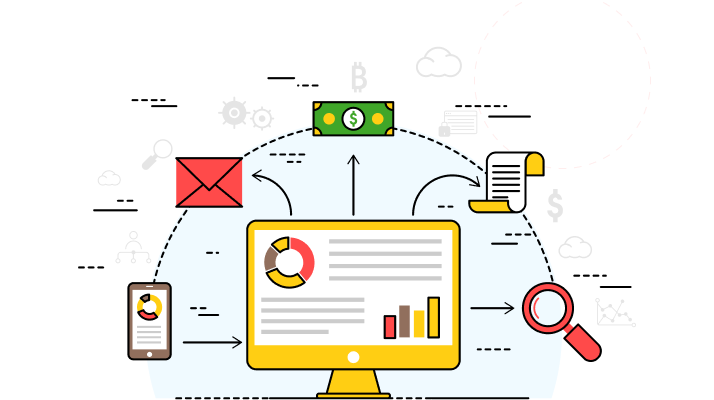
We help businesses automate financial operations with streamlined workflows, smarter reporting systems, and AI-assisted processes that improve accuracy and efficiency. Our solutions reduce manual work, improve visibility, and create scalable finance operations that support faster decision-making.
Our team automates month-end close processes, reconciliations, journal entries, invoicing, collections, and accounts payable workflows with organized approval systems and audit tracking. We also build financial dashboards and reporting systems that provide clearer operational insights.
With AI-assisted variance analysis, trend detection, and scalable finance controls, we help businesses improve efficiency while maintaining accuracy and oversight. Our goal is to create reliable financial automation systems that support long-term operational growth and financial clarity.

Record-to-Report Automation
We want to make month-end close easier.
- Close faster with workflows, for
- Reconciliations
- Journal support
- Close checklists
- Reporting packaging
This way month-end stops being a fire drill.

Procure-to-Pay Automation is really important for Accounts workflows.
This means we have to make sure our approval process and payment scheduling are working well so we can be accurate and keep track of everything.

Order-to-Cash Automation (AR workflows)
When we use Order-to-Cash Automation for our Accounts Receivable workflows we can make our invoicing process go a lot faster. This helps to cut down on the problems that slow us down and make it easier to collect cash. Order-to-Cash Automation also helps us to follow up with people in a way and deal with any problems that come up. This makes our cash collection workflows better and more efficient. Order-to-Cash Automation is really good at helping us with these things.

Approval Workflows and Controls
Replace “email approvals” with role-based approvals, audit trails, and exception handling so finance has fewer bottlenecks and stronger governance.

Financial Reporting and Dashboard Automation
Implement dashboards that refresh predictably and support decisions not just “monthly PDFs.” (Power BI is a common platform for business analytics dashboards and reporting in many organizations.)

AI-Assisted Insight Layer
We use AI to speed up finding reasons for differences point out patterns and give a quick overview of how things are going.
We also make sure a person checks the information and that there are clear rules, in place.
Benefits

Reduced Manual Work
Automate repetitive finance tasks such as reconciliations, approvals, and reporting workflows to reduce manual effort and improve operational efficiency.

Improved Accuracy
Minimize spreadsheet errors and manual data entry with automated workflows that keep financial records more accurate and consistent.

Faster Reporting
Standardized close processes and automated reporting systems help businesses generate financial reports more quickly and reliably.

Better Decision-Making
Access real-time financial data, dashboards, and performance insights instead of relying on outdated spreadsheets and delayed reports.

More Strategic Focus
Automation gives finance teams more time to focus on forecasting, planning, analysis, and long-term business strategy.
Finance Automation Process Timeline
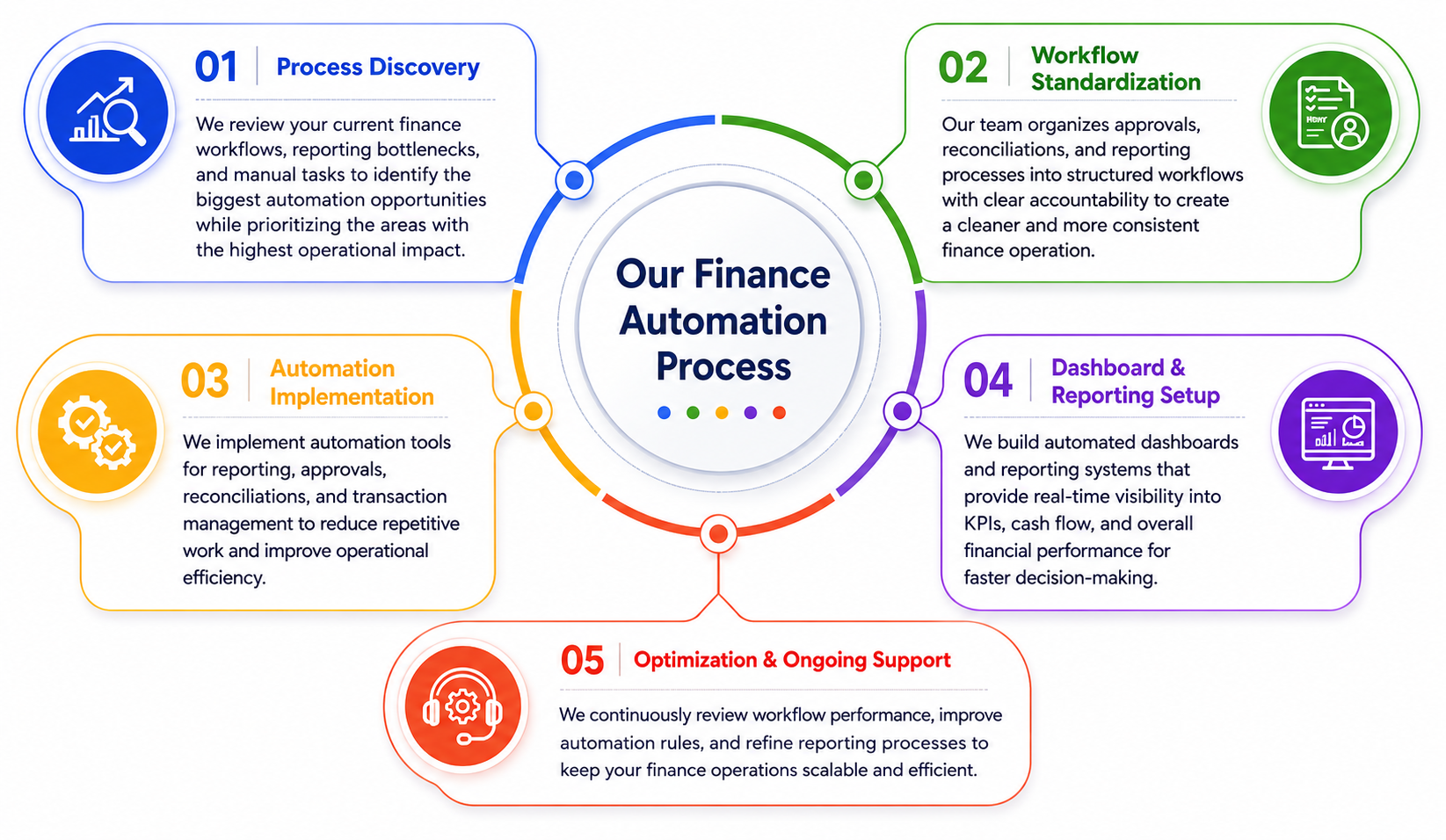
Our finance automation process helps businesses reduce manual work, improve reporting accuracy, and build faster financial workflows. From process analysis to automation setup and ongoing optimization, we create systems that support better financial visibility and scalable operations.
Process Discovery
We review your current finance workflows, reporting bottlenecks, and manual tasks to identify the biggest automation opportunities while prioritizing the areas with the highest operational impact.
Workflow Standardization
Our team organizes approvals, reconciliations, and reporting processes into structured workflows with clear accountability to create a cleaner and more consistent finance operation.
Automation Implementation
We implement automation tools for reporting, approvals, reconciliations, and transaction management to reduce repetitive work and improve operational efficiency.
Dashboard & Reporting Setup
We build automated dashboards and reporting systems that provide real-time visibility into KPIs, cash flow, and overall financial performance for faster decision-making.
Optimization & Ongoing Support
We continuously review workflow performance, improve automation rules, and refine reporting processes to keep your finance operations scalable and efficient.
Case study

Replacing Manual Processes
A fast-growing SaaS company was dedicating significant time and resources to manual financial processes, creating operational inefficiencies as the business scaled. Crownglobe implemented Finance Automation solutions designed to streamline critical accounting workflows. Our team automated invoicing, bank reconciliations, and financial reporting, reducing manual effort and improving accuracy. The integrated systems provided real-time financial visibility and enhanced process consistency across the organization. By eliminating repetitive tasks, the finance team was able to focus on strategic initiatives rather than administrative work. As a result, financial operations became faster, more efficient, and fully scalable to support the company’s continued growth.
FAQs
Finance automation uses technology and AI to reduce repetitive finance tasks like invoice processing, reconciliations, approvals, and reporting. Instead of manually re-keying data or chasing emails, workflows run systematically with built-in controls. This allows finance teams to focus more on forecasting, margin analysis, and strategic decision-making.
Finance Automation Resources
Finance automation is the broad concept of using technology to streamline financial work.
Finance process automation refers specifically to automating structured workflows like procure-to-pay (AP), order-to-cash (AR), and record-to-report (month-end close).
In practice, finance process automation focuses on standardizing and improving specific workflows to reduce manual touchpoints and improve accuracy.
For most SMBs, the fastest ROI typically comes from:
- Accounts Payable (invoice intake and approvals)
- Month-end close checklists and reconciliations
- Recurring reporting packages
- Approval workflows
These areas are repetitive, time-consuming, and often spreadsheet-driven making them strong candidates for automation in finance.
No. Finance automation reduces repetitive administrative work, but human oversight remains critical. Accountants validate exceptions, apply professional judgment, interpret results, and guide strategic decisions. The goal is to elevate finance not replace it.
Virtual CFO Services
A focused automation sprint (like AP approvals or close workflow standardization) can often be delivered in 4–8 weeks.
A broader finance automation operating system covering close, AP/AR, dashboards, and reporting may be phased in over multiple cycles to minimize disruption.
We implement controls-first automation, including:
- Role-based approvals
- Separation of duties
- Full audit trails
- Exception handling
- Human review for high-risk decisions
Automation without governance often fails. Our approach ensures compliance, clarity, and measurable business value.
The biggest risks include:
- Automating broken processes without redesign
- Lack of internal ownership
- Weak governance controls
- Overpromising ROI without measurement
Successful automation in finance requires clear scope, process standardization, performance tracking, and leadership alignment.
We work within common SMB accounting ecosystems and implement dashboard reporting when it adds measurable value. Dashboards centralize KPIs, reduce manual report rebuilding, and provide real-time financial visibility.
Power BI Dashboards Page
We use your actual operating data, including:
- Invoice volume
- Reconciliation hours
- Close cycle duration
- Reporting preparation time
- Approval steps
By quantifying today’s workload, we identify bottlenecks and prioritize finance process automation where ROI is highest.
Yes. Standardized close workflows, reconciliation automation, structured task tracking, and repeatable reporting packages can significantly reduce close cycle time. Many teams see meaningful improvements once manual coordination and spreadsheet tracking are eliminated.
No. While large enterprises pioneered automation in finance, SMBs often benefit even more because their teams are lean and time-constrained. Structured automation creates leverage without requiring large headcount increases.
Agentic automation combines:
- People (finance professionals)
- Agents (AI-assisted systems)
- Robots (workflow automation tools)
The system handles structured tasks and surfaces insights, while humans retain control and decision authority. This model improves speed without sacrificing accountability.
Not necessarily. Finance automation is typically layered onto your existing accounting stack. We improve workflows around your systems rather than forcing a full system replacement reducing disruption and implementation risk.
Dashboards replace static monthly PDFs with dynamic, refreshable metrics. Instead of reviewing outdated spreadsheets, leadership sees current KPIs for revenue, margins, cash flow, and close performance supporting faster, more informed decisions.
Results vary by organization, but common outcomes include:
- Reduced manual touchpoints
- Faster reporting cycles
- Improved approval visibility
- Fewer data-entry errors
- Increased strategic capacity within finance
The key is measurable improvement not hype. We prioritize sustainable automation aligned with governance and ROI.
Accelerate Your Business Growth
Discover our core solutions designed to streamline your financial operations and branding.
Stop rebuilding reports. Start running finance like a system.
Schedule a free consultation to review your top automation opportunities then build a controls-first roadmap for faster close, clearer dashboards, and less manual work.
Book a Consultation