S-Corp
Benefit Driven: Get S-Corp tax structure, payroll and books done so you can save time stay compliant and make better decisions with accurate financials.
Value proposition (one sentence): We help US business owners with S-Corp status by setting up the accounting systems and payroll so the S-Corp status supports the growth of the US business owners instead of causing problems, with the IRS.
Why S-Corp Setup & Compliance Matters
S-Corporations offer valuable pass-through taxation benefits, but incorrect setup and poor financial management can create serious tax and compliance issues. Many businesses struggle with S-Corp elections, payroll requirements, shareholder rules, and inaccurate bookkeeping, which can lead to audit risks and reporting problems. Crownglobe simplifies the entire process by handling S-Corp setup, Form 2553 coordination, payroll structure, and ongoing accounting support to keep your business compliant, organized, and audit-ready year-round.
- S-Corp owners often pick this tax status because they want the benefits of pass-through taxation.. They usually have problems when they do not set it up right and do not run it correctly. The problems that S-Corp owners have are mostly because they are confused about the differences between S-Corp and other types of companies, like C-Corp and LLC and how these differences affect taxes and the way they do business.
- Missing the S‑election or filing incorrectly (Form 2553 requirements and shareholder consent are strict)
- Payroll risk: shareholder‑employees must be paid an appropriate and reasonable salary before distributions - this is a common audit trigger when mishandled
- Books that aren’t timely, leading to late tax prep, inaccurate K‑1s, and weak cash flow visibility
- How Crownglobe solves them Crownglobe combines company-structure support with accounting execution. We: - Confirm eligibility and requirements (domestic corporation, allowable shareholders, ≤100 shareholders, one class of stock, etc.)
- Prepare and coordinate Form 2553 election (and related administrative steps) the right way
- Build a simple system for S‑Corp payroll + accounting that supports clean reporting
- Maintain an audit‑ready trail and consistent reporting cadence year‑round
- Our team creates organized payroll and accounting systems with audit-ready documentation to support accurate financial reporting and year-round compliance.

S-Corp Setup & Support
We help businesses set up and manage S-Corporation structures with proper IRS election filing, payroll setup, bookkeeping, and ongoing compliance support. Our goal is to keep your business financially organized, compliant, and structured for long-term success.
From Form 2553 filing and LLC-to-S-Corp transitions to payroll planning and bookkeeping reconciliation, we handle the key financial processes with accuracy and consistency. We also manage profit tracking, owner distributions, and financial reporting to support smarter tax planning decisions.
Our team provides year-end reporting support, compliance management, and scalable accounting workflows tailored to your business needs. By reducing common S-Corp mistakes and improving financial organization, we help create a reliable system that supports business growth and tax efficiency.
We provide complete S-Corp setup and support services, including IRS election filing, payroll management, bookkeeping, compliance reporting, and structured financial workflows to help businesses stay organized and tax-efficient.

S‑Corp Eligibility & Structure Review
We confirm whether S‑Corp status is a fit and whether you meet IRS requirements (including shareholder limits and stock class rules).

S‑Corp Election (Form 2553) Coordination
The IRS describes Form 2553 as the election under section 1362(a) to be an S corporation.
We prepare the election package, confirm shareholder consent, and coordinate filing.

LLC to S‑Corp Election (Tax Status)
The IRS notes that a corporation or other entity eligible to be treated as a corporation files Form 2553 to elect S‑Corp treatment.
When deciding LLC vs S corp, we help coordinate the election and ensure your accounting system supports the new workflow.

S‑Corp Payroll Setup + Reasonable Salary Support
If a shareholder received or had the right to receive cash or property, the IRS notes the S‑Corp must determine and report an appropriate and reasonable salary for that shareholder.
We help establish the payroll process and documentation so compensation is defensible.

S‑Corp Bookkeeping + Monthly Close
Transaction coding, reconciliations, payroll reconciliation, and consistent monthly reporting so tax and planning decisions are made from accurate data.

S‑Corp Tax Return Support Pack (1120‑S + K‑1 readiness)
When comparing S corp vs LLC, the Internal Revenue Service S corporations page explains the required filings, including Form 1120-S and Schedule K-1. We keep your books ready and deliver schedules your tax professional can trust.
Benefits

Stat / rules box: Eligibility snapshot (IRS)
When comparing S corp vs C corp, to qualify for S-Corp status a business must be a domestic corporation, have only allowable shareholders, no more than 100 shareholders, and only one class of stock.

Stat / compliance box: Reasonable salary requirement (IRS)
IRS guidance notes that when a shareholder receives (or has the right to receive) cash/property, the S‑Corp must determine and report an appropriate and reasonable salary for that shareholder.

Clarity on S‑Corp vs C‑Corp vs LLC
You understand what you’re choosing and why (without guesswork).

Compliance-first setup
Your election and corporate records are built correctly, minimizing risk.
Clean payroll & distribution workflow
Keeps the compensation fair. The reports clear.

Decision-ready financial reports
Monthly reports help us make plans not just fill out tax forms.

Scalable support
Add bookkeeping services, then payroll and finally Chief Financial Officer advisory as your business grows.
S-Corp Process Timeline
Our S-Corp setup and compliance process is designed to help businesses maintain accurate reporting, payroll compliance, and tax efficiency throughout the year. From eligibility review and IRS election filing to payroll setup and financial reporting, we create a structured system that keeps your S-Corp organized and audit-ready.
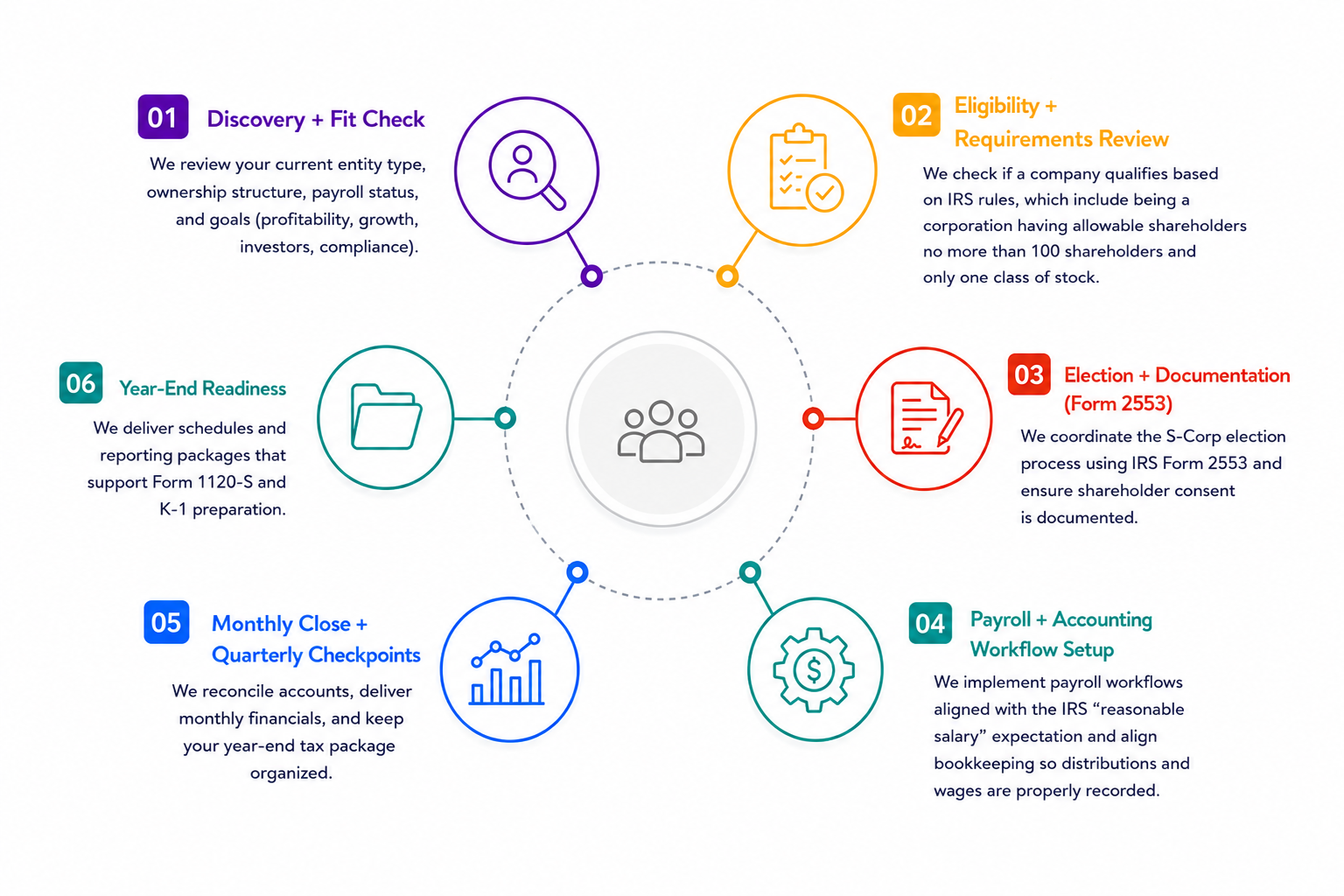
Discovery + Fit Check
We review your current entity type, ownership structure, payroll status, and goals (profitability, growth, investors, compliance).
Eligibility + Requirements Review
We check if a company qualifies based on IRS rules, which include being a corporation having allowable shareholders no more than 100 shareholders and only one class of stock.
Election + Documentation (Form 2553)
We coordinate the S-Corp election process using IRS Form 2553 and ensure shareholder consent is documented.
Payroll + Accounting Workflow Setup
We implement payroll workflows aligned with the IRS “reasonable salary” expectation and align bookkeeping so distributions and wages are properly recorded.
Monthly Close + Quarterly Checkpoints
We reconcile accounts, deliver monthly financials, and keep your year-end tax package organized.
Year-End Readiness
We deliver schedules and reporting packages that support Form 1120-S and K-1 preparation.
Case Study

Maximizing Tax Efficiency
A small business owner in San Antonio was looking for ways to reduce their self-employment tax burden and improve overall tax efficiency. Crownglobe conducted a detailed review of the company’s existing business structure and financial situation. Based on our analysis, we recommended and facilitated the transition to an S-Corporation. Our team managed the formation process, filings, and ongoing compliance requirements to ensure a seamless conversion. We also provided guidance on payroll and tax obligations associated with the new structure. As a result, the business owner achieved meaningful annual tax savings while maintaining full regulatory compliance.
FAQs
An S-Corp is a special tax status for qualified U.S. corporations that lets profits and losses pass through to owners’ personal tax returns, avoiding the “double taxation” that regular C-corps face. In other words, the corporation itself generally pays no federal income tax; instead, shareholders report their share of income on Form 1040.
A C-corp is taxed at the corporate level and again on dividends paid to shareholders, whereas an S-Corp is a pass-through entity for tax purposes. This means an S-Corp’s income is taxed only once on the owners’ personal returns, while a C-corp’s profits can be taxed twice (corporate tax plus personal tax on dividends).
Both an S-Corp and an LLC (with no election) generally pass income through to owners, but LLC members are considered self-employed and must pay self-employment tax on all profits. By contrast, S-Corp shareholders who work as employees pay payroll taxes on their salaries, and only salary (not distributions) is subject to those payroll taxes.
The IRS requires that an S-Corp be a domestic corporation with only allowable shareholders, no more than 100 shareholders, and only one class of stock. Allowable shareholders include U.S. citizens or resident individuals, certain trusts, and estates – no partnerships, corporations, or non-resident aliens are permitted. All shareholders must consent to the S-Corp election.
A corporation (or LLC treated as a corporation) makes the S-Corp election by filing IRS Form 2553. The form must be signed by all shareholders and submitted by the due date (generally within 2½ months after the start of the tax year for which the election is to take effect). Once approved by the IRS, the business will be taxed as an S-Corp as of the effective date on Form 2553.
The IRS requires that any shareholder-employee of an S-Corp be paid a reasonable W-2 salary for services performed before taking owner distributions. This salary is subject to payroll taxes (Social Security, Medicare) like any wage. Paying a reasonable salary is an “audit trigger” – if the IRS finds salary was unreasonably low, it can reclassify excess distributions as wages and impose back taxes and penalties.
The main tax benefit is pass-through treatment: profits, losses, deductions, and credits flow directly to shareholders, so income is taxed only at the personal level. This avoids the double taxation of C-corps. Shareholders can also potentially save on self-employment taxes by structuring income as a reasonable salary plus distributions (which are not subject to self-employment tax).
An S-Corp must file Form 1120-S to report corporate income, deductions, and credits, and it issues a Schedule K-1 (Form 1120-S) to each shareholder for their share of income and deductions. Shareholders then report the amounts from the K-1 on their individual tax returns.
Schedule K-1 (Form 1120-S) is the worksheet that an S-Corp uses to report each shareholder’s share of the corporation’s income, deductions, and credits. Each owner receives a K-1 showing their allocable amounts for the year, which they include on their personal tax return. The K-1 ensures that all income (even if not distributed) is taxed on the owners’ returns.
Yes. A domestic LLC that is treated as a corporation (or elects to be taxed as one) can file Form 2553 to become an S-Corp for tax purposes. The LLC must meet all S-Corp eligibility rules (e.g. shareholder limits, one class of stock, etc.) after the election. This allows an LLC owner to take advantage of S-Corp tax treatment.
Only individuals who are U.S. citizens or residents, certain trusts, and estates may be shareholders. Partnerships, corporations, and non-resident aliens cannot own S-Corp stock. There is a strict limit of 100 shareholders. All shareholders must consent in writing to the S-Corp election.
S-Corp profits are passed through to shareholders and taxed at their individual rates; distributions to owners are generally not taxed again (unless they exceed the owner’s basis). Because the profits are already taxed on the owners’ personal returns, taking a distribution is typically tax-free up to that shareholder’s remaining basis in the company.
If the IRS audits the S-Corp and finds that owner-employees took distributions without a proper salary, it will treat a portion of those distributions as wages. This can trigger back payroll taxes, penalties, and interest. In short, failing to pay a reasonable salary can nullify the intended tax benefits and lead to significant IRS adjustments.
Exceeding the 100-shareholder limit or having a non-permitted shareholder (like a non-resident alien or another corporation) will terminate S-Corp status. The business would then revert to being taxed as a C-Corp (subject to corporate income tax) unless another qualification is met. It’s crucial to monitor ownership and maintain compliance to keep the S-Corp election in effect.
In an S-Corp, only salaries paid to owner-employees are subject to payroll taxes; remaining profits are taken as distributions and are not subject to self-employment tax. By contrast, sole proprietors or LLC members pay self-employment tax on all business profits. Thus, a properly structured S-Corp can reduce overall employment tax liability by splitting profit between salary and tax-free distributions.
Accelerate Your Business Growth
Discover our core solutions designed to streamline your financial operations and branding.
Schedule a Call
If you’re considering an S‑Corp election or already have one and want to make sure it’s compliant. Crownglobe can help you build a clean, repeatable accounting system and payroll workflow aligned with IRS expectations.
Book a Consultation