Master Liquor Store Finances: Streamlined Bookkeeping & Compliance
Crownglobe delivers specialized liquor store bookkeeping that automates sales tracking, maintains vendor and tax compliance, and uncovers profit opportunities.
Schedule a Free ConsultationDaily Sales & Cash Flow
Track daily liquor sales, cash transactions, card payments, and supplier invoices with accurate reporting.
Inventory & Vendor Management
Manage liquor inventory, distributor payments, stock levels, and product costs to avoid shortages and losses.
Payroll & Store Operations
Handle payroll for store staff, shift scheduling, overtime, and employee expense tracking efficiently.
Tax & Regulatory Compliance
Stay compliant with sales tax, liquor regulations, quarterly filings, and year-end bookkeeping requirements.
Liquor Store Accounting Challenges
Liquor stores operate in highly regulated environments where inventory control, tax compliance, and accurate sales tracking are essential for smooth operations. Without organized accounting systems, businesses can face inventory losses, reconciliation issues, and compliance risks across multiple sales channels.
Our accounting solutions help liquor stores manage alcohol taxes, licensing requirements, inventory tracking, POS reconciliations, and high-volume daily transactions with accuracy and consistency. We also support payroll management, cash controls, and separate tracking for online, delivery, and in-store sales.
With organized bookkeeping workflows, accurate reporting systems, and improved profitability tracking, we help liquor businesses reduce errors and operate more efficiently. Our goal is to create reliable financial systems that support compliance, inventory control, and long-term business growth.
Contact Us

Complex Tax & Licensing:
Liquor stores have to deal with a lot of taxes and licenses, like alcohol excise and state laws or they will get in trouble.

Inventory Management:
You need to keep an eye on beer, wine and spirits inventory to avoid losing some of it.

Point-of-Sale Integration:
The beverage sales data needs to match the accounting records.

Labor & POS Turnover:
Many stores use part-time staff and inconsistent records on shift changes and cash handling can hide losses.

Multi-Channel Sales:
Delivery, online orders and, in-store sales make reconciliation complicated. Need different tax treatment.
How Crownglobe Solves Them
Crownglobe’s hospitality accounting expertise tailors solutions for liquor stores:
Automated Sales & Inventory Sync:
We connect your point of sale system like Square or Lightspeed, with QuickBooks or Xero so your sales and returns go into your bookkeeping automatically.
Tax Compliance Management:
With our bookkeeping for liquor store businesses, our team stays on top of excise tax rates and state alcohol laws to help manage liquor taxes and license fees.
Segmented Accounting:
We use ledgers, for alcohol income and retail income to understand the profit margins of alcohol sales and retail sales.
Cash Flow Optimization:
Weekly cash reports are really useful because they show you what is selling well like craft beer in the summer so you can order more of the cash reports and avoid running out of money during slow times.
Services

Inventory & Vendor Management:
We need to create and track purchase orders, for people who sell products like state liquor boards. • Receiving and auditing shipments against invoices. • Automated updating of on-hand inventory in accounts.

Excise & Sales Tax Handling:
Filing of federal and state alcohol taxes. • We handle state liquor tax tracking. This involves noting state- rules. For example some states tax, by the case while others tax by the gallon. • We also do state sales tax filing. This includes filing for -beverage items. Examples are snacks and merchandise.

Payroll & Tip Accounting:
• Staff payroll with multi-state tax setup (if applicable). • Management of tip reporting or commission (where law requires). • The company needs to keep track of what employees spend money on like when they have to travel to the distribution centers.

Financial Reporting & Analysis:
• Custom P&L and balance sheet by location or entity. • I want to see the margin, for each product line. • Monthly cash flow forecasts based on sales trends.
Benefits of Specialized Liquor Store Bookkeeping
Improved Cash Flow
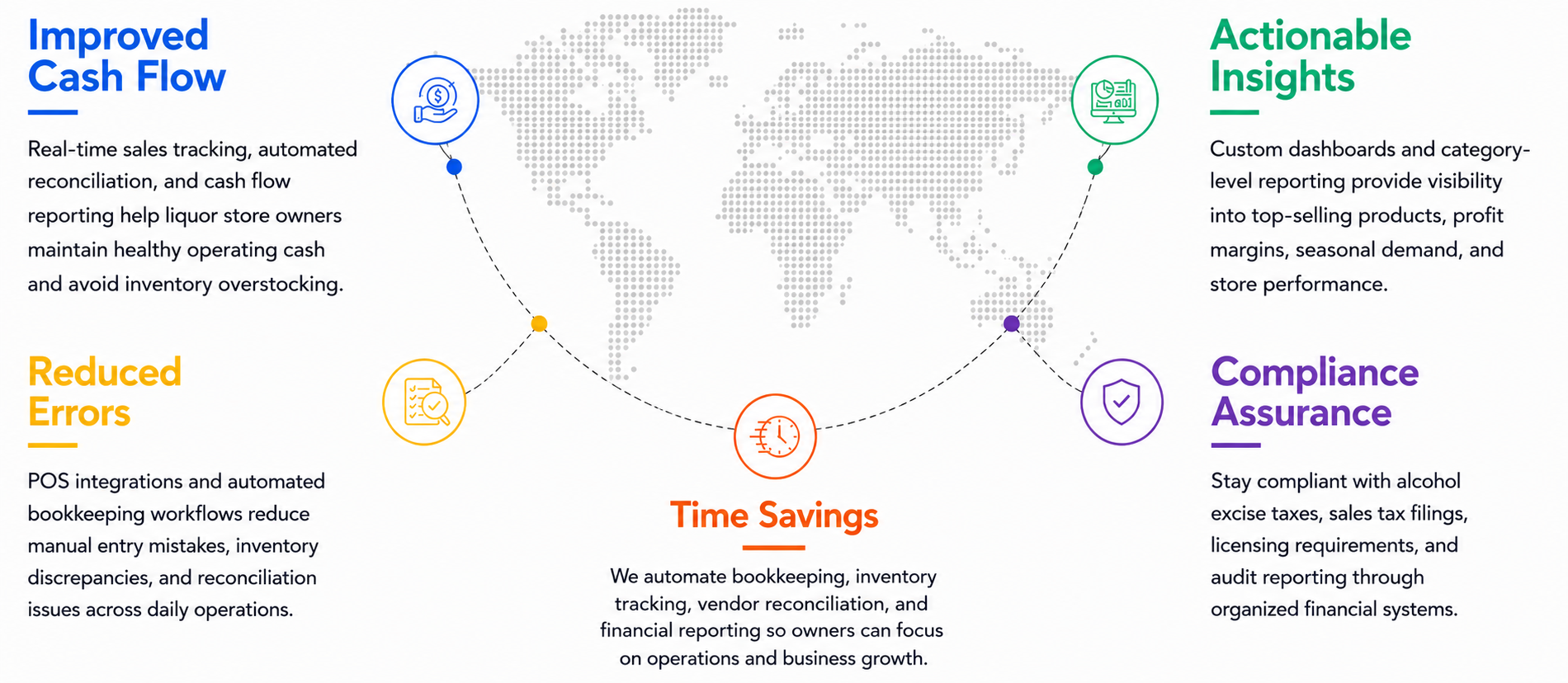
Real-time sales tracking, automated reconciliation, and cash flow reporting help liquor store owners maintain healthy operating cash and avoid inventory overstocking.
Actionable Insights
Custom dashboards and category-level reporting provide visibility into top-selling products, profit margins, seasonal demand, and store performance.
Reduced Errors
POS integrations and automated bookkeeping workflows reduce manual entry mistakes, inventory discrepancies, and reconciliation issues across daily operations.
Compliance Assurance
Stay compliant with alcohol excise taxes, sales tax filings, licensing requirements, and audit reporting through organized financial systems.
Time Savings
We automate bookkeeping, inventory tracking, vendor reconciliation, and financial reporting so owners can focus on operations and business growth.
Virtual CFO & BI Reports
KPI Dashboards:
Real-time dashboards, created with tools, like Power BI or Looker Studio show us sales numbers how often we sell and replace inventory and what percentage of our sales goes to labor costs.
Margin Optimization:
Comparative analysis of tax rates and supplier pricing helps us negotiate better terms.
Growth Planning:
Scenario modeling helps plan for opening locations adjusting business hours or expanding product lines.
Cash Management:
The company will send automated alerts when the business has cash reserves or when tax liabilities are coming up to prevent surprises.
Case Study
Managing Margins More Effectively
The liquor store owner faced difficulties accurately tracking inventory costs, sales performance, and profit margins across a large number of products. Manual bookkeeping processes made it challenging to reconcile inventory with financial records, leading to limited visibility into true profitability. Fluctuating inventory levels, shrinkage concerns, and inconsistent reporting further complicated financial management. Without clear and timely financial insights, the owner struggled to identify cost trends, control expenses, and make informed pricing and purchasing decisions.
Solution:
I was able to reduce shrinkage by 50 percent I also secured a $200k expansion loan with profit and loss statements and I saved $8k, per year on tax penalties by catching all excise filings on time for the tax filings.
Result:
Reduced shrinkage by fifty percent got a two hundred thousand dollar loan for expansion, with profit and loss statements and saved eight thousand dollars a year on tax penalties by filing excise taxes on time.
Technology & Tools

POS Systems:
Lightspeed, Shopify POS, Square, Toast (restaurant offshoot)

Accounting Software:
QuickBooks Online, Xero, Sage Intacct

Inventory Management:
Orca Inventory, BevSpot, ShipBob

BI & Reporting:
Microsoft Power BI, Google Looker Studio, Fathom

Integrations:
Auto syncing via Zapier or native connectors; cloud-based document storage (Dropbox, Google Drive).
Engagement Model
Start with Standard $125/ Per Month For single-location stores with stable volume. Includes monthly reconciliations and basic reporting.
Start with Growth $245/ Per Month Pricing scales with sales volume or number of SKUs – ideal for growing multi-location shops.
Start with Virtual CFO $345/ Per Month Combines bookkeeping + tax prep + CFO advisory (perfect for chains or franchisees).
FAQs
Liquor store bookkeeping is specialized retail accounting for beverage alcohol sales. It tracks every sale of beer, wine, and spirits, along with associated expenses like inventory purchases, rent, and payroll. This ensures accurate profit calculation for each product category (beer, wine, liquor) and maintains compliance with alcohol-specific taxes.
Integrating your Point of Sale system with your accounting software automatically records every sale. This avoids manual entry errors from thousands of daily transactions. With integration, you instantly see sales revenue and inventory changes, so financials are updated in real time.
We set up inventory tracking that reconciles stock on hand with sales. Periodic stock counts are compared to recorded sales to detect shrinkage (theft or loss). Alerts for low stock and detailed COGS reports help maintain accurate inventory levels and minimize losses.
Liquor stores typically pay excise taxes on alcohol (per gallon or liter), plus regular sales tax on retail sales. We calculate and prepare these returns, including any required deposits. By automating tax calculations, you’ll never miss filing deadlines or underpay the state.
We record all payroll information, including hourly wages, overtime, and commission for your employees. Each paycheck is coded by department (e.g., front register vs. stocking) so you know labor costs by area. All payroll taxes and filings (W-2s, 941s, state unemployment) are prepared as required.
You’ll get detailed profit & loss statements and balance sheets. Reports can be broken down by store location and product category (beer, wine, liquor, accessories). We also provide cash flow statements and inventory valuation reports. These help you see which categories are most profitable.
Each location’s books are maintained separately for clear local tracking. We then provide consolidated financial reports that aggregate all stores. This lets you compare performance across locations while still drilling down into any individual store’s accounts.
We analyze sales trends to forecast busy periods (holidays, events). This helps you budget for increased inventory purchases and temporary labor. For example, knowing December boosts sales, we ensure you have cash on hand to stock up and hire seasonal staff.
Virtual CFO Services
By comparing sales data by SKU or category, we highlight slow-moving stock. You’ll see which spirits or wines sell less often. Armed with this information, you can run promotions or adjust orders to improve turnover.
Returns are recorded as negative sales in the accounting system, linked to the original product category. This ensures refunds don’t mix into regular sales totals. Accurate refund tracking helps you see net sales correctly and manage cash flow for returned inventory.
Best practices include segregating duties (e.g. one person handles sales and another handles deposits) and performing daily cash reconciliations. Also, limit access to price changes in the POS and review voids/discounts monthly. These controls reduce theft and errors.
We can integrate with common retail POS systems (such as Square, Lightspeed, or any system that exports sales data). As long as sales and payment data can be exported or connected via API, we’ll automate the flow into your accounting software.
Every purchase of inventory is recorded, and sales are tracked, allowing calculation of Cost of Goods Sold (COGS) per item. By updating inventory levels and costs in real time, the system shows you the gross margin on each bottle sold, making pricing and purchasing decisions data-driven.
Begin by automating your bookkeeping: connect your POS and bank accounts to accounting software. Next, set up product categories and departmental accounts (beer, wine, liquor, etc.). You may also want to consult with a retail accounting specialist to implement best practices.
Schedule a Consultation
A virtual CFO provides strategic insights beyond basic bookkeeping. They can analyze sales trends, optimize pricing, negotiate supplier deals, and forecast cash flow. For example, seeing a low margin in a product line might lead to changing suppliers or adjusting prices. These decisions help grow profits without the cost of a full-time executive.
Virtual CFO Services
Accelerate Your Business Growth
Discover our core solutions designed to streamline your financial operations and branding.
Ready to raise a toast to better finances?
Schedule a Free Consultation to see how Crownglobe’s specialized liquor store bookkeeping can tighten your operations and boost profits.
Schedule a Free Consultation