C-Corp
One-sentence value proposition: Build a C‑Corp structure that’s investor-ready, tax-ready, and reporting-ready – without messy books, missed filings, or compliance surprises.
Why C-Corp Structure & Compliance Matters
C-Corporations provide strong growth potential and investor advantages, but without proper financial systems and compliance processes, they can quickly become difficult to manage. Many businesses struggle with delayed reporting, misunderstanding double taxation, and keeping up with Form 1120 filing requirements. Crownglobe helps businesses build a structured accounting and reporting system that supports accurate financial statements, organized tax workflows, investor readiness, and long-term corporate compliance.
- C-Corps often have problems when they are first formed because the system for handling money and making decisions is not in place, which can cause confusion about the differences between C-Corps and other types of companies, like S-Corps and LLCs.
- Poor reporting discipline - leading to delayed tax filings, weak investor reporting, and year-end chaos.
- Not understanding “double taxation” and dividend treatment - corporate income may be taxed at the entity level, and then dividends can create a second layer of tax at the shareholder level.
- Not knowing what filings are required: most domestic corporations must file a corporate return (Form 1120) whether or not they have taxable income (unless exempt).

- Crownglobe builds the operating system around your needs. C‑Corp: - We are here to help you figure out if a C-Corp is the choice, for you and how it stacks up against an S-Corp or LLC when it comes to taxes and growing your business.
- We set up your accounting and reporting rhythm so you can have correct statements. They are matched, steady and prepared for tax returns and investors.
- We make sure your tax work is done according to the Form 1120 rules and help you keep records of dividends and distributions for your tax workflow.
- We help you evaluate and set up a C-Corp structure, establish accurate accounting and reporting systems, and ensure compliance with Form 1120 requirements while maintaining proper records for taxes, dividends, and distributions.

C‑Corp Services
We help businesses build and maintain investor-ready C-Corporation accounting systems with organized reporting, compliance support, and scalable financial workflows. From accounting setup to monthly bookkeeping and reconciliations, we create a strong financial foundation for long-term growth.
Our team manages month-end close processes, Form 1120 readiness, shareholder distribution tracking, and investor-focused financial reporting with accuracy and consistency. We also support LLC to C-Corp transitions and help organize financial systems for fundraising and compliance needs.
With clean bookkeeping workflows, structured reporting, and scalable accounting support, we help reduce year-end risks and improve financial visibility. Our goal is to create a reliable accounting system that supports business growth, investor confidence, and operational efficiency.

C‑Corp Formation + Accounting Setup Alignment
We work with your attorneys/formation provider (or your internal admin) to ensure that when the C‑Corp is formed, the accounting system and reporting workflow are prepared to support a real business, not just paperwork. (Not legal advice.)

C‑Corp Tax Return Readiness (Form 1120 workflow)
The Internal Revenue Service states that domestic corporations use Form 1120 to report their income and to figure out how income tax they have to pay.

Month-End Close System (Investor-ready reporting habits)
Monthly reconciliation, close checklists, and consistent financial statements that match the reality of the business. (This reduces year-end risk and improves decision speed.)

Dividend + Distribution Tracking Support
The IRS describes dividends as distributions of earnings and profits a corporation may pay to stock owners, typically reported via Form 1099‑DIV when meeting thresholds.We implement bookkeeping categories and documentation habits that correctly distinguish dividends from other transactions (and keep the story clean for tax season).

Entity Classification Guidance for LLCs electing corporate treatment (if applicable)
The IRS explains that if an LLC is treated as a corporation, normal corporate tax rules apply and it should file Form 1120; Form 1120 is the C‑corporation income tax return and does not flow through to Form 1040.

Funding & Securities “Readiness” Check (coordination-ready)
If you plan to raise capital, the SEC states that every offer and sale of securities must be registered under the Securities Act of 1933 or rely on an available exemption (and it provides common exemptions and rules).We don’t provide securities legal advice – but we can ensure your accounting and reporting can withstand investor scrutiny.
Benefits
Corporate tax rate context (USA)
The Tax Policy Center explains that the United States taxes profits of U.S. resident C‑corporations at 21 percent.

Compliance-first setup
We make sure your corporate filing and recordkeeping are always consistent and easy to audit.

Tax-ready data
You maintain clean, consistent records aligned with Form 1120 requirements to ensure accurate reporting of C corp taxes.

Double taxation explained (IRS + Tax Policy Center)
The IRS explains corporate profit is taxed to the corporation when earned and taxed again to shareholders when distributed as dividends – creating a “double tax.”
Cleaner distributions story
Dividends/distributions are tracked with documentation discipline (reducing confusion during tax time).

Funding readiness
If you raise capital then your accounting system helps with investor talks and compliance tasks.
C-Corp Process Timeline
Our C-Corp process is designed to create a strong financial and compliance foundation for growing businesses. From entity planning and accounting setup to monthly reporting and tax readiness, we help maintain accurate records, organized workflows, and investor-ready financial systems.
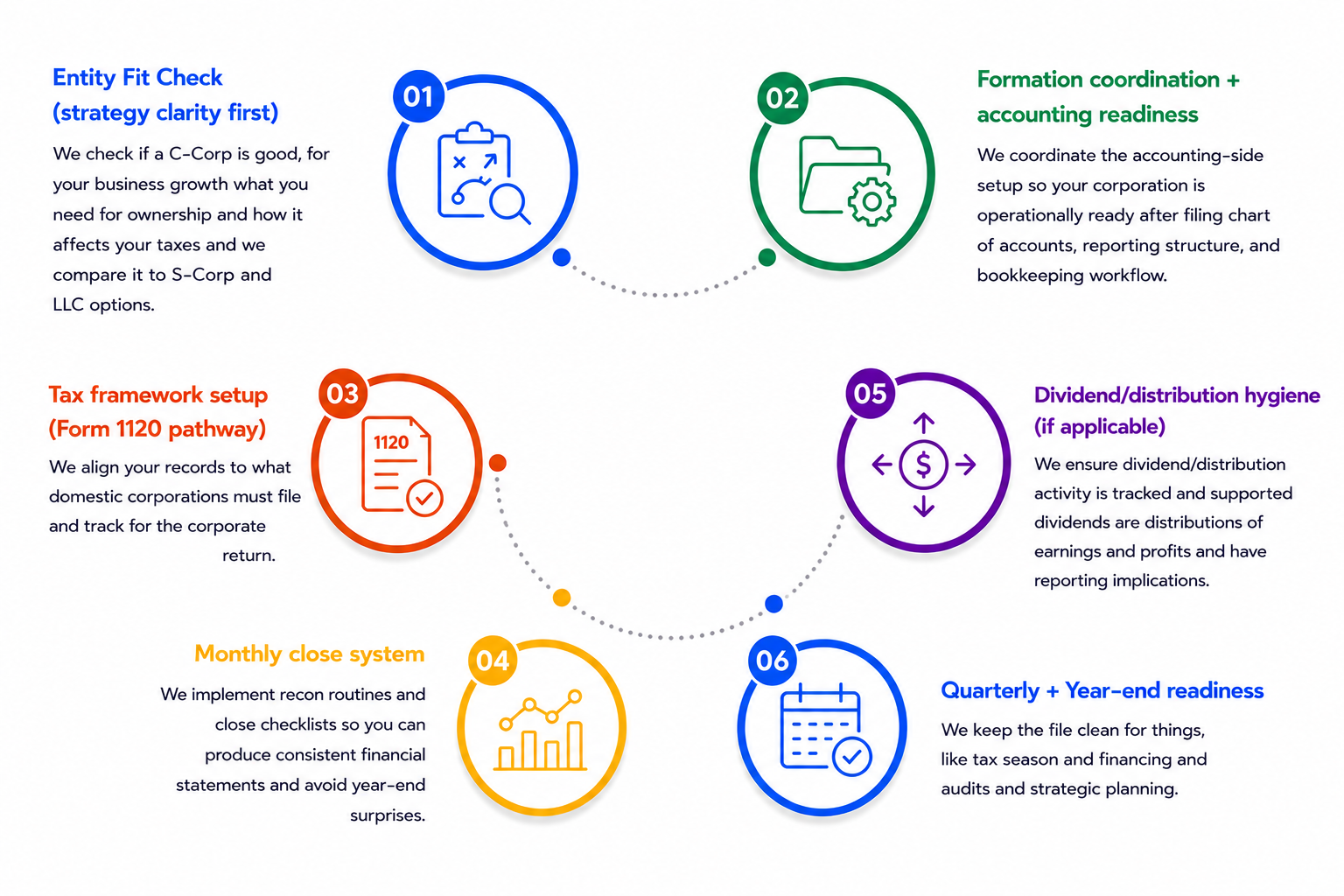
Entity Fit Check
We check if a C-Corp is good, for your business growth what you need for ownership and how it affects your taxes and we compare it to S-Corp and LLC options.
Formation coordination + accounting readiness
We coordinate the accounting-side setup so your corporation is operationally ready after filing chart of accounts, reporting structure, and bookkeeping workflow.
Tax framework setup
We align your records to what domestic corporations must file and track for the corporate return.
Monthly close system
We implement recon routines and close checklists so you can produce consistent financial statements and avoid year-end surprises.
Dividend/distribution hygiene
We ensure dividend/distribution activity is tracked and supported dividends are distributions of earnings and profits and have reporting implications.
Quarterly + Year-end readiness
We keep the file clean for things, like tax season and financing and audits and strategic planning.
Case Study

Preparing for Growth Capital
A growing startup preparing to raise venture capital needed the right corporate structure to attract investors and support future expansion. Crownglobe guided the founders through the C-Corporation formation process, ensuring all legal and regulatory requirements were properly addressed. Our team handled incorporation filings, compliance setup, and corporate governance essentials. We also implemented reliable accounting systems to support accurate financial reporting and investor due diligence. By establishing a strong operational and financial framework, the company gained greater credibility with potential investors. As a result, the startup became investor-ready and well-positioned for sustainable growth and future funding opportunities.
FAQs
A C-Corp is a legal business entity that’s taxed separately from its owners. The corporation itself files its own tax return (Form 1120) and pays corporate income tax on profits. When profits are later distributed as dividends, shareholders pay tax on those dividends again, resulting in the well-known “double taxation” scenario.
Unlike an S-Corp or LLC, a C-Corp is taxed at the corporate level. An S-Corp and most LLCs (by default) use pass-through taxation (profits/losses flow to owner tax returns). A C-Corp can have an unlimited number of shareholders (including other corporations), while an S-Corp is limited to 100 individual shareholders. LLCs offer liability protection like corporations, but C-Corps are often chosen for easier equity financing and investor readiness.
C-Corps are ideal for businesses planning to raise institutional capital, go public, or retain earnings for growth. They are often chosen by startups seeking venture investment because investors are familiar with the C-Corp structure. However, small businesses with only one or few owners frequently choose S-Corp or LLC to avoid double taxation.
A C-Corp pays corporate income tax on its profits (currently 21% federal rate). When dividends are distributed, shareholders pay personal income tax on those dividends (often eligible for favorable “qualified dividend” rates). This means corporate income can be taxed twice. C-Corps also must file Form 1120 annually, even if no profit is distributed.
Double taxation refers to the two levels of tax on C-Corp earnings: first at the corporate level when income is earned, then at the shareholder level when after-tax profits are paid out as dividends. The IRS defines corporate profit as taxed when earned and taxed again on distribution. This contrasts with pass-through entities like S-Corps/LLCs, which avoid taxing the business separately.
Forming a C-Corp involves filing Articles of Incorporation with your state’s Secretary of State and creating corporate bylaws. You must obtain an EIN from the IRS and issue stock to initial shareholders. Crownglobe can handle the filings (with your attorney or directly) and set up your accounting system to align with corporate requirements.
C-Corps must file IRS Form 1120 each year to report income and calculate tax. They also distribute Form 1099-DIV to shareholders for any dividends paid. State filings (annual reports or franchise taxes) vary by state. Importantly, most C-Corps must file 1120 even if they have no taxable income.
Dividends are payments from after-tax corporate earnings to shareholders. They are not deductible by the corporation, and shareholders report them on their personal taxes. The IRS requires issuing Form 1099-DIV for dividend distributions above certain amounts. Proper bookkeeping should clearly separate dividends from other equity transactions.
Yes. An LLC can choose “corporate treatment” by filing IRS Form 8832 and choosing C-Corp status. From that point, the LLC follows corporate tax rules (filing Form 1120, double taxation, etc.). This may be advantageous for retaining earnings or attracting investors.
Like other corporations, a C-Corp provides limited liability protection. Owners (shareholders) are generally not personally responsible for business debts or lawsuits. Their risk is limited to their investment in the company’s stock.
Owners working for the C-Corp are treated as employees. The corporation must withhold and pay payroll taxes on salaries. Reasonable compensation should be paid to owner-employees to comply with IRS rules (especially important compared to S-Corp rules).
A sole proprietorship has no legal separation between owner and business, so the owner is personally liable for debts and must pay self-employment taxes on all net income. In contrast, a C-Corp is a separate legal entity with owner liability protection. Taxed at the corporate level, a C-Corp can offer tax deferral or benefit via retained earnings (at the cost of potential double taxation).
C-Corps have more formalities than LLCs. They must hold annual shareholder meetings, maintain corporate records, and file annual reports and tax returns. U.S. tax law requires a corporate tax return (Form 1120) and potentially state corporate filings. Missing these can lead to penalties or the loss of corporate status.
Yes. A C-Corp can elect S-Corp status by filing IRS Form 2553 if it meets eligibility (<=100 shareholders, all U.S. persons, one class of stock, etc.). This election changes taxation to pass-through, avoiding double taxation going forward. The election must be timely (usually by March 15 of the year to be effective for that year).
In addition to taxes, costs include state incorporation fees, annual report fees, and possibly higher accounting costs due to more complex compliance. Outsourced accounting services can manage these processes more efficiently than an internal team. Crownglobe’s expertise can reduce risks of errors or penalties.
C-Corps are preferred when raising capital (investors often insist), issuing multiple stock classes, or planning to reinvest earnings. They have unlimited shareholders and clear rules. However, for small owner-operated businesses focused on simpler taxation, an LLC or S-Corp might be more efficient. Decisions should consider growth plans, tax strategy, and administrative capacity.
Accelerate Your Business Growth
Discover our core solutions designed to streamline your financial operations and branding.
Schedule a Free Consultation
If you’re choosing between C‑Corp vs S‑Corp vs LLC, the best structure is the one you can run compliantly - with clean books, clear reporting, and a workflow that supports growth. The IRS explains C‑Corps are separate taxpaying entities and generally file Form 1120 and can create “double taxation” when dividends are distributed. Schedule a Free Consultation and we’ll help you build a C‑Corp system that is tax‑ready and stakeholder‑ready.
Book a Consultation