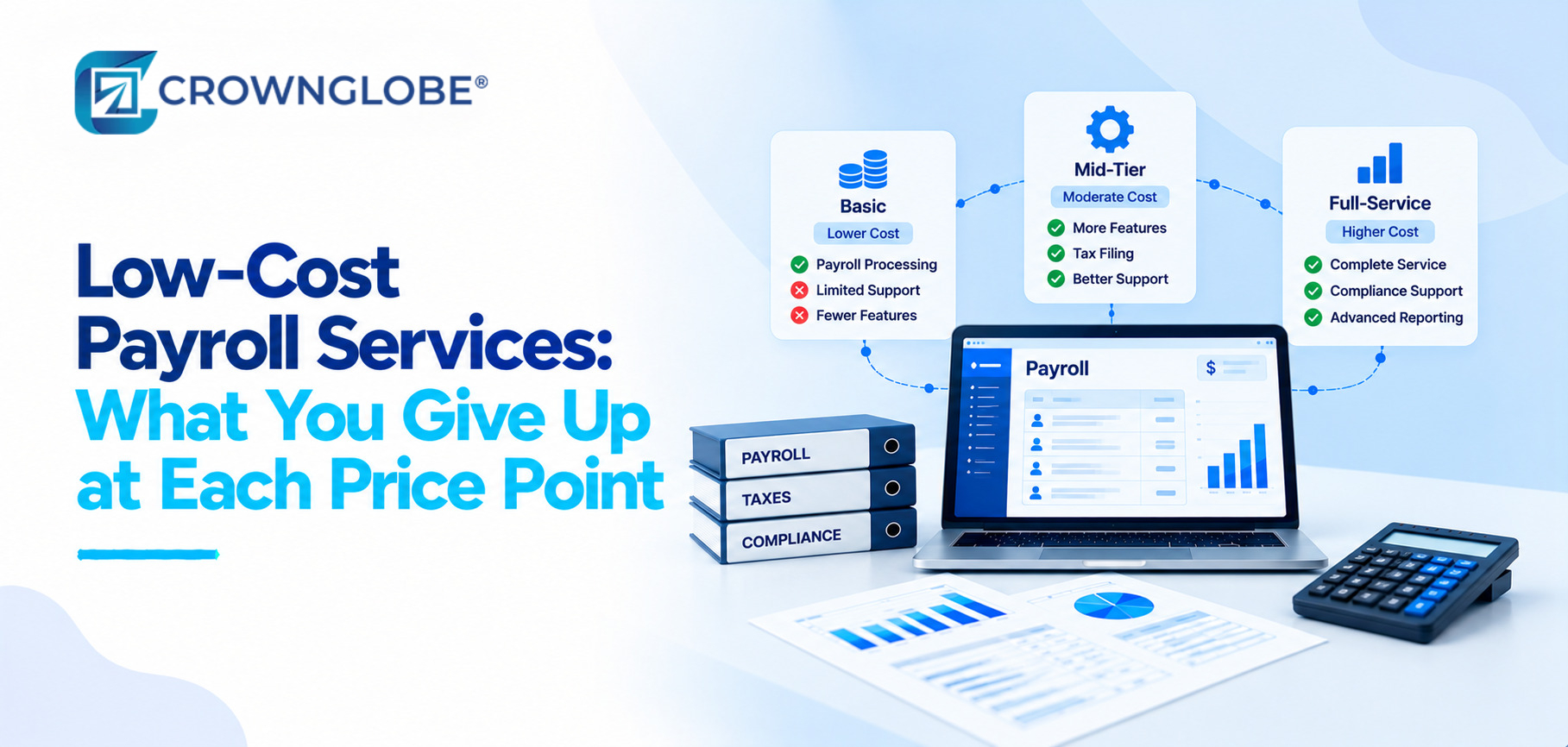
What does that price. Excluded from coverage is tax preparation, multiple state payroll end-of-year filings, payroll processing, timekeeping, set-up and support.
Cheaper plans are not necessarily plans; cheaper plans become less effective when businesses consider providers to own content that cheaper plans really leave to the internal team to manage.
The aim is to look at the payroll process not just the first number, on the pricing page.
What Actually Moves the Price of Payroll Service
The Cost of Payroll Processing of the Company Will Depend on the Level of Work that Needs to Be Done.
Payroll needs also vary by industry and workforce. A company with one location, one state and a simple biweekly payroll may need a different service level, than a business dealing with multiple jurisdictions, hourly workers, contractors, bonuses or frequent payroll changes.
Cost Drivers to Compare
They are just a comparative tool rather than statistical values.
Answer three questions before doing a price comparison: What does the advertised price include? What changes when you add workers or states? What payroll work does your team still have to complete?
Three Ways Payroll Companies Price the Work
Not all payroll firms provide equal services and therefore it is imperative to know the cost structure before a quote can be given.
Base Fee Plus a Worker Charge
A popular billing structure is the use of a monthly fee along with an extra fee per employee or worker that is paid.
Patriot, Gusto, OnPay and Square each produce a version of this model; the main difference is how each defines the worker charge and which duties are covered in the base plan.
Tiered Capability Pricing
Some providers place more advanced capabilities in progressively higher plans.
Gusto’s basic plan focuses on payroll while the higher plans add tools such, as multistate payroll, time tracking, scheduling, support and HR tools.
The real question isn't about more features, in the higher tier but whether one single feature your business truly needs makes that tier the right choice.
Customized or Quote-Based Pricing
Other payroll providers set fees based on how the company operates.
ADP lists ADP pricing factors such, as worker count, payroll frequency, payment method, support and extra services.
Ask for the included scope. Cost drivers, in writing with a customized quote. That gives you a way to compare the proposal with payroll companies that publish standard plans.
What a Lower Price May Leave With You
One of the easiest mistakes in payroll comparison is assuming that a lower-priced plan and a higher-priced plan transfer the same responsibilities.
They often do not.
Depending on provider and tier priced option may leave some items, outside base package.
- payroll-tax deposits and filings;
- additional state or local coverage;
- year-end W-2 or 1099 processing;
- time tracking or scheduling;
- HR tools;
- state tax registration help;
- setup or migration work;
- accounting integrations;
- higher-touch support;
- selected faster-payment options.
The word may matters.
Patriot's current Basic Payroll plan, for example, leaves federal, state, and local payroll-tax filing to the customer, while its Full Service plan adds that work. OnPay, by contrast, currently includes relatively broad federal, state, and local tax filing within its base payroll product.
That contrast is exactly why low cost payroll services should not be judged from price alone.
If you want a broader view of provider involvement, our guide to what managed payroll services can include explains the wider outsourcing model.
The Total-Cost Worksheet Most Buyers Skip
A headline price is what the provider wants to be seen. It does not always show what the complete payroll workflow will cost.
A more useful comparison separates provider charges from the work that still remains inside the business.
Provider-Side Cost
- monthly base fee;
- per-worker charges;
- required state or local fees;
- year-end forms;
- special or off-cycle runs where charged;
- tax-registration support;
- time or scheduling tools;
- HR or compliance add-ons;
- setup or migration;
- required integrations;
- upgraded support.
Work Your Team Still Owns
- payroll inputs and changes;
- exception review;
- payroll approval;
- tax work not included in the service;
- reconciliations;
- corrections;
- tax notices;
- provider follow-up;
- recurring payroll administration.
That distinction matters because provider pricing is not the same thing as the company's total payroll burden.
For context on the underlying obligations behind the service fee, see our guide to payroll expenses and payroll taxes.
A Simple Comparison Method
Use this formula for the provider side:
Monthly payroll-service cost = base fee + worker fees + required state/local charges + required add-ons + allocated annual fees
Keep internal work on a separate line.
Never put a dollar figure on employee time unless your company has an internal estimate of labor costs, for employee time.
Current Published Examples
The following are dated provider examples reviewed in October 2026. They are not a market average, Crownglobe pricing, or a recommendation.
| Provider / plan | Published pricing structure | Scope signal |
|---|---|---|
| Patriot Basic Payroll | $17/month + $4 per worker paid | Customer handles payroll-tax filings/deposits |
| Patriot Full Service Payroll | $37/month + $5 per worker paid | Adds federal, state, and local tax filing |
| Square Full-Service Payroll | $35/month + $6 per person paid | Full-service payroll positioning |
| Gusto Simple | $49/month + $6 per person | Positioned for more basic, one-state payroll needs |
| Gusto Plus | $80/month + $12 per person | Adds broader multi-state and time/scheduling capabilities |
| OnPay Payroll Essentials | $49/month + $6 per worker | Broad tax-filing and multi-state scope in base payroll |
Prices and features can change. Promotions may also temporarily reduce the amount displayed on a provider's pricing page.
Make Two Payroll Quotes Comparable
Once you have the quotes put the quotes into the format. Please give the quotes in one line.
Two plans can both use the phrase "service" but still have different actual scopes and a normalization sheet helps make those differences clearer.
| Line to normalize | What to confirm |
|---|---|
| Base fee | Monthly, annual, or per-payroll |
| Worker charge | Employee, contractor, active worker, or worker paid |
| Payroll runs | Unlimited or separately charged |
| Tax calculation | Included or excluded |
| Tax deposits and filings | Federal, state, and local scope |
| State coverage | First state and additional states |
| Local payroll taxes | Included or extra |
| Year-end forms | W-2 / 1099 included or extra |
| New-hire reporting | Included or extra |
| Setup and migration | Included or separate |
| Time tracking | Included, add-on, or higher tier |
| HR tools | Included, add-on, or higher tier |
| Accounting integration | Included and supported systems |
| Support | Chat, phone, advisor, service hours |
| Promotion | Temporary price versus standard price |
| Contract | Monthly, annual, or other commitment |
This is where the cost of payroll services for small business becomes easier to compare. Instead of comparing marketing labels, you are comparing the same responsibilities across providers.
Price Signals Worth Slowing Down For
A low price, a price is sensible when it meets the real needs of your business.
The warning sign is not the number. It is unclear responsibility.
Slow down when:
- a promotional rate is more visible than the regular price;
- “full service” is used without defining tax-filing scope;
- multi-state or local-tax costs are unclear;
- year-end form charges are not easy to find;
- a required feature is available only through an add-on or higher tier;
- setup and migration responsibility is vague;
- the definition of a billable worker is unclear;
- responsibility for corrections or payroll-tax notices is not explained;
- the quote is not tied to a written scope.
There is nothing coming down from the above that makes them an impossible choice. It only provides information on the terminologies involved.
The cheapest payroll plan is not necessarily the wrong plan. It becomes the wrong plan when the buyer believes the provider owns work that the agreement actually leaves with the business.
Questions About Payroll Pricing
There is no single price that represents the entire market.
Providers may use a base fee plus worker charges, tiered plans, customized quotes, or combinations of those approaches. The total depends on factors such as headcount, states, tax-filing scope, year-end forms, payroll runs, integrations, and support.
Most payroll plans are designed to handle core payroll processing, but included scope varies materially by provider.
Tax filings, multi-state payroll, year-end forms, time tracking, HR tools, setup, integrations, and support may be included in the base price, sold separately, or placed in a higher tier.
Some do, while others include those services in the standard plan.
For example, some providers separate basic payroll processing from tax filing, while others bundle federal, state, local, and year-end filing into the base payroll service. Check the exact plan rather than assuming the label tells you the answer.
Multi-state payroll can increase complexity because the provider may need to support additional registrations, filings, state rules, and local requirements.
Some providers charge for additional states, some include multi-state payroll in certain tiers, and others include broader state coverage in the base plan.
Put both quotes into the same scope table.
Compare the base fee, worker definition, payroll runs, tax filings, state and local coverage, year-end forms, implementation, integrations, HR/time tools, support, promotions, and contract terms.
Generally, no.
The IRS states that employers generally remain responsible for federal employment-tax obligations when they use an ordinary third-party payroll provider, although certain formal arrangements can change specific responsibilities. Businesses should understand both the provider's service scope and their own obligations.
Sources & Further Reading
- ADP How Much Does It Cost to Run Payroll?
- ADP Understanding Small Business Payroll and HR Platform Pricing Transparency
- Patriot Software Pricing
- Gusto Pricing
- OnPay Payroll Pricing
- Square Payroll
- Internal Revenue Service Outsourcing Payroll Duties
- Internal Revenue Service Publication 15, Employer's Tax Guide (2026)
- U.S. Department of Labor Fact Sheet #21: Recordkeeping Requirements under the FLSA
Crownglobe provides payroll-processing services, so this article is not disinterested.
Apply the same pricing, scope, responsibility, and diligence questions to Crownglobe and any other payroll provider you are considering.
General-information disclaimer: This article is for general informational purposes only. It is not individualized legal, tax, payroll, accounting, employment, or financial advice.
Payroll requirements vary by workforce, jurisdiction, provider arrangement, and company facts. Consult appropriate qualified advisers for obligations specific to your business.
Want a Payroll Quote You Can Actually Compare?
The best payroll quote is not necessarily the one with the lowest starting price.
It is the one that clearly shows the work being transferred, the costs attached to that scope, and the responsibilities that remain with your business.
If you want to compare payroll options using that framework, Crownglobe can help define the required scope before you evaluate the final price.