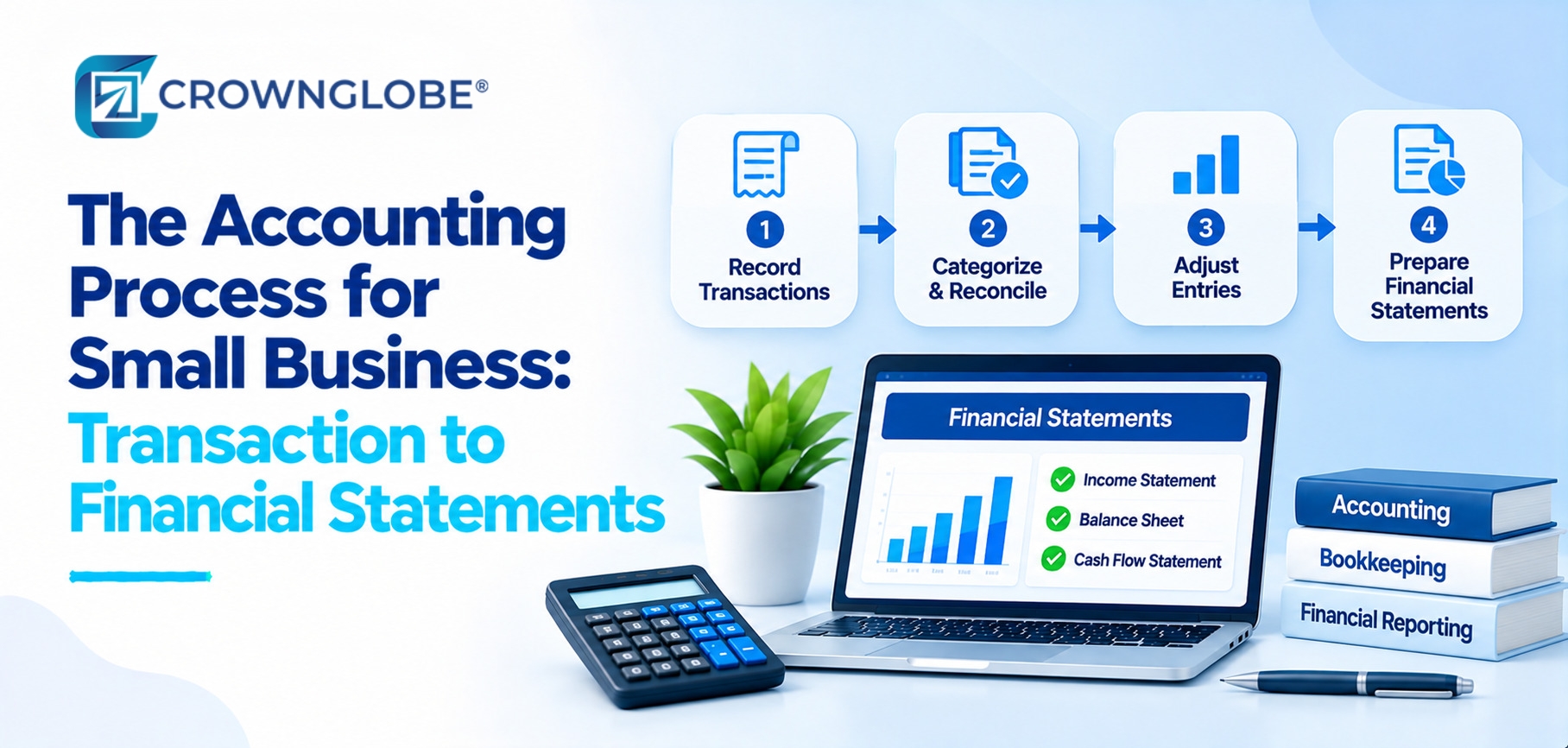
This process transforms business events into accounting information by passing through the process of accounting transaction evidence journalizing, posting to the ledger, reconciliation, trial balance, adjusting, preparing the financial statements and closing, where the critical aspect is knowing what needs to be done and confirmed at each step of the process.
Prerequisites
- You need first
- Source documents and complete transaction records
- Also required
- A chart of accounts and an accounting system appropriate to the business
- Before period close
- A clear accounting basis, review responsibility, and defined period
The supporting details may differ by industry. The core accounting process remains the same reliable records depend on evidence, consistent classification, reconciliation, review and a clean handoff, into reporting. See CrownGlobe's overview of industry-specific accounting needs for broader context.
Businesses comparing full-cycle accounting and taxation services for financial services companies can apply the same core process to evidence, classification, reconciliation, review and controlled reporting.
Cash basis businesses and accrual basis businesses can note activity at times and IRS Publication 538 says that accounting methods decide when income and expenses are counted so the process below should be applied within the accounting method suitable, to the business.
Six Accounting Process Steps, From Transaction to Financial Statements
The accounting cycle could be explained as consisting of six steps for a small business owner: recording transactions organizing and reconciling accounts, testing balances making any necessary adjustments, reporting and closing.
Capture and Analyze the Transaction
Every accounting entry should start with a business event. Have proof, like an invoice, receipt, bank statement, payroll report, contract or loan document to clearly show the amount, when it happened and why it was done.
The first decision isn’t just choosing a software category it’s figuring out the transaction’s business purpose, accounting period, amount and affected accounts which a bank-feed description alone often doesn’t provide context to determine.
If source documents are missing or older balances cannot be supported, routine processing may need to pause for bookkeeping cleanup before the current-period workflow can be relied on.
Record the Journal Entry
Once the transaction is checked it is written in the journal and in double-entry accounting every entry changes at two accounts so that the total of the debits is the same, as the total of the credits.
The accounting transactions examples below are illustrative not universal; exact account treatment can vary based on facts the accounting method, company policy and other applicable requirements.
| Business event | Illustrative accounts affected | Where it enters the process | What to verify |
|---|---|---|---|
| Customer invoice | Accounts receivable and revenue | Journal entry | Customer, amount, date, revenue period, supporting invoice |
| Customer payment | Cash and accounts receivable | Journal entry | Payment matches the correct customer balance |
| Supplier bill | Expense or asset and accounts payable | Journal entry | Vendor, business purpose, period, and classification |
| Equipment purchase | Equipment and cash or accounts payable | Journal entry | Asset description, cost, payment terms, and support |
| Loan proceeds | Cash and loan payable | Journal entry | Lender documentation and principal amount |
Post to the General Ledger and Reconcile the Underlying Accounts
Journal entries are more helpful when grouped by account in the ledger and can include details such, as customers, vendors, payroll or other subledger information.
Reconciliation, Reconciliation is the process of checking balances against records, such as matching bank and card accounts to statements or linking receivables, payables and other control accounts, to supporting schedules.
Automation can reduce tasks. Automation still needs people to deal with exceptions and comprehend the input to the process. See what to automate in bookkeeping and reporting when deciding which recurring tasks can be systematized without weakening review controls.
Prepare the Unadjusted Trial Balance and Investigate Exceptions
Trial Balance is an unadjusted trial balance that contains all ledger balances before making any period end adjustments. Proves that debits and credits are equal in amount. Gives the preparer an organized overview of the accounts before the next stage.
A trial balance that is in balance does not guarantee accuracy since mistakes like omission, duplication, misclassification or improper periods may arise even if there is equality between the debits and the credits.
During this stage, we will look into all our balances, suspense accounts, or other accounts which do not have any classification. In order to solve their problems, we post our adjusting entries.
Record Adjustments and Prepare the Adjusted Trial Balance
Period end adjustments align the ledger to the condition required for the business’s reporting under its accounting method and policies; depending on the facts these period end adjustments may cover accruals, deferrals, prepayments, depreciation, estimates, corrections or other period end items.
Support is the control; every material adjustment must have a clear reason, evidence or calculation the correct period and a reviewer who understands why the entry was made and adjustments should not become unexplained plugs used only to make an account match an expected number.
Once the adjustments are approved they are. The new trial balance is used to create the financial statements, for the period.
Prepare Financial Statements, Complete the Close, and Start the Next Period Cleanly
This is because during the reporting phase, the account balances are converted into statements, with the income statement indicating the performance within a period; the balance sheet representing assets, liabilities and owner’s equity at a point in time; while cash flow reporting indicates cash inflow and outflows.
The correct sequence, for the closing accounting process is to complete adjustments prepare the adjusted trial balance produce the statements, complete applicable formal closing entries and perform post-close checks, where temporary revenue and expense accounts are reset while permanent balance-sheet accounts continue.
Owners asking what is the correct sequence for the closing accounting process should treat it as a controlled progression from approved adjustments and an adjusted trial balance through statements, formal closing entries and post-close checks.
Formal closing entries are part of the month end process that includes reconciling accounts checking variances fixing open items producing management reports noting corrections and locking the period, in the software.
Where the Accounting Process Breaks Down
An accounting process can seem complete. Still produce unreliable results especially when issues, like missing evidence inconsistent treatment, unresolved balances or late reviews occur at handoffs.
Missing source documents
The transaction is recorded before anyone can explain or support the transaction.
Inconsistent classification
Similar transactions are treated differently without any explanation provided.
Unreconciled accounts
Ledger balances may be different, from what's shown on statements or supporting schedules.
Suspense or uncategorized items
Exceptions pile up Exceptions are assigned Exceptions are fixed.
Unsupported adjustments
Period end entries are posted without a basis making the reason, for Period-end entries unclear.
Reporting before the ledger is ready
Financial statements are produced before exceptions and adjustments are complete.
What the Owner Should Receive at the End of the Accounting Process
The end product should do more than confirm that transactions were entered; the end product should give the owner a view of performance, financial position, cash movement and the exceptions that still need attention.
Profit and Loss / Income Statement
Revenue and expenses, during the reporting period are displayed, helping the owner see how the business is doing and what the main changes are.
Balance Sheet
A balance sheet shows assets, liabilities and equity at a point, in time and becomes more useful when balances are reconciled and supported instead of being carried forward.
Cash-Flow Information
This shows how money moved in and, out of the business through operating, investing and financing activities when a cash-flow statement is created or when the business uses cash reporting.
Reconciliation and Open-Item Context
Explain any material items, unusual balances or follow-up actions that an owner must know before relying on the reporting package, for decisions.
A balanced trial balance or completion of the checklist or successful synchronization of the data through the software is the control point but it does not provide proof that all the transactions have been concluded or accurately recorded.
Accounting Process FAQs
Accounting process refers to a number of processes involved in recording transactions, entering the transactions in the ledger, balancing accounts, adjusting accounts, preparing statements, and completing the closing process, among others, to ensure that the accounting process remains accurate.
The steps in a sequence for small business accounting are capturing and analyzing transactions, preparing journal entries, posting and balancing the ledgers, preparing and checking the trial balance, making needed adjustments and ending with the preparation of financial statements.
First do the period end adjustments and then prepare the adjusted trial balance, prepare the statements, do the formal closing entries, and conduct post close testing; the wider month end close process may also involve other activities such as reconciliation, review by the management, reporting, exceptions handling, and period control.
Common examples include customer invoices, customer payments, supplier bills, payroll activity, equipment purchases, loan proceeds and business expenses with the journal entry depending on the transaction type, accounting method and accounts used by the business.
The transaction is analyzed, documented in journal form, entered into the ledger by way of reconciliation, adjusted where necessary in the trial balance, and then included in the account balances.
The Accounting Cycle deals with the processes, from recording the transactions up to the closing stage whereas the Accounting Process refers to the system, control and reports surrounding it.
Sources & Further Reading
- Internal Revenue Service, Publication 583, Starting a Business and Keeping Records
- Internal Revenue Service, Publication 538, Accounting Periods and Methods
- Internal Revenue Service, How should I record my business transactions?
- U.S. Securities and Exchange Commission, Beginners' Guide to Financial Statements
- OpenStax, Principles of Financial Accounting, accounting-cycle sections
This article provides general educational information about accounting processes and is not individualized accounting, tax, or legal advice. Accounting methods, reporting requirements, and transaction treatment can vary by business and circumstances. Consult a qualified professional before making decisions that depend on your specific facts.
Build a repeatable accounting process from transaction capture through reporting
If your books depend on catch-up work, unresolved reconciliations, or last-minute adjustments, CrownGlobe can help you map a more reliable process. Book a consultation.