The Verdict, Before the Analysis
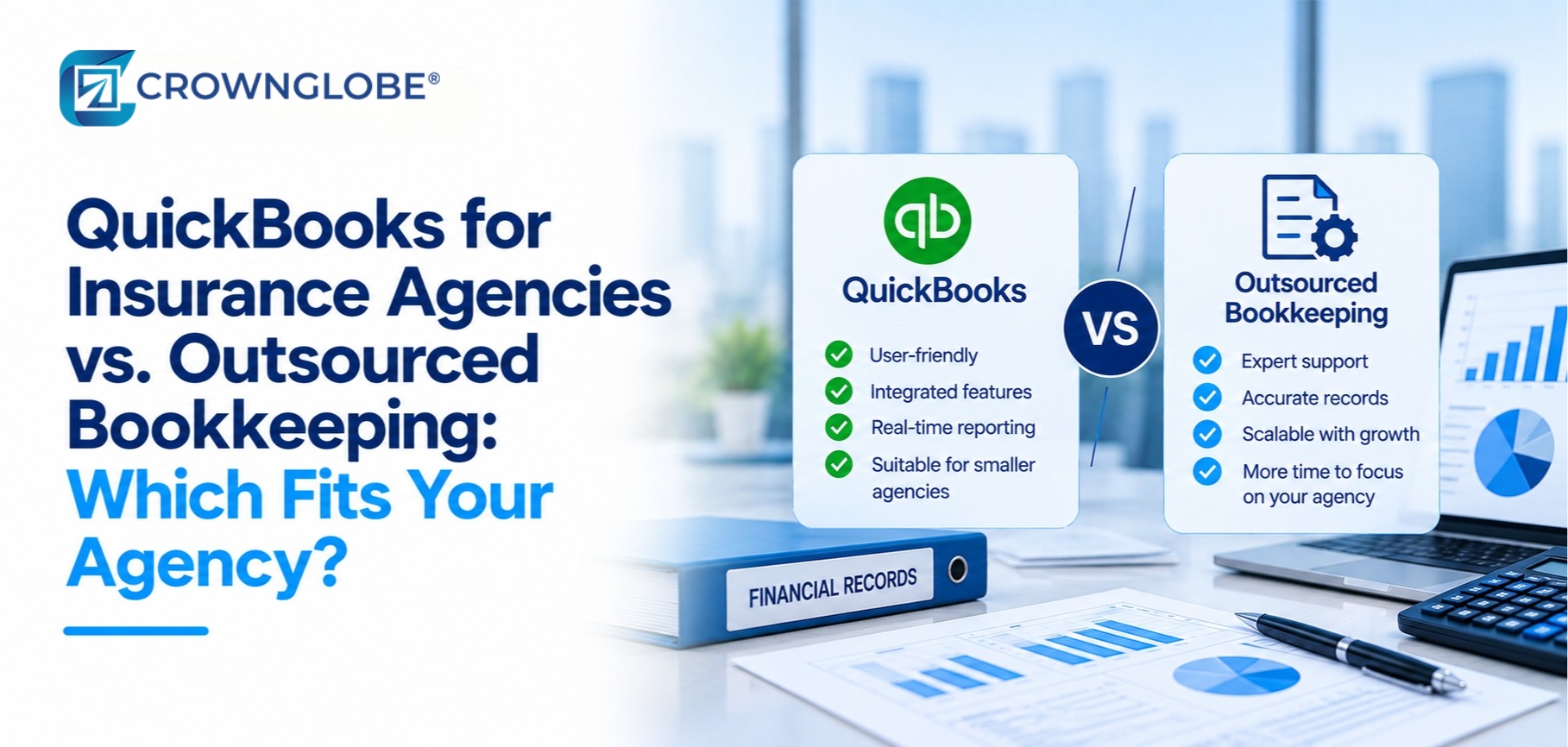
For many agencies evaluating QuickBooks for insurance agency accounting, the real decision is not “QuickBooks or outsourcing.” It is “who should operate QuickBooks and take responsibility for the close?”
QuickBooks In-House vs. Outsourced Bookkeeping: Head to Head
If you are evaluating QuickBooks for an insurance agency, start with operating fit rather than software enthusiasm. QuickBooks Online can support reconciliation and segmented reporting, including class tracking in Plus and Advanced. But the software still depends on clean source data, sensible setup, and a disciplined close process. Intuit’s current documentation also says QuickBooks Online does not have a native commission-calculation feature.
The scores below are CrownGlobe editorial fit judgments, not independent performance measurements. A score of 5 means the model is generally stronger on that decision factor; it does not mean the model is universally better.
| Decision factor | In-house QuickBooks | Outsourced bookkeeping | What matters most |
|---|---|---|---|
| Direct day-to-day control | ●●●●● | ●●●●● | How often management needs immediate hands-on access to the person doing the work |
| Owner / manager time | ●●●●● | ●●●●● | Whether leaders are still resolving coding, reconciliation, or close issues themselves |
| Insurance-specific bookkeeping depth | ●●●●● | ●●●●● | Actual experience with carrier activity, producer commissions, AMS-to-ledger differences, and agency reporting |
| Monthly-close consistency | ●●●●● | ●●●●● | Whether reconciliations and reports are completed on a dependable schedule |
| Continuity | ●●●●● | ●●●●● | What happens when the internal bookkeeper is unavailable |
| Scalability | ●●●●● | ●●●●● | Whether growth requires another hire, more supervision, or simply a revised service scope |
| Transition effort | ●●●●● | ●●●●● | How much cleanup, process mapping, access design, and handoff work is needed initially |
The point is not to add up the scores and declare a winner. The better approach is to weight the factors that are actually creating friction in your agency.
A small agency with a strong internal accountant and a disciplined close may have little reason to outsource. A growing agency whose owner is still reviewing uncategorized transactions every month has a different problem, even if the QuickBooks subscription itself is perfectly adequate.
QuickBooks Is the System; Bookkeeping Is the Process
A well-structured insurance agency accounting QuickBooks environment can organize records, reconcile bank and credit-card accounts, and support segment reporting when configured appropriately. It does not decide which carrier statement is authoritative, whether a commission difference needs investigation, who should approve an adjustment, or whether month-end is actually complete.
Why the Best Answer Is Often QuickBooks + an Outsourced Close
Many agencies do not need to choose between keeping every accounting task inside the business and handing over everything. A hybrid model can separate business judgment from recurring accounting execution, making bookkeeping for insurance agencies easier to scale without giving up management oversight.
Keep Inside the Agency
The agency should retain the areas that depend on commercial context and authority, such as:- ownership of the AMS or policy-management system;
- carrier and producer context;
- approval of unusual or disputed transactions;
- payment authorization;
- decisions about producer compensation or business policy; and
- management interpretation of financial results.
Outsource Where Appropriate
An external bookkeeping team can potentially own recurring execution such as:- transaction categorization;
- bank and credit-card reconciliation;
- recurring journal-entry workflows;
- cleanup and catch-up work;
- support for commission-to-ledger reconciliation;
- month-end close;
- financial-statement preparation; and
- recurring management reporting.
For broader insurance-specific finance context, see CrownGlobe’s insurance agency bookkeeping and accounting resource.
What to Verify Before Choosing an Outsourced Bookkeeping Provider
The quality of outsourced bookkeeping depends heavily on how responsibilities are defined before the work begins. A useful diligence process should cover at least these points:
- QuickBooks ownership and admin access. Know who owns the company file, who has administrator rights, and what access remains with the agency.
- Chart-of-accounts approach. Confirm whether the provider will work within the existing structure, recommend changes, or require cleanup first.
- Insurance-agency experience. Ask how the team handles carrier statements, producer-related activity, AMS data, and reconciliation differences.
- Reconciliation ownership. Define exactly which bank, credit-card, clearing, commission, or other accounts the provider is responsible for reconciling.
- Close calendar. Agree on when inputs are due, when exceptions are raised, and when management reports are expected.
- Review layer. Identify who reviews the bookkeeper’s work and how unresolved items are escalated.
- Approval boundaries. Separate bookkeeping execution from payment authorization and other management approvals where appropriate.
- Access and security controls. Document who receives access to QuickBooks, banking information, shared files, and supporting records. For deeper questions, see CrownGlobe’s guide to data security in bookkeeping outsourcing.
- Cleanup versus recurring scope. Historical cleanup should be clearly distinguished from normal monthly work.
- Exit process. Confirm how data, workpapers, account access, and open issues will be handed back if the relationship ends.
What It Takes to Switch From DIY or In-House QuickBooks to Outsourced Bookkeeping
Moving the work outside the agency should be treated as a controlled accounting transition, not simply as adding another user to QuickBooks.
Discovery
Document the current QuickBooks company, connected bank and credit-card accounts, users, AMS inputs, recurring entries, reporting requirements, and unresolved balances.
Cleanup / Design
Resolve material historical problems before they become part of the new recurring workflow. Before QuickBooks accounting is set up for an insurance agency, agree on any needed changes to the chart of accounts, reconciliation process, and monthly reporting structure.
A thoughtful QuickBooks accounting setup for an insurance agency should support the reporting and reconciliation process the agency intends to maintain.
Responsibility Map
Define who approves transactions, who posts them, who reconciles accounts, who answers carrier or producer questions, and who reviews the final financial statements. Shared responsibility works only when each handoff is explicit.
Parallel Close
Before treating the handoff as stable, complete a controlled close in which source records, reconciliations, open exceptions, and financial outputs can be reviewed together.
Stabilize
During the first recurring cycles, track unresolved exceptions, late source data, recurring manual adjustments, and reporting questions.
There is no universal transition timeline. The effort depends on the condition of the existing books, the number of accounts and systems involved, the quality of documentation, and the scope being transferred.
Outsourcing the bookkeeping does not require outsourcing ownership of QuickBooks or the agency’s business decisions. The agency can retain system visibility, approvals, carrier and producer context, and management judgment while an external team takes responsibility for agreed recurring bookkeeping, reconciliations, close, and reporting.
Questions Insurance Agency Owners Ask When Choosing
QuickBooks can be a practical accounting ledger for an insurance agency when the setup, reconciliations, source data, and reporting process are well controlled. QuickBooks Online also supports features such as bank reconciliation and class-based reporting in eligible plans. The software does not replace the need to resolve insurance-specific commission, carrier, or AMS-to-ledger questions.
QuickBooks records accounting data, but someone still needs to categorize transactions, reconcile accounts, investigate differences, maintain the close, and produce useful financial statements. That work can be handled internally, outsourced, or divided between the two.
Keep the work internal when a capable person has enough time, accounting knowledge, and insurance-agency context to maintain accurate books and close consistently. Consider outsourcing when bookkeeping is owner-dependent, repeatedly delayed, difficult to review, or requires capacity the agency does not want to hire and manage internally.
Yes, an outsourced arrangement can be built around the agency’s existing QuickBooks environment. The important issues are ownership, user permissions, responsibility boundaries, approval controls, and how access is removed or transferred if the relationship ends.
QuickBooks Online does not currently provide a native sales-commission calculation feature. Intuit documents ways to track sales by employee or representative using class or location tracking, but the underlying commission calculation may need to come from another source or process.
Start with discovery and cleanup, then define who owns approvals, posting, reconciliation, review, and reporting. Maintain appropriate agency access to QuickBooks and supporting records, complete a controlled handoff or parallel close, and keep an exception log until the recurring process is stable.
Sources & Further Reading
- Intuit QuickBooks Reconcile an account in QuickBooks Online. Current reconciliation workflow and prerequisites. Read the Intuit QuickBooks resource.
- Intuit QuickBooks Get started with class tracking in QuickBooks. Current class-tracking availability and reporting use. Read the Intuit QuickBooks resource.
- Intuit QuickBooks Track and record sales for commissions in QuickBooks Online. Current limitation on native commission calculations and available tracking approaches. Read the Intuit QuickBooks resource.
- CrownGlobe Insurance Agency Bookkeeping and Accounting Services. Insurance-agency accounting, commission, and AMS-to-ledger context. Visit the CrownGlobe resource.
- CrownGlobe Outsourced Accounting. Bookkeeping, reconciliation, close, and reporting service context. Visit the CrownGlobe resource.
Comparison disclosure: CrownGlobe provides both QuickBooks Accounting and Outsourced Accounting services. This comparison is intended as a practical decision framework for insurance agencies, not an independent product test. The scorecard reflects editorial fit judgments rather than measured product-performance rankings.
General-information disclaimer: This article is for general informational purposes only. It is not individualized accounting, tax, legal, technology, cybersecurity, insurance-regulatory, or financial advice. The right bookkeeping model depends on the agency’s systems, staffing, transaction volume, internal controls, reporting needs, service scope, and other facts. Evaluate provider terms, access arrangements, software capabilities, and professional advice applicable to your circumstances.
Which Accounting Model Fits Your Insurance Agency?
If QuickBooks is working but the bookkeeping process is not, the next decision may be about ownership of the work rather than replacement of the software. Map the current close, identify the recurring bottlenecks, and decide which responsibilities genuinely belong inside the agency.