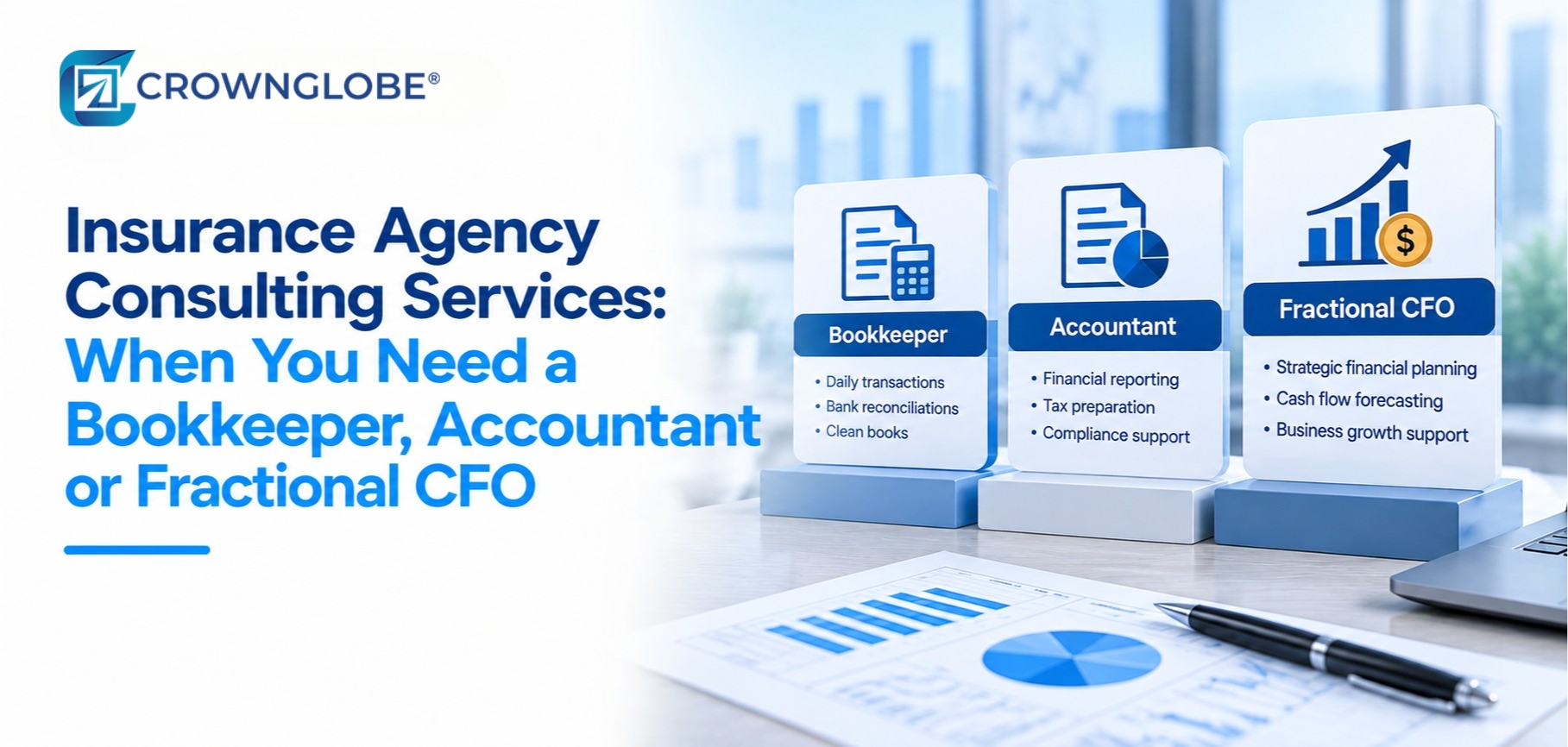
Verdict: Which Level of Finance Support Does Your Agency Need?
Choose a bookkeeper whenFinancial execution is the issue that keeps repeating. Transactions are not recorded consistently. Reconciliations fall behind. Supporting details are incomplete and routine bookkeeping takes much time from owner or staff. These problems make it hard to keep the books clean. The business running smoothly.
Choose an accountant whenthe books need stronger review, accounting judgment, close ownership, or financial interpretation. At that point, the issue is no longer just getting activity into the system. Someone needs to evaluate whether it is classified, reconciled, and presented appropriately.
Choose a fractional CFO whenleadership needs a forward looking finance layer: forecasts, budgets, cash flow planning, KPIs, scenario analysis, and structured financial input for hiring, growth, or other management decisions.
Choose a layered model whenthe agency needs more than one of those capabilities. Reliable bookkeeping supports accounting review, and reliable accounting supports useful forecasting and strategic finance work. The roles can complement one another rather than compete.
For the broader operating context, see CrownGlobe's insurance agency bookkeeping and accounting services.
01 · Compared
Bookkeeper vs. Accountant vs. Fractional CFO: What Changes at Each Level?
To compare bookkeeping, accounting and auditing look at what each does of their titles. The U.S. Bureau of Labor Statistics says that people, in these roles record, sort, check and balance information. Bookkeeping, accounting and auditing all involve handling of money records and each job has its own clear set of duties even if the names differ. Accountants and auditors closely examine records and operations to help companies understand health and risks while a fractional CFO adds extra management focused on planning and decision making.
The scorecard below uses CrownGlobe editorial fit signals, not objective ratings. More dots indicate that a role is more likely to own that responsibility in a typical engagement. Actual scope still depends on the person, firm, contract, and agency.
| Finance responsibility | Bookkeeper | Accountant | Fractional CFO |
|---|---|---|---|
| Routine transaction recording | ●●● | ●●● | ●●● |
| Recurring reconciliations | ●●● | ●●● | ●●● |
| Month end close preparation | ●●● | ●●● | ●●● |
| Accounting judgment and exception review | ●●● | ●●● | ●●● |
| Financial statement interpretation | ●●● | ●●● | ●●● |
| Forecasting | ●●● | ●●● | ●●● |
| Budgeting and scenario analysis | ●●● | ●●● | ●●● |
| KPI design and management reporting | ●●● | ●●● | ●●● |
| Leadership decision support | ●●● | ●●● | ●●● |
Bookkeeper: Keep the recurring finance process moving
A bookkeeper is usually the person who works closely with daily financial records. That can include recording transactions, keeping documentation reconciling accounts, managing receivables and payables and preparing the books for review or close.
For an insurance agency, that recurring workload can also include carrier commission activity, direct bill and agency bill workflows, producer related entries, and reconciliation follow up. CrownGlobe's guide to insurance agency commission reconciliation and bookkeeping workflows shows why clean recurring finance work matters before higher level reporting becomes useful.
A bookkeeping problem usually shows up in the mechanics: records are delayed; reconciliations remain open; transactions need cleanup repeatedly; management cannot trust the books.
Accountant: Add review, judgment, and financial interpretation
An accountant becomes more important when the agency needs someone to review the work, resolve accounting questions, strengthen the close, interpret financial statements, or take ownership of more complex classification and reconciliation issues.
That is why insurance accounting services should be evaluated on more than transaction processing. An insurance accountant may work with the same underlying records as a bookkeeper, but the engagement should make clear who reviews exceptions, who owns closing decisions, who explains financial results, and which matters still require outside tax, audit, legal, or other specialist advice.
CrownGlobe's outsourced accounting for recurring bookkeeping and close support covers the operating layer between routine bookkeeping and higher level finance leadership.
Fractional CFO: Add forward looking finance leadership
Fractional CFO support makes sense when leadership needs more than a reliable historical close. The focus shifts toward what management should do next: forecasting cash needs, building budgets, testing scenarios, defining useful KPIs, improving reporting cadence, and bringing financial context into operating decisions.
CrownGlobe's fractional CFO support for forecasting and decision making includes forecasting, budgeting, cash flow strategy, KPI dashboards, scenario planning, and executive reporting.
The title should not be the trigger. An agency can do bookkeeping and accounting even though it does not yet need recurring CFO level support. An owner who is growing, expanding capacity handling cash or planning may still need a layer even when the core books are already well maintained.
02 · Layered model
Where a Layered Finance Model Fits an Insurance Agency
The three support levels do not have to sit in separate departments. A growing agency may keep one responsibility in house, outsource another, and add fractional support only where management needs more depth.
Recurring finance operations
- Transaction recording and coding
- Bank and balance sheet reconciliations
- Commission related bookkeeping support
- AP/AR support where scoped
- Close preparation
- Standard recurring reports
Accounting and strategic finance layer
- Review of exceptions and accounting questions
- Close oversight and financial interpretation
- Management reporting and trend analysis
- Cash flow forecasting and budgeting
- Scenario analysis and KPI design
- Owner and leadership decision support
The handoffs matter more than the labels. A bookkeeper may prepare a reconciliation, an accountant may review and resolve an unusual item, and a fractional CFO may use the resulting financial information in a forecast. If everyone thinks someone else will fix the gap, between the steps the agency still has a money problem.
The model works best when responsibilities are clear: who prepares, who reviews, who approves, who resolves exceptions and who explains the numbers, to management. That clarity keeps CFO work from becoming a replacement, for basic bookkeeping cleanup.
03 · Diligence
What to Check Before You Hire Any Finance Support
The same diligence questions matter whether the agency is hiring an employee, engaging a firm, or adding fractional finance leadership.
- Exact scope. What work is included, and what is outside the engagement?
- Named owner. Who is responsible for each recurring deliverable?
- Review structure. Who checks reconciliations, close work, and material exceptions?
- Insurance agency context. Can the person or team work with the carrier, commission, producer, and system workflows relevant to your agency?
- Systems. Which agency management, accounting, banking, and reporting systems must they use?
- Deliverables. Are you buying clean books, a close package, financial statements, forecasts, dashboards, meetings, or a combination?
- Cadence. What happens weekly, monthly, quarterly, or only when needed?
- Decision boundary. Which issues can the provider resolve, and which require agency management or another professional?
- Continuity. What happens when the primary person is unavailable?
- Escalation path. When does a bookkeeping issue become an accounting issue, and when does an accounting question require strategic finance support?
Role selection comes before credential selection. If the agency specifically needs CPA level services or wants help evaluating a CPA relationship, see how to choose a CPA for your insurance agency.
04 · Progression
How to Move From Bookkeeping Support to CFO Level Finance
Higher level finance support is most useful when the information underneath it is dependable. The progression below is not a mandatory maturity model; it is simply a practical way to identify the next missing capability.
1
Stabilize the books
Bring recurring entries, documentation, reconciliations, and open items current enough that management is not making decisions from incomplete records.2
Close consistently
Define who prepares the close, who reviews it, which exceptions remain open, and what management receives at the end of the process.3
Build useful reporting
Move beyond producing statements simply because the month ended. Choose the operating views that management truly needs and ensure the reporting schedule is consistent.4
Add forecasts, budgets, and KPIs
Once the historical information is usable, introduce forward looking tools. Forecasts and budgets need to be linked to management decisions of being separate spreadsheets.5
Establish a strategy cadence
Use recurring finance reviews to discuss changes in cash expectations, hiring plans, spending, producer or book of business economics, and other material decisions that benefit from financial context.An agency does not need to move through every stage at the same speed, and CFO level support is not the automatic destination. The point is to add the capability that solves the next management problem without neglecting the finance work underneath it.
The right finance role is usually determined by the responsibility or management decision that has no dependable owner not by the most senior title available. Start with the gap, then choose the scope and level of support that closes it.
Questions
Questions Insurance Agency Owners Ask About Finance Support
A bookkeeper usually focuses on recurring financial records and reconciliations. An accountant adds more review, accounting judgment, close ownership, and financial interpretation. A fractional CFO focuses more heavily on forward looking work such as forecasts, budgets, cash flow planning, KPIs, scenarios, and management decision support. Actual responsibilities can overlap depending on the engagement.
A bookkeeper is worth considering when recurring finance work is falling behind or consuming too much internal time. Common signals include unreconciled accounts, inconsistent transaction coding, incomplete supporting records, delayed bookkeeping, or recurring commission and bank activity that needs a dependable process owner. There is no universal agency size threshold.
An accountant becomes more useful when the agency needs stronger review, close ownership, financial statement interpretation, or help resolving accounting questions and exceptions. The distinction should be based on the work required, not the title alone. An accountant also does not automatically mean a CPA; credential requirements depend on the service being performed.
Fractional CFO support is worth evaluating when agency leadership needs reliable forecasts, budgets, cash flow planning, scenario analysis, KPI design, or recurring financial input into management decisions. It should not be tied to a universal revenue or headcount threshold.
Yes, if the provider's scope is explicit. One engagement may include multiple layers of support, or the agency may use separate people for each. The important point is to document who prepares recurring work, who reviews it, who owns exceptions, and who provides strategic finance input.
Not necessarily. CFO level work depends on reliable underlying financial information. A fractional CFO may coordinate with bookkeeping or accounting resources, but forecasting and strategic analysis do not eliminate the need for accurate records, reconciliations, close discipline, and accounting review.
Sources & further reading
CrownGlobe provides accounting and Virtual CFO services, so this comparison is not disinterested. The scorecard reflects editorial fit judgments rather than independent performance measurements and should be applied to CrownGlobe as well as other options. This article provides general information only and is not legal, tax, accounting, audit, regulatory, employment, investment, or software advice. Professional scope, credential requirements, and appropriate finance processes vary by agency, jurisdiction, engagement, and facts. Obtain appropriate professional advice for material accounting, tax, legal, regulatory, audit, employment, investment, or contractual decisions.