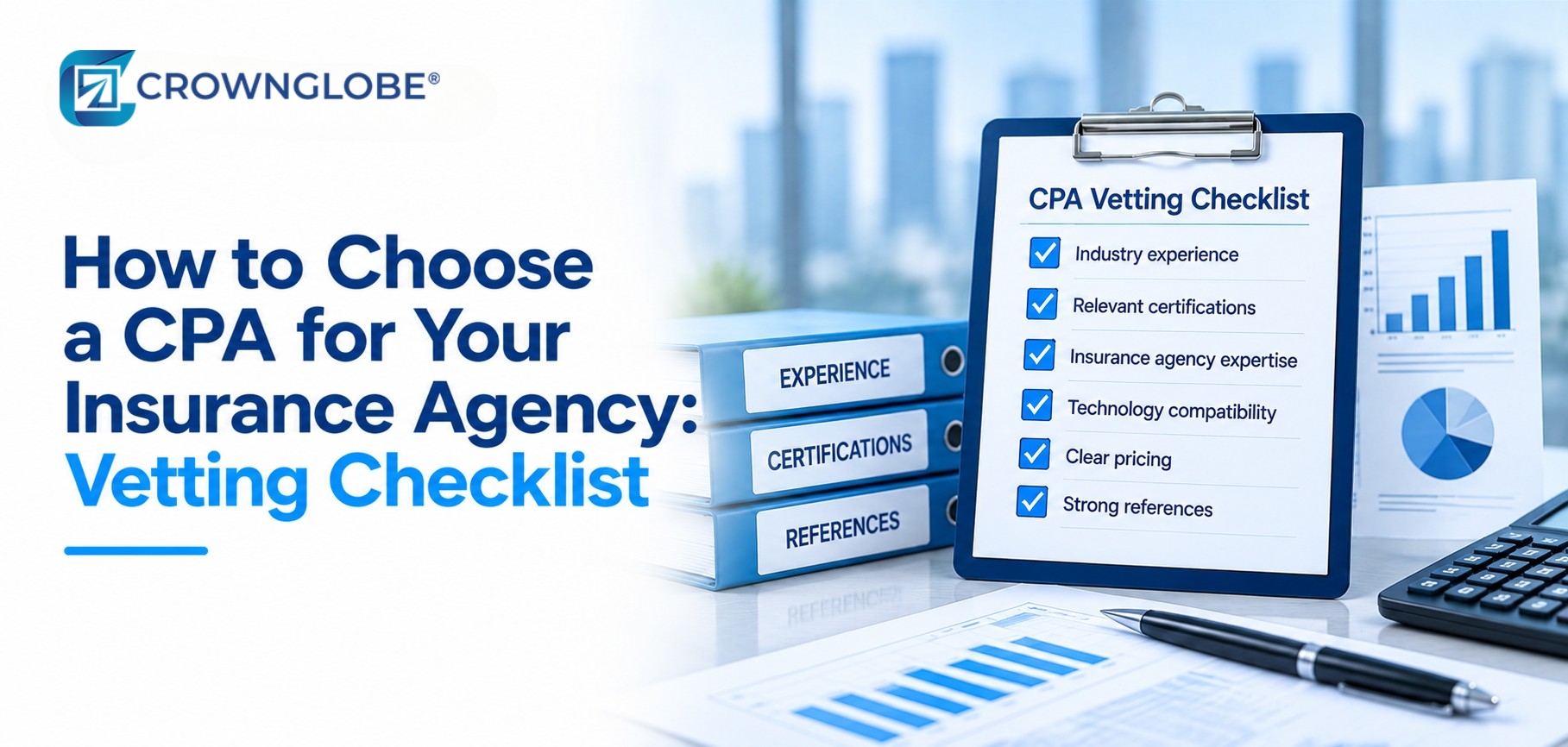
A CPA license is an important gate, but it is not the whole decision. When choosing a CPA for insurance agency work, verify the credential first. Then compare insurance agency experience, actual scope, reviewer structure, systems fit, security, continuity, fees, and exit terms. The right choice should fit the work your agency actually needs not simply carry the strongest title on a business card.
Score Your CPA Candidates Against the Same Criteria
A useful comparison starts by moving past biographies and putting every candidate through the same operating questions.
A CPA license matters. It does not, by itself, tell you whether someone understands insurance agency commissions, carrier activity, your AMS, or the way your monthly accounting process actually works.
Use the scorecard below for each CPA, accountant for insurance agency operations, or insurance accounting firm you are considering. Score what the candidate can demonstrate, not how polished the marketing sounds.
| Dimension | Candidate A | Candidate B | Candidate C | What a strong score requires |
|---|---|---|---|---|
| Credential verification | CPA status can be independently verified where the credential is represented | |||
| Insurance agency experience | Candidate can explain relevant carrier, commission, agency bill/direct bill, and close workflows | |||
| Scope fit | Inclusions, exclusions, responsibilities, and deliverables are written down | |||
| Review structure | Reviewer and escalation path are identifiable | |||
| Systems fit | Candidate understands the agency's actual AMS and accounting environment | |||
| Security and access | Access controls, MFA, data handling, and revocation procedures are explained | |||
| Continuity and availability | Backup coverage and communication expectations are defined | |||
| Fee and exit clarity | Pricing basis, out of scope work, and handoff terms are understandable |
Do not simply total the scores and assume the highest number is automatically the right choice. The relative importance of each factor should reflect the work your agency is actually buying.
NASBA says CPAverify is populated with official licensing data sent by participating Boards of Accountancy. Use that type of independent verification as a starting gate where CPA status is part of the candidate's proposition. Then evaluate specialization and operating fit separately.
Where a CPA Fits and Where the Accounting Team May Still Fit
A CPA and a recurring accounting team may solve different parts of the same finance function.
The exact split depends on the engagement. Do not assume that the CPA must personally perform every recurring task, or that a bookkeeper should handle work that calls for a different credential or level of professional judgment.
CPA or advisory side, where included in scope
- tax return preparation
- tax planning
- IRS representation where the individual is authorized and the engagement includes it
- higher level accounting issues
- review and advisory
- entity or planning discussions
- attest work where applicable and properly engaged
Recurring accounting team side may include
- transaction processing
- bank and credit card reconciliation
- carrier and commission reconciliation support
- accounts payable and receivable
- month end close preparation
- management report production
- cleanup or catch up bookkeeping
The IRS states that CPAs, attorneys, and enrolled agents have unlimited representation rights before the IRS. It also requires paid federal return preparers to have a valid PTIN. Those facts matter when tax preparation or representation is actually part of the engagement; they do not mean every insurance agency needs the same tax service model.
If tax return preparation is part of the scope, CrownGlobe's business tax filing support provides related service context.
What to Verify Before Choosing the CPA or Accounting Firm
Verify the Credential First
If a candidate presents as a CPA or CPA firm, verify the credential rather than relying on a website biography, proposal, or email signature.
CPAverify is designed to search CPA and accounting firm licensing information supplied by participating Boards of Accountancy. Because licensing is jurisdiction specific, pay attention to the status and jurisdiction shown rather than treating the letters CPA as a blanket national approval.
Test Actual Insurance Agency Experience
Industry experience should show up in the candidate's answers, not just in a statement that the firm “works with insurance agencies.”
Ask the candidate to walk through the parts of your agency that are relevant to the proposed engagement: carrier statements, direct bill and agency bill activity, producer commissions, AMS to ledger differences, reconciliations, month end close, and tax readiness.
A capable insurance accountant should be able to explain where accounting questions commonly arise and, just as important, when the provider will need commercial context or a decision from agency management.
Get Scope and Review Responsibility in Writing
Whether the candidate is an individual CPA or an insurance accounting firm, the proposal should separate recurring bookkeeping, reconciliations, close, tax preparation, tax planning, payroll, cleanup, advisory, and special projects rather than placing everything under a broad “accounting” label.
Ask who is responsible for the engagement, who reviews the work, how exceptions are escalated, what the agency must provide, and what is explicitly excluded.
If federal tax return preparation is included, confirm the preparer's credentials and PTIN as applicable.
Check Systems, Security, and Continuity
Start with the practical questions: Which systems does the provider need? Who will receive access? What level of access does each person need? What happens when that access is no longer required?
The FTC advises written vendor security expectations, verification, need to know access, safeguards for sensitive data, and multi factor authentication for sensitive systems.
For a deeper set of vendor control questions, see CrownGlobe's guide to data security in bookkeeping outsourcing.
Then ask the continuity question that often gets overlooked: what happens if your primary contact is unavailable during close or filing season?
A strong answer should explain backup coverage and documentation instead of depending on one person's memory.
Compare Fees, Exclusions, and Exit Terms
Do not compare headline fees until you know that you are comparing equivalent scopes.
Clarify recurring fees, hourly or project work, cleanup charges, additional entities, special projects, tax or advisory work, and the process for approving anything outside the agreed engagement.
Exit terms deserve the same attention. Before signing, clarify file ownership, deliverables, open item documentation, access removal, and what needs to be handed to the next provider if the relationship ends.
Red Flags to Take Seriously
- CPA status cannot be independently verified where the credential is represented.
- An “insurance expert” cannot explain the workflows that matter to your agency.
- The proposal blurs tax, advisory, bookkeeping, and recurring accounting responsibilities.
- No one can identify the reviewer or escalation path.
- The security answer is only “your data is secure.”
- There is no credible backup or continuity plan.
- Fees rely on undefined “extra work.”
- The provider cannot explain how records, open items, and access are handled at exit.
What It Costs to Change Your Mind
Choosing a provider is easier when the exit path is understood before the engagement starts.
If you later change CPAs or accounting firms, treat the move as an operational handoff rather than simply sending a cancellation notice.
Inventory
List active services, tax filings, recurring reports, accounting systems, authorizations, deadlines, and unresolved items.
Collect
Identify the records, returns, reports, and agreed deliverables that need to move under the existing engagement and applicable requirements.
Reassign Access
Review user accounts, file sharing permissions, accounting system access, and tax authorizations where relevant. Remove or change access as responsibilities move.
Handoff
Document open questions, upcoming deadlines, prior year context, and who owns the next close or filing cycle.
Stabilize
Review the first completed reporting or filing cycle under the new arrangement before treating the transition as finished.
There is no universal switching timeline, and required transfer materials depend on the engagement and applicable professional or legal requirements.
The CPA credential and the operating model answer different questions.
Questions Insurance Agency Owners Ask When Choosing a CPA
Start with independently verifiable credentials where CPA status is represented. Then evaluate insurance agency experience, exact service scope, reviewer responsibility, systems knowledge, security and access controls, availability, fees, and exit terms.
The goal is not simply to find the most qualified sounding candidate. It is to find one whose credentials and operating model both fit the work your agency needs.
CPAverify provides a national search tool using licensing data supplied by participating Boards of Accountancy. Review the jurisdiction and status shown, and use the relevant state board when additional confirmation is needed.
Do not rely only on a provider's website or business card.
Not every assignment requires the same degree of industry specialization.
Direct insurance agency experience becomes more important when the engagement includes carrier activity, producer commissions, agency bill or direct bill workflows, AMS to ledger reconciliation, recurring close, or other insurance specific accounting issues.
The more central those workflows are to the scope, the more closely you should test the candidate's experience with them.
It can, but it does not have to.
Some agencies prefer one provider with clearly separated responsibilities. Others use a CPA or tax professional for tax and advisory work while a separate accounting team handles recurring bookkeeping and close.
What matters is that ownership, review, handoffs, and exclusions are clear.
Ask what is recurring, what is project based, how cleanup and special requests are billed, whether additional entities or filings change the fee, and what falls outside the engagement.
Also ask who responds outside filing season, who provides backup coverage, and how urgent accounting questions are escalated. A fee is easier to evaluate when you know both what it buys and how the relationship works throughout the year.
Consider a change when the engagement no longer matches the agency's needs, responsibilities remain unclear, communication or review consistently breaks down, important insurance specific workflows are not understood, or the provider cannot support the required scope.
Before switching, document records, access, deadlines, authorizations, and open items so the transition is controlled.
Sources & Further Reading
- National Association of State Boards of Accountancy All About CPAverify. Current 2026 guidance on CPA and accounting firm license verification using data from participating Boards of Accountancy. nasba.org
- Internal Revenue Service Understanding Tax Return Preparer Credentials and Qualifications. Current guidance on PTIN requirements, professional credentials, and representation rights. irs.gov
- Federal Trade Commission Cybersecurity for Small Business. Current vendor security, access control, encryption, and multi factor authentication guidance. ftc.gov
- CrownGlobe Insurance Agency Bookkeeping and Accounting Services. Insurance agency accounting workflow and service context. crownglobe.com
- CrownGlobe Outsourced Accounting. Current outsourced accounting service context. crownglobe.com
CrownGlobe provides Outsourced Accounting services. This guide is a provider vetting framework, not an independent ranking, and it does not represent CrownGlobe as a licensed CPA firm.
This article is for general informational purposes only. It is not individualized accounting, tax, legal, cybersecurity, insurance regulatory, or financial advice. Requirements and engagement terms vary by provider and jurisdiction; verify what applies to your agency.
Ready to Pressure Test Your Provider Shortlist?
A strong CPA for insurance agency work should demonstrate verified credentials where represented, relevant insurance experience, a clear scope, identifiable review, practical controls, understandable fees, and a workable exit path.