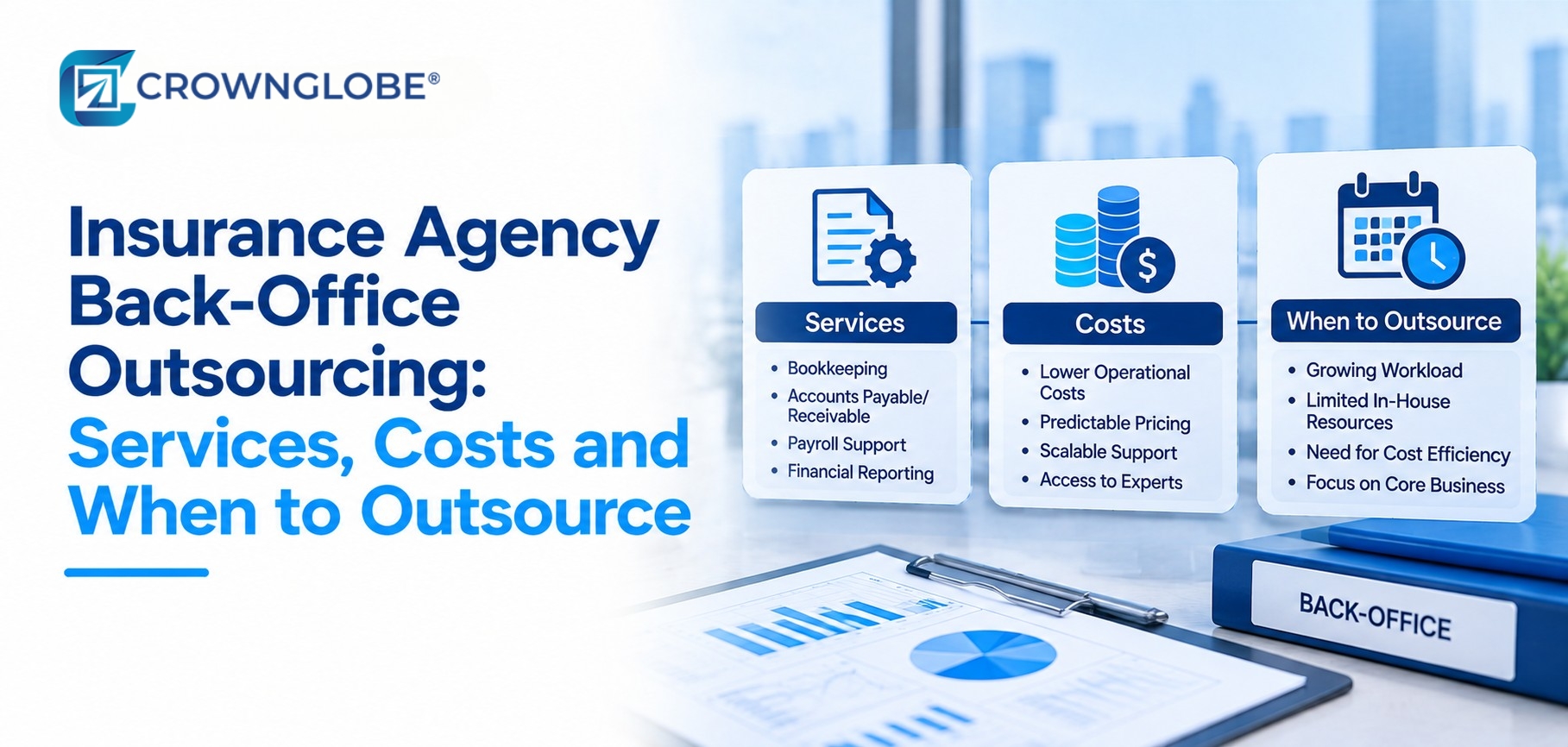
Insurance agencies usually start looking at outsourcing when recurring work begins to pile up, experienced employees spend too much time on administration, or month end relies heavily on one person who knows how every piece fits together. The right response is not necessarily to move the entire back office outside the agency. First define the work, decide what must remain internally owned, and determine whether a provider can operate reliably within those boundaries.
CrownGlobe's insurance agency bookkeeping and accounting workflows provide the industry context for recurring finance work. The live industry page addresses agency specific bookkeeping, commission reconciliation, producer related accounting, and related financial workflows. This guide focuses on how to evaluate outside support for that kind of repeatable activity.
Twelve Questions to Ask Before Outsourcing Insurance Agency Back Office Work
What exactly is included in the scope?
A provider should be able to tell you precisely which tasks are included, how often they occur, what information your agency must supply, what the provider will deliver, and what sits outside the engagement.
- A strong answer
- A written task list with frequency, inputs, outputs, cutoffs, approvals, and exclusions.
- A weak answer
- “We handle your whole back office” without defining workflows or responsibilities.
CrownGlobe's documented scope centers on outsourced accounting for insurance agencies, including bookkeeping, reconciliations, AP/AR, close, and reporting. Broader insurance BPO services may include activities outside that finance scope, so compare the promised work carefully rather than treating every “back office” proposal as equivalent.
Should we outsource one module or the full workflow?
Insurance back office support can start with a single recurring process or extend across a broader managed scope. A modular engagement may make sense when one workflow is creating the bottleneck. A broader model may be more practical when several connected processes use the same systems, records, and review cycle.
- A strong answer
- The provider can explain dependencies and scope one workflow first if appropriate.
- A weak answer
- The provider pushes a full stack transfer before understanding the bottleneck.
A defined process such as commission reconciliation, chargebacks and carrier statements is an example of work that can be evaluated separately before a larger commitment.
Who performs the work, and who reviews it?
Adding capacity is not the same as buying a managed service. Your agency should know who performs the recurring work, who reviews exceptions, and what happens when the primary person is unavailable.
- A strong answer
- Defined delivery roles, a reviewer layer, documented procedures, and backup coverage.
- A weak answer
- One individual with no clear reviewer, backup, or escalation path.
The distinction matters because routine processing may look straightforward until an exception appears. A reliable operating model should not depend on one person's availability or undocumented judgment.
Which work remains our agency's responsibility?
Outsourcing changes who performs a process; it does not automatically transfer every decision. Your agency may still need to approve exceptions, authorize payments, make policy or compliance judgments, and sign off on final outputs.
- A strong answer
- The proposal separates provider tasks, agency approvals, and shared responsibilities.
- A weak answer
- The provider implies outsourcing removes the need for an internal owner.
For the narrower in house versus outsourced accounting decision, see CrownGlobe's guide on whether to outsource insurance agency accounting. This article focuses on defining and evaluating the broader back office scope.
How will the provider work inside our AMS and accounting systems?
Before granting access, document which systems the provider will use, which permissions each role requires, what the provider is allowed to change, and how information will move between the AMS, accounting system, bank activity, and supporting records.
- A strong answer
- Systems, roles, permissions, handoffs, and the source of truth are clearly identified.
- A weak answer
- “We work with all major systems” without explaining access or authority.
Platform familiarity can be useful, but it is not the same as a defined integration or controlled workflow. Verify what the provider will actually do inside each system.
How is access and sensitive data controlled?
Insurance organizations handle sensitive information, so access management and third party oversight belong in provider diligence. The NAIC Insurance Data Security Model Law provides a framework that states may adopt, while NAIC itself makes clear that model laws are not automatically binding in every state.
- A strong answer
- Written access controls, user provisioning and removal, incident procedures, data handling rules, and evidence supporting security claims.
- A weak answer
- Generic reassurance that the environment is “secure” or “compliant.”
For deeper diligence, see data security in bookkeeping outsourcing.
What service levels and quality measures will we see?
Broad claims about accuracy or speed are not enough. The useful question is how performance will be defined for your specific scope.
- A strong answer
- Agreed measures for turnaround, backlog, open exceptions, rework, response time, or reconciliation progress where relevant.
- A weak answer
- “High accuracy” or “fast turnaround” without a definition of success.
The right measures depend on the work. A month end process may focus on close timing and unresolved exceptions. An administrative queue may depend more on age, rework, and response commitments.
How are exceptions escalated?
The quality of the operating model becomes clearer when something falls outside the normal process: information is missing, a transaction does not match, or the task requires a judgment the provider is not authorized to make.
- A strong answer
- A documented escalation path showing who is contacted, what information is supplied, and which decisions remain with the agency.
- A weak answer
- The provider resolves exceptions informally or makes judgment calls without defined agency rules.
Routine work tells you whether a team can follow a process. Exceptions tell you whether the process itself is well controlled.
What does onboarding actually require?
A serious transition involves more than sharing passwords and scheduling a kickoff call. The agency and provider need to document the workflow, establish access, test routine tasks, calibrate review expectations, and agree when the process is ready to move into normal service.
- A strong answer
- A written onboarding sequence with owners, systems, test work, acceptance criteria, and sign off.
- A weak answer
- Immediate live production with no calibration phase.
There is no universal onboarding timeline. Complexity depends on the scope, systems involved, cleanup required, access setup, and existing exceptions.
How is pricing structured, and what is excluded?
Two proposals can show similar headline prices while covering materially different work. Normalize the scope before comparing the number.
| Compare | Ask what is included |
|---|---|
| Core scope | Tasks, frequency, entities, systems, deliverables |
| Management and QA | Review layer, reporting, escalation |
| Onboarding | Discovery, cleanup, documentation, implementation |
| Commercial terms | Minimums, volume rules, change requests |
| Exclusions | Tax, payroll, cleanup, special projects, other non core work |
- A strong answer
- Assumptions, management/QA coverage, exclusions, and scope change triggers are explicit.
- A weak answer
- A headline price without enough detail to compare the actual service.
Competitor savings percentages or offshore labor rates are not a dependable business case unless the underlying scope, responsibilities, and evidence are genuinely comparable.
Can we start with a controlled pilot?
A pilot should test more than whether routine tasks can be completed. It should show how the working relationship functions under real conditions. Choose one bounded workflow with a clear definition of done, known inputs, an agency owner, and agreed review criteria.
- A strong answer
- A limited, measurable scope is reviewed before expansion.
- A weak answer
- A broad or long commitment is required before the agency can observe how the team handles real work.
A pilot does not remove risk. It gives both sides a smaller environment in which to make the operating model visible before increasing the scope.
What happens if we scale down, change providers, or bring the work back in house?
Exit planning should be part of the buying process, not something discussed only after the relationship changes. Your agency should understand how files, open items, process documentation, access, and responsibilities will be transferred if the engagement is reduced or ended.
- A strong answer
- Written handoff expectations, access removal, open item ownership, and transition responsibilities.
- A weak answer
- “We can discuss that if it happens.”
What the Agency Has to Bring
A provider is only one side of the operating model. The agency still needs a clear internal owner and a dependable way to answer questions that require an internal decision.
Conditions for success
- Named owner for the relationship
- Timely answers to provider questions
- Complete but controlled system access
- Written approvals and decision rules
- Realistic transition expectations
Patterns that create problems
- No single internal point of accountability
- Exceptions sit unanswered
- Partial access forces workarounds
- Important decisions live in memory
- Full performance is expected before calibration
The agency should also decide what management will continue to review. Outsourcing a process should not reduce visibility into exceptions, reconciliations, or financial reports.
Structure a Scoped Pilot Instead of a Leap
Pick one workflow
Choose a recurring process with a clear beginning and end.
Write the deliverable down
Define the inputs, output, timing, owner, review step, and what “complete” means.
Watch the exceptions
Pay close attention to what happens when information is missing, something does not match, or a decision has to return to the agency.
Review before expanding
Compare the results with the agreed criteria and widen the engagement only when responsibilities and controls are clear.
whether the provider communicates clearly, surfaces exceptions, follows authority limits, and improves visibility rather than becoming a new black box.
The most revealing provider behavior often appears when something falls outside the routine. Ask what happens when a document is missing, a difference cannot be explained, or a task requires agency judgment. Those moments show whether the provider makes problems visible or simply reports that the work is “done.”
Questions Insurance Agency Buyers Ask
They are recurring operational and administrative activities performed outside the agency's client facing sales function. The broader market covers many types of work. CrownGlobe's documented scope is finance focused: bookkeeping, AP/AR, reconciliations, monthly close, reporting, and related accounting support.
It is worth evaluating when repeatable work creates a persistent backlog, consumes too much key staff capacity, or depends heavily on one person. If the workflow itself is poorly defined or relies on undocumented judgment, document the process before moving it outside the agency.
The market includes finance, data, policy service, and administrative work, but an agency should outsource only tasks the selected provider is qualified and contracted to perform. CrownGlobe's verified scope centers on accounting and finance administration; do not assume a finance provider also handles claims, underwriting, policy issuance, or COIs.
There is no responsible universal price without a defined scope. Cost can depend on task volume, systems, cleanup needs, review requirements, service levels, staffing model, and minimum commitments. Compare quotes by normalizing those assumptions rather than relying on one headline rate.
The provider may work through controlled access, exports, defined handoffs, or other documented processes. Clarify which system owns each record, what the provider may change, how exceptions return to the agency, and how access is removed when roles change. Verify specific integrations directly.
Ask how users receive and lose access, how sensitive information is handled, what happens during an incident, which third parties are involved, where relevant data is stored, and what evidence supports security statements. Confirm applicable state requirements separately rather than treating an NAIC model law as automatically binding nationwide.
Sources & Further Reading
- National Association of Insurance Commissioners (NAIC) Cybersecurity and Insurance Data Security Model Law context: content.naic.org
- NAIC How Model Laws and Model Regulations Work: content.naic.org
- Independent Insurance Agents & Brokers of America Best Practices Guide to Agency Business Processes and Information Management (2008; durable workflow/process context only): iiaba.net
- CrownGlobe Outsourced Accounting Services: crownglobe.com
- CrownGlobe Insurance Agency Bookkeeping and Accounting Services: crownglobe.com
CrownGlobe provides outsourced accounting services, so this guide is not disinterested. It is a diligence framework we are willing to be measured against ourselves and should be applied to every provider under consideration. This article provides general information only and is not legal, regulatory, cybersecurity, tax, or accounting advice. Requirements can vary by jurisdiction, contract, agency structure, and facts. Obtain appropriate professional advice for material legal, regulatory, security, or contractual decisions.
Evaluating Back Office Outsourcing for Your Insurance Agency?
CrownGlobe can help define a finance focused back office scope, document the systems and responsibilities around it, and structure a controlled transition before the engagement expands.