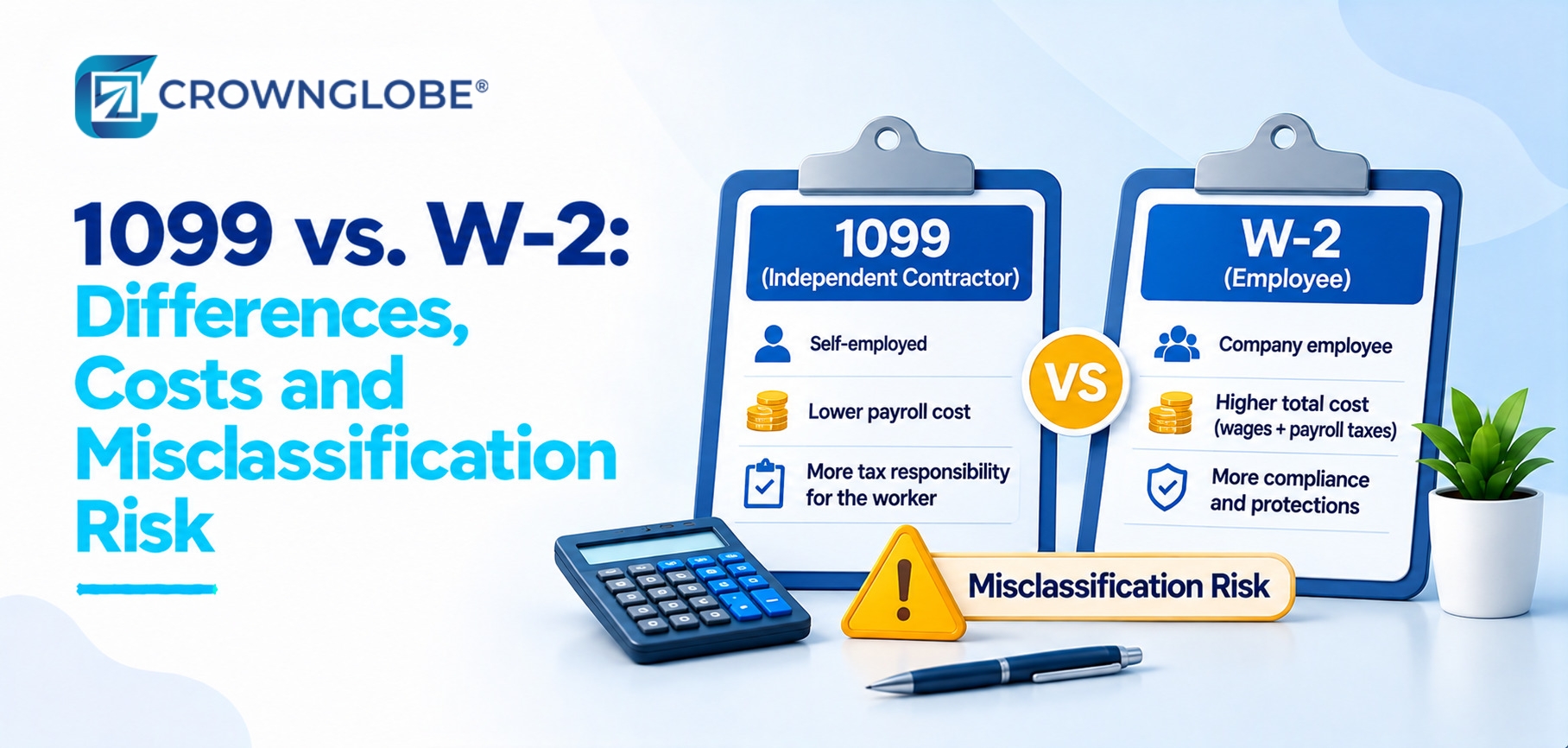
The main distinction between a 1099 and a W-2 is not in the actual tax document. Rather, it is whether the individual is accurately considered either an employee or an independent contractor depending on the actual working arrangement.
The classification decision impacts payrolls, withholding, employers’ payroll taxes, onboarding, end-of-year reporting, and the risk of misclassification. Different workforce models can also create different industry-specific payroll and worker-classification needs.
Readers comparing worker classifications sometimes use the search phrase “1099 vs w22” when looking for this distinction.
What Does Worker Classification Mean?
Worker Classification refers to determination of whether the worker is an employee or independent contractor, through application of principles governing the working relationship.
For tax purposes the IRS looks at all facts, including how the business controls the work how money is. The type of relationship, between the business and the worker.
No single contract term, no single payment method and no single tax form can automatically determine the outcome.
The Two Worker Types People Mean
W-2 employee
A W-2 employee works in an employer-employee relationship. Is generally paid through payroll.
The employer deducts the needed income tax and the portion of Social Security and Medicare that the worker needs to pay. The employer also has some tasks of its own.
Employees normally get their Form W-2 at the close of the year.
Independent contractor
An independent contractor is someone who works for themselves and has control, over their business.
Businesses usually do not take out employment taxes from payments to independent contractors and the independent contractor usually handles their own income tax and self-employment tax duties.
It might be necessary to fill Form 1099 NEC if certain criteria are fulfilled; getting a 1099 form doesn’t necessarily make one an independent contractor.
Worker categorization requires adherence to certain criteria, such as those set by the IRS on taxation and other wage laws and rules, but the current article only provides basic information.
Terms You Need Before Comparing 1099 vs. W-2
How Classification Changes the Payroll Workflow
1. Determine the working relationship
Start with the facts of the relationship, not the form the business expects to issue at year-end.
For federal tax purposes, review behavioral control, financial control and the type of relationship as part of the overall analysis.
2. Collect the appropriate onboarding information
Employees and contractors go through onboarding procedures and Onboarding procedures are advantageous to employees and contractors.
Form W 4 and Form I 9 will typically be filled out during employee setup, while companies generally require Form W 9 from contractors for tax identification purposes.
Those papers help the process. Do not decide the category on their own.
3. Apply the correct payment and tax treatment
Employee wages are processed through payroll with the withholding and employer employment tax duties.
Most independent contractors do not pay any employment taxes through their compensation. May be subject to backup withholding sometimes.
4. Keep the records distinct
Accounting system or payroll system can be employed by the organization to make payments to the employees and contractors using the accounting system or payroll system.
Nevertheless, this does not imply that both categories of workers are equal, and any classification, withholding, accounting, and reporting should follow suit.
5. Reconcile year-end reporting
Employees usually get Form W-2 from their employer.
All payments not classified as wages after 2026 exceeding $2,000 must be filed using Form 1099-NEC according to certain conditions.
What Actually Changes in Business Cost
The financial difference between a W-2 employee and an independent contractor goes well beyond the amount of the check issued to the worker.
| Cost or obligation | W-2 employee | Independent contractor |
|---|---|---|
| Cash compensation | Wage or salary | Contract fee |
| Federal income-tax withholding | Generally handled through payroll | Generally not withheld |
| Social Security and Medicare | Employer and employee payroll-tax components generally apply | Contractor generally handles self-employment tax |
| Federal unemployment tax | May apply to qualifying employee wages | Generally not treated as employer payroll tax |
| Benefits | Depends on law, plan and employer policy | Depends on the contract and relationship |
| Workers' compensation | Depends on state law | Depends on state law and classification |
| Administration | Employee payroll workflow | Contractor payment and information-reporting workflow |
| Misclassification exposure | Correct classification still required | Significant risk if the person should have been an employee |
That is why it can be misleading to say a contractor is automatically "cheaper" because contract rates, payroll taxes, benefits, administration and compliance risk all affect the economics.
Importantly cost does not decide worker status; correct classification must come first because cost cannot decide worker status.
Businesses consulting older “best 1099 payroll providers 2025” comparisons should still evaluate current service scope only after confirming the correct worker classification.
The Questions People Actually Ask
The employer employee relationship applies to a W-2 employee, who receives pay via payroll, and the employment taxes of the employer must be paid at the same time.
Independent contractors are typically self-employed individuals who get paid without employment tax deduction.
The correct classification comes from the actual relationship, not simply from which form the business prefers to issue.
Not technically.
The term "1099 employee" is not correct; an employee and an independent contractor are classifications and a properly classified independent contractor is typically self-employed, not an employee of the business.
No.
Their legal status should be defined on the basis of facts and proper legal standards rather than to evade paying taxes or taking any benefits or avoiding work responsibilities.
For tax purposes the IRS groups relevant facts, into behavioral control, financial control and type of relationship.
The analysis looks at the relationship in its entirety and no single factor automatically decides the outcome, in every situation.
No.
A written agreement is one part of the relationship and the label, on the contract doesn't change how the relationship really works.
The substance of the work and the degree of independence still matter.
Employers normally keep out of wages the required income tax and the employee portion of Social Security and Medicare taxes.
Employers usually pay their Social Security and Medicare contributions and may also have federal and state unemployment tax responsibilities.
Tasks to be done depend upon circumstances, payment, and federal as well as state laws.
Generally, withholding of federal payroll taxes does not apply to payments to contractors.
I believe that certain payments might need to be withheld so businesses should keep taxpayer information and follow proper reporting procedures.
No.
A contractor may not create the employer payroll tax or benefit costs but the contract rate may be higher and the business may still incur administrative, insurance or other costs.
If a worker is misclassified the apparent savings may also lead to exposure, to tax and wage law.
Employees normally complete form W-4 to determine their income tax withholding. Employees also complete form I 9 to show that they are eligible for employment.
Businesses frequently request contractors to complete Form W-9 to obtain their taxpayer identification information.
These forms help with the process; they don't decide worker status on their own.
The federal reporting threshold for covered nonemployee compensation payments in 2026 is generally $2,000. The federal reporting threshold, for covered nonemployee compensation payments is $2,000.
Specific reporting exceptions and rules can still apply so businesses should check the IRS requirements for the payment and, for the recipient.
Misclassification can lead to problems with employment taxes and might also cause issues, with wage and hour rules or state laws.
The outcome depends on the facts the law and the availability of any relief provisions.
There isn't one punishment that works for every kind of mistake in classification.
Yes.
If you are a business or a worker you can send Form SS-8 to the IRS to get an answer, about your federal worker status when the classification is not clear.
That process addresses federal tax status and should not be assumed to resolve every issue under other federal or state laws.
No.
Different laws have rules for classifying workers; the IRS tax test is different from the wage and hour test or a state law test.
Federal labor regulations are likewise undergoing review through rulemaking in 2026, making it even more critical to verify sources.
Keep the two workflows distinct.
Employees should follow the payroll, withholding and wage reporting steps and legitimate contractors should follow the contractor payment and information reporting steps.
Businesses in industries with specialized workforce arrangements may also need guidance that is specific, to their industry. CrownGlobe's trucking example explains the distinction between a 1099 owner-operator and a W-2 company driver.
Six Things That Are Not True
- “If we issue a 1099, the worker is a contractor.” No. The underlying working relationship determines classification; the tax form follows the relationship.
- “The worker signed a contractor agreement, so classification is settled.” No. A contract label is only one fact and does not override the substance of the relationship.
- “1099 is simply the cheaper hiring option.” No. Cost does not determine worker status, and total economics depend on more than payroll taxes.
- “There is one classification test for every law.” No. Tax, wage and hour and state rules can use different standards.
- “The 1099-NEC threshold is still $600 in 2026.” Not for the general covered nonemployee-compensation reporting threshold for payments made in 2026. The federal threshold increased to $2,000, subject to applicable reporting rules and exceptions.
- “Paying someone through payroll software makes them an employee.” No. A software platform or payment method does not determine the legal or tax classification.
I believe worker classification needs to take place before setting up payroll than, at the end of the year when tax forms are being handled.
A good process records the working relationship gathers onboarding data applies the payroll or contractor payment rules and reviews the relationship when the work changes a lot.
CrownGlobe provides help with payroll processing and worker classification questions. If those questions have serious consequences they might need to be looked at by a qualified tax or legal professional.
Sources & Further Reading
- IRS Independent Contractor (Self-Employed) or Employee?
- IRS Publication 15-A, Employer's Supplemental Tax Guide
- IRS Publication 15, Employer's Tax Guide
- IRS Am I Required to File a Form 1099 or Other Information Return?
- IRS Completing Form SS-8
- U.S. Department of Labor Independent Contractor Classification Rulemaking
This article is for general business and payroll information and does not constitute tax, legal, accounting or financial advice. Worker classification depends on the facts and applicable federal, state and local law. Classification tests, reporting thresholds and payroll requirements can change. Confirm material classification, payroll or compliance decisions with the appropriate government guidance and qualified professional.
Review Worker Setup Before Payroll and Year-End Reporting Get More Complicated
Worker status affects much more than the year-end tax form.
A clean process starts with the relationship itself, then carries that decision through onboarding, payroll or contractor payments, tax treatment, records and reporting.