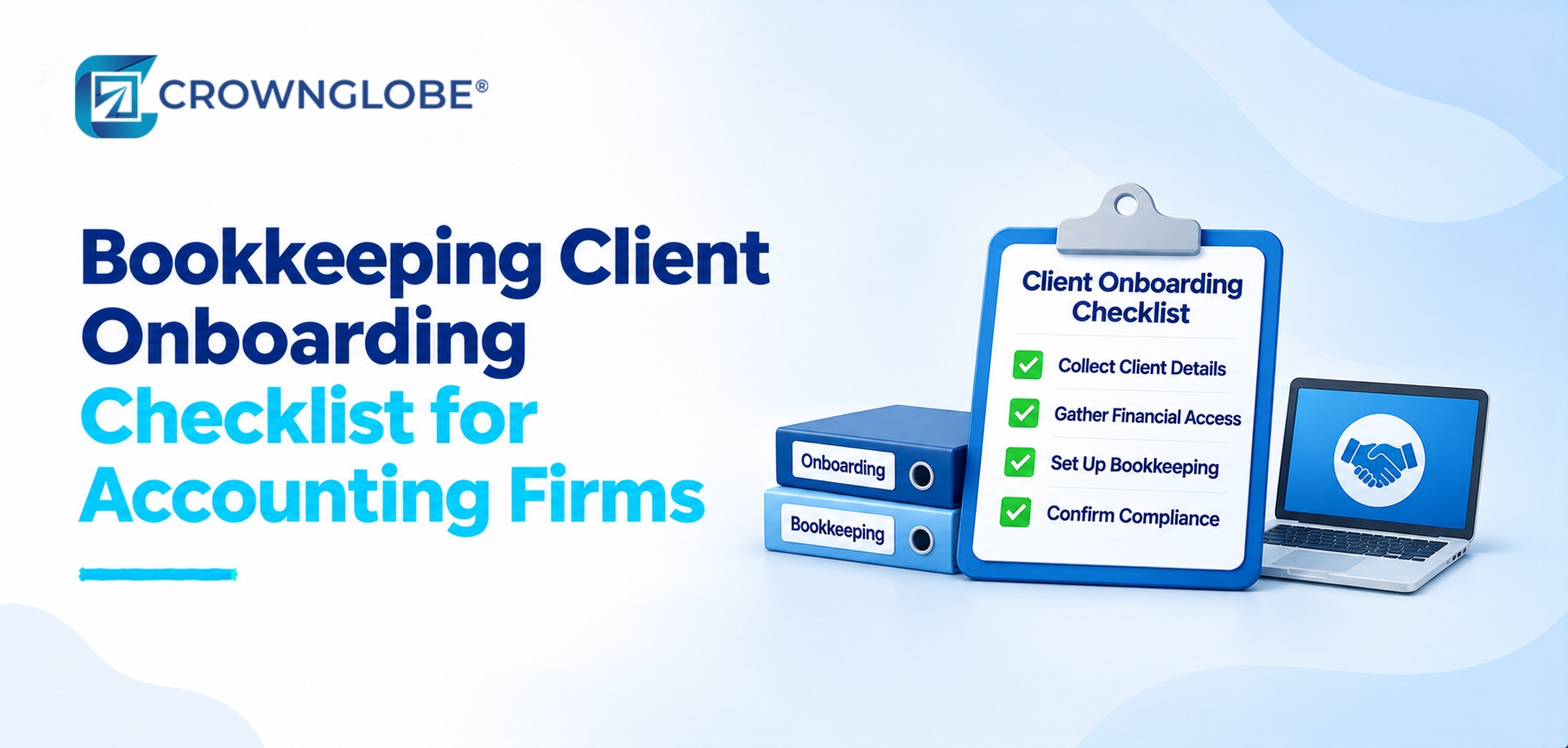
The process of onboarding of accounting clients must transition from scope agreement to a structured closure process whereby ownership is confirmed, record keeping is secure, access is defined, the difference between cleanup and other processes is defined, and reporting requirements are set.
However, the manner in which the records will be kept will depend on the client, their business type and even the industry. CrownGlobe's overview of industry-specific bookkeeping requirements provides broader context for firms serving different types of businesses.
Scope Before You Start
- For
- Accounting and bookkeeping firms
- Start
- Accepted client / agreed scope
- Groups
- 6
- Ends with
- First close completed and recurring ownership confirmed
Confirm Scope and Internal Ownership
It is important that the proposed engagement be turned into an implementation plan prior to any document or system request being made.
Confirm Scope and Internal Ownership
7 checks- Confirm the services in scope. Anything performed for the client including bookkeeping, reconciliations, AR/AP, payroll assistance etc. needs to be listed separately. This is possible once the delivery team has complete clarity on what falls in and what does not fall under the list.
- Confirm the effective start date. Acknowledge the period covered by your enterprise. This is possible if there is understanding between the two parties on the period covered by the previous work and the beginning of yours.
- Record material exclusions. Identify those activities that need approval or a second expert. Finished after the team knows what to avoid assuming.
- Assign a responsible partner or manager. There should be someone who will take charge of the problem, in the group. This can happen if there is an individual who is responsible for the escalation of the problem.
- Assign an onboarding owner. Finish onboarding without the help of a group. Complete it when one member is ready to check off the list.
- Confirm the primary client contact. Identify the individual responsible for answering questions, granting permission, and arranging for the provision of information that is lacking.
- Capture known filing, reporting, or operational deadlines. Include only deadlines that are relevant to the determined engagement. The task will be considered complete when the onboarding process covers all immediate dependencies.
The perfect orientation checklist in bookkeeping must be based on scope first because asking for permission without knowing what to do will mean doing the job twice.
Build the Client Profile and Secure Intake
Once the scope is defined, collect the required information to arrange the meeting without sending a lengthy request list to all the clients since most of them have nothing to do with it.
Build the Client Profile and Secure Intake
6 checks- Confirm the legal business name and relevant entities. The entities to be included must lie within the scope of the audit. The scope can be determined after the firm understands the accounting records to be included.
- Confirm fiscal year-end and accounting basis where known. When a team is able to understand the openings of records and reporting periods, they are ready for the task.
- Collect primary contacts and approval roles. Identify the individuals who are authorized to process payments, code data, and review reports, specifically those who are not implicitly authorized based on their position descriptions.
- Identify the accounting, payroll, payment, and document systems in use. Only include those systems which relate to the interaction. Completed once the access request is either prearranged or spontaneous.
- Use an approved secure route for sensitive information. It is essential to ensure that the taxpayer’s financial details are not collected through an IRS Publication 4557; in addition, the FTC has highlighted this point in regards to protecting the data.
- Set the communication channel. Determine the location of the routine inquiries, document’s requests and approvals; this job will be done when the client knows where to respond and the organization knows where to find them.
For a deeper discussion of safeguards around financial information, see CrownGlobe's guide to data security in bookkeeping outsourcing.
Set Up Access and Permissions
It is basically trying to ensure that the team has access to the task at hand without putting themselves in any kind of security risk.
Set Up Access and Permissions
6 checks- Request accountant or advisor access to the accounting platform where available. Utilization of user invites using the credential sharing platform should be carried out when the designated team has access to the books through their assigned roles.
- Confirm bank and card feed status. Determine what feeds will work, which feeds won’t, and which accounts are out of scope and be done when you have pinpointed exactly how the action at the source is going to get into the books.
- Set up payroll or payment-system access only if the service requires it. Completion refers to when the rights match the recognized responsibility.
- Review user roles and approval rights. These include the following: view, post, approve, and pay; all of these are permissions that must be considered individually.
- Identify an owner for access problems. When complete: the expiry of invitations, blocked accounts, or failure to grant permission can be escalated.
- Handle federal tax authorization only when relevant. While 2848 form relates to representation before the IRS and 8821 form is used to disclose tax information, neither of the forms is mandatory in terms of bookkeeping or onboarding process.
Total access occurs when the team is capable of doing the set work without there being the need for permission solely through password sharing.
Collect Historical Records and Diagnose the Opening Position
If you know the starting point, then periodic bookkeeping will be easy to stabilize and past cleanup efforts should not be confused with work.
Collect Historical Records and Diagnose the Opening Position
7 checks- Collect the latest available financial statements and trial balance or general-ledger detail where appropriate. Completion time: When the team identifies the accounting position.
- Gather bank and credit-card statements for periods that still need reconciliation. Timing of event: when there is unexplained time gap.
- Review AP and AR aging when those functions are in scope. Operated in the presence of open accounts and conspicuous exceptions.
- Collect relevant loan, fixed-asset, payroll, or other supporting schedules only where the engagement needs them. Time to stop: When material balance sheets or recurring activities are considered.
- Document prior bookkeeper or accountant handoff needs. When to do it: Open issues, documents and tasks assigned to someone.
- Create a missing-information list. Upon completion: the client will have a full understanding of why the initial review is not possible.
- Separate cleanup from recurring bookkeeping. Some historical errors, unresolved timeframes, or incomplete data may demand their own scope and clearance, which is achieved by the absence of any cleanup in the routine process itself.
This helps in separating old problems from those that have been created during the collaborative effort.
Lock the Recurring Workflow and Reporting Rules
The moment you find out the starting position, make the whole onboarding procedure routine.
Lock the Recurring Workflow and Reporting Rules
7 checks- Set the recurring document deadline. Tell the customer how many times statements, invoices, payrolls, and other agreed-upon data should be provided and keep doing so until the periodic instructions are placed on the calendar.
- Define who answers transaction questions. The process is concluded with the completion of the response to every exceptional or unclassified transaction.
- Document coding and approval rules. Write down the guidelines for every client that affect the process of continuous handling so that the team won’t need to make the same decision every month.
- Set the close calendar. Identify the expected deadlines for reconciliations, reviews, and reports and establish the point at which the monthly cycle is stabilized.
- Confirm the reporting package. Find out what kind of reports the client needs and how they will be evaluated. Consider your job done when the phrase “monthly reports” receives its practical meaning.
- Clarify AP, AR, payroll, and escalation handoffs where in scope. This happens when: recurring ownership becomes overt instead of being implied.
- Save the process as a reusable bookkeeping client onboarding checklist template. The visible checklist can be a beginning point for the companies that already have a visible checklist designed for every customer.
Complete the First Close and Move to Recurring Service
Access to the system alone does not mean that the process of onboarding is finished, and Onboarding is to be measured by whether the first cycle of reporting will be completed with the recognized exceptions and accountabilities.
Complete the First Close and Move to Recurring Service
7 checks- Address all in-scope bank and card accounts. Completion takes place when all reconciliations have been done totally or when all open items have been identified.
- Review opening balances and outstanding historical issues. Performed where there is splitting up of the list of tasks to be cleaned up, and preparation of clean-up tasks.
- Complete the first agreed close checklist. Completed once the company has undergone the cyclical process.
- Deliver the agreed reports. Timing: Once the reporting package has been submitted to the client through the onboarding process.
- Review open questions with the client. When complete: when there is ownership and next steps for all issues.
- Confirm recurring responsibilities and deadlines. Completed when: the team and customer understand what will happen each month without having to start the onboarding process again.
- Formally mark onboarding complete. Identification of: access issues, missing records, scope exemptions, and future responsibilities completed.
Define “done” before the first close. Completion of an effective standard means all the accesses required are available, the historical exceptions have been found, the first reporting cycle has been finished, and the owners for the future have been determined.
If your firm needs additional capacity after the handoff, review the bookkeeping services accounting firms commonly outsource and decide which work should remain internal.
Why the Order Matters
Each stage serves as the foundation; scope precedes access, access precedes processing, and knowing your position precedes repeat performance and proper closure for the first time before taking the relationship to the next level of conducting business.
Scope
Secure intake and access
Historical position
Recurring workflow
First close and handoff
This process will not eradicate all exceptions. Useful in detecting incomplete transactions and ownership problems.
Client’s onboarding process will only be completed when there is an operational readiness for the repeating process, and there must be clarity about the scope, access, exceptions, repetitive task reporting, and the first close in order not to rely on handover; clients’ onboarding process must always be clear.
Related bookkeeping and accounting resources
Use these resources when planning bookkeeping, payroll coordination or financial reporting alongside the work described in this guide.
- Boston bookkeeping services Local accounting, monthly close and financial reporting.
- Toledo bookkeeping services Local accounting, monthly close and financial reporting.
- Durham bookkeeping services Local accounting, monthly close and financial reporting.
- Fresno bookkeeping services Local accounting, monthly close and financial reporting.
Frequently Asked Questions
It should cover scope and ownership, secure intake, system access, historical records, recurring workflow rules, and first-close handoff. Exact records and permissions should reflect the services in scope.
Typical needs may include financial statements, ledger or trial-balance detail, relevant bank and card statements, AP/AR aging, and supporting schedules. Request only what the engagement and opening review require.
Request only the access needed for the agreed work, preferably through platform-supported accountant invitations and individual user roles. Avoid shared passwords when direct account-level access is available.
Identify records, reconciliations, schedules, questions, and unresolved items that still need to transfer. Separate historical cleanup from recurring work so prior-period responsibility is clear.
There is no universal number of days. A practical completion point is when required access is working, historical exceptions are documented, the first agreed close and reporting cycle has been completed, and recurring responsibilities and deadlines are confirmed.
Use approved secure systems for sensitive taxpayer and financial information, limit access to what the engagement requires, and follow applicable security obligations. IRS Publication 4557 and FTC safeguards guidance provide useful U.S. frameworks.
Sources & Further Reading
- Internal Revenue Service Publication 4557: Safeguarding Taxpayer Data
- Federal Trade Commission FTC Safeguards Rule: What Your Business Needs to Know
- Internal Revenue Service Power of Attorney and Other Authorizations
- Intuit Add clients to Intuit Accountant Suite
- Karbon Client onboarding for accounting firms: a guide plus 6 top tools
This article provides general educational information and is not individualized accounting, tax, legal, cybersecurity, or regulatory advice. Client onboarding requirements, data-security obligations, tax authorizations, records, and access needs vary by engagement and business. Use qualified professional advice where your facts or regulatory responsibilities require it.
Turn a repeatable onboarding checklist into a repeatable accounting workflow
A strong client handoff should make recurring work easier to own, review, and scale.