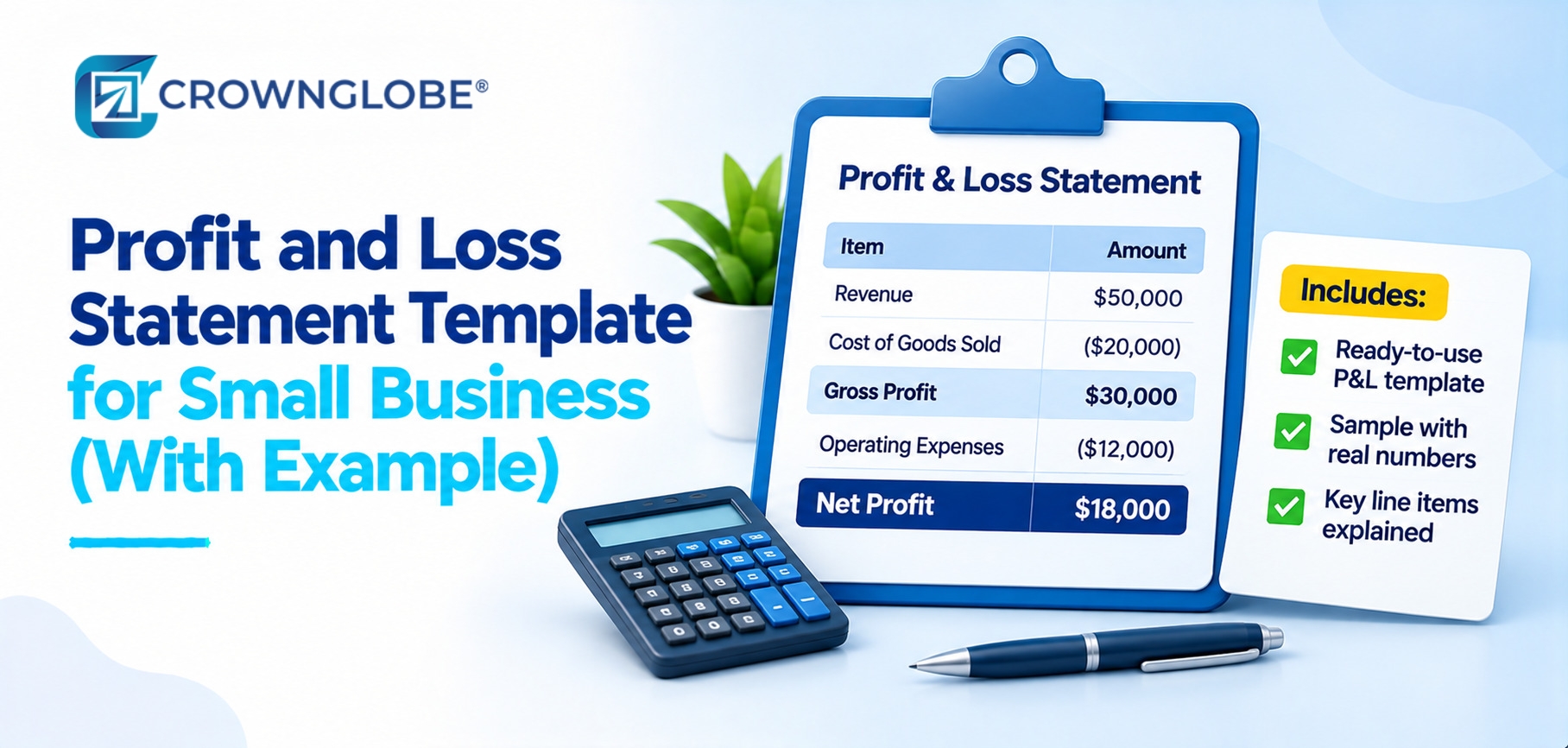
A Profit & Loss Statement shows whether there has been a profit or loss made by a business within a certain period of time by summarizing all income and expenses into one single statement.
The template provides the format while it is actually the classifying and checking of each line that adds value to it. The template is not valuable until after you have completed analyzing the final statement.
A profit and loss statement template is most useful when its line items are supported by consistent classifications and reliable accounting records.
Financial reporting needs can vary by business model, so owners may also benefit from reviewing CrownGlobe's industry-focused accounting context.
Scope Before You Start
- Scope
- Small-business historical profit and loss statement
- Reporting period
- Monthly, quarterly or annual
- Build from
- The business's accounting records
- Checklist
- 6 groups; finish with a reconciled, reviewed p&l
A P&L, also known as an income statement or statement of earnings should have a reporting period and accounting records from the first line, to the last.
Set the Scope Before You Enter Numbers
Before you post any revenue and expense accounts, you should know what you are supposed to see on the statement and how these will be backed by evidence.
Set the Scope Before You Enter Numbers
7 checks- Please verify the name under which the business is being run.
- State both start date and end date of the period of reporting.
- The statement provides actual values, while the forecast or the comparison, depending on the nature of the data or analysis being done, is provided.
- Use the accounting method shown in the books.
- Obtain the source data for that particular period, which is available in the accounting system/general ledger.
- If the goal is to compare performance, then have the previous period P&L available.
- Can you please let me know if the report is primarily aimed at managers, advisers, lenders, or anyone else?
The reporting period is important because the reporting period shows how well a business does over time and mixing transactions, from reporting periods can make the final result look finished but hard to understand.
A clear scope helps you determine which transactions belong in the report, which records back them up and what the final profit and loss statement should include.
Build Revenue and Direct Costs Correctly
The top half of a profit and loss statement usually starts with revenue then lists costs when those costs matter to the business.
Build Revenue and Direct Costs Correctly
6 checks- Match the reported revenue, with the sales or accounting records.
- Keep different income streams separate for clarity.
- Use returns, discounts or allowance rates consistently whenever applicable.
- Find the cost of goods sold or other direct costs that match the reported revenue, in one line.
- Keep costs separate, from general overhead when the business model allows for that distinction.
- Calculate gross profit consistently when COGS or direct costs are presented.
A sample profit and loss statement can make this section look straightforward because the formulas themselves are simple. The harder question is whether each figure comes from the right source and is being classified the same way from one period, to the next.
For example, gross profit is generally calculated by subtracting cost of goods sold from revenue. That subtotal becomes less useful when similar direct costs move between COGS and operating expenses across reporting periods.
Classify Operating and Non-Operating Items
Once revenue and direct costs are set look at the expenses and other factors that affect how well the business is doing.
Classify Operating and Non-Operating Items
7 checks- Group operational costs are constant across different periods.
- Ensure all costs associated with payroll and the workforce are included.
- Depreciation/amortization should be included in the accounting records, wherever necessary.
- Keep interest expense segregated where the format of the report demands.
- Examine any non-recurring gains and losses prior to incorporating them into the general overhead expenses.
- Check owner draws or distributions before treating them as business expenses.
- Check loan payments so principal is not automatically treated as a P&L expense.
The goal is to make the statement clear so the owner can see what caused the result not to make the list of expense categories.
Consistency matters here as well. When the same type of cost moves between categories from period to period, trend analysis becomes harder even if the overall expense total is correct.
Calculate the Bottom Line and Work Through the Example
The sample profit and loss account of a real world company demonstrates how the important subtotals interrelate in practice.
Calculate the Bottom Line and Work Through the Example
ExampleIllustrative only not a benchmark
| Line item | Example amount |
|---|---|
| Revenue | $120,000 |
| Cost of goods sold | ($45,000) |
| Gross profit | $75,000 |
| Operating expenses | ($55,000) |
| Operating income | $20,000 |
| Interest expense | ($2,000) |
| Income before income taxes | $18,000 |
The firm starts off with income of $120,000. We then subtract the cost of goods of $45,000 to arrive at a total profit of $75,000.
Operating income is $20,000 after subtracting $55,000 of Operating Expenses; meanwhile, $2,000 Interest Expense leads to $18,000 of income before tax.
These numbers are examples only and should not be considered goals or average industry numbers, nor should these numbers reflect the success of a company that runs with such margins.
What matters is the sequence: revenue, direct costs, gross profit, operating expenses and then other applicable items, before arriving at the profit or loss.
Reconcile the Statement Before You Rely on It
Completion of the template is the beginning of everything. It is imperative to tie the report back to the initial source before accepting the figures.
Reconcile the Statement Before You Rely on It
7 checks- Connect the P&L to the accounting system the ledger or the trial balance.
- Investigate negative balances or unusually large changes please give me in one line.
- Please compare revenue, gross profit and major expense categories with periods.
- Recheck the arithmetic behind gross profit, operating income and final profit or loss.
- Look for balance-sheet transactions that may have been posted to P&L expenses.
- Make sure that accounting profit is not the same as the cash, in the bank.
- Look at the P&L balance sheet and cash-flow statement to decide actions.
Profit and cash flow are. Not the same, because cash can change due to things, like borrowing, buying assets timing issues and other balance sheet activities not just profit or loss.
If the source books do not match the underlying records must be checked before the financial statement is finalized. CrownGlobe's guide to bookkeeping cleanup services explains what that process can involve.
A reconciled P&L is a starting point but it does not, by itself prove that every part of the accounting file is correct.
Make the Finished P&L Useful
A finished P&L should do more than sit in a folder; the final review should make the P&L easier to compare explain and use.
Make the Finished P&L Useful
7 checks- Add prior-period columns because prior-period columns help make numbers easier to interpret.
- Flag material changes of merely presenting totals without context.
- Keep line item labels line item labels across reporting periods.
- Retain supporting schedules for material balances where appropriate.
- Please provide the version that was actually reviewed then export or share it.
- Kindly note down the period during which reporting is done and when preparation/review is done.
- Establish the cycle for monthly, quarterly, or any other periodic reporting.
Using the same format when preparing a profit and loss account makes it useful, since the format enables easy comparison, thus providing owners with a clear picture of their firm’s performance.
The exact reporting package may also depend on who will use it. For one industry-specific example, see what owners and lenders expect from property-management financial statements.
Why the Order Matters
Define
Lock the period, the goal, and the source documents to reduce the possibility of using data from other periods and objectives.
Classify
Include the revenues costs, operating costs, and other such figures in the proper sections so that they can be compared from one period to another.
Calculate
Calculate the gross profit, operating income, and ultimately the net profit or loss based on the line items calculated above, in one line.
Reconcile
Connect the statement with the books studied and look for any balance or movement that is out of the ordinary before accepting the statement.
Review and share
Apply the revised format for management decision making while dealing with advisers and finance matters. It would be better if you can maintain the same format in the coming reporting period.
It can arrange the content of the report by using the Profit & Loss Statement Template. But it will not be able to resolve any problem of poor sources.
For the P&L to be accurate, the following two criteria have to be met: Each line item should be treated consistently, and a review should be conducted in writing before the statement is issued.
If the report is to be used for making an important decision concerning finance, taxes, accounting, or legal concerns, then the criteria should be met.
Frequently Asked Questions
A profit and loss statement is a financial report that summarizes revenue and expenses over a defined period and shows the resulting profit or loss.
It is used to understand financial performance over time rather than the financial position at one single date.
Generally, yes.
“Profit and loss statement,” “income statement” and “statement of earnings” are commonly used for the same core report showing revenue, expenses and profit or loss over a period.
A small-business P&L commonly includes revenue, cost of goods sold or other direct costs where relevant, gross profit, operating expenses and the resulting income or loss.
Additional lines may be appropriate depending on the business and reporting purpose.
Start by defining the reporting period and pulling the matching accounting records.
Enter and reconcile revenue, classify direct costs, add operating and other applicable expenses, calculate the subtotals, then compare the finished P&L with the underlying books before relying on it.
Use the accounting method that is appropriate for the business and consistent with the records from which the statement is being prepared.
Neither method should be treated as universally better for every company or every reporting purpose.
Confirm the reporting period, reconcile revenue and major expense categories to the books, review unusual changes, check the main calculations and make sure the version being shared is the version that was actually reviewed.
Requirements can vary by lender or adviser, so confirm any specific requested format or supporting schedules before submission.
Sources & Further Reading
This article provides general business and accounting information and does not constitute accounting, tax, legal, financial or lending advice. Financial-statement presentation and accounting treatment can depend on the business, reporting purpose, accounting method and applicable requirements. Confirm material reporting or financing decisions with the appropriate qualified professional.
Review Your Financial Reporting Before the Next Decision Depends on It
A well-structured P&L gives owners a clearer view of revenue, costs and operating performance. A reviewed P&L goes further by connecting those numbers back to the accounting records that support them.