Accounting & Automation for Gas Station & Convenience Store Owners
Fuel margins are very small inventory loss is a problem and compliance fines can put you out of business. Running a gas station and convenience store can be really tough because fuel margins are very small inventory loss is a problem and compliance fines can put a gas station and convenience store out of business that is why automation of bookkeeping for a convenience store is necessary.
Schedule a Free ConsultationAutomated Bookkeeping
Link your Point of Sale or Petrosoft system to get entries and make fewer errors.
Inventory & Shrinkage Control
I need to reconcile the fuel tank data manage the shrinkage reports and control the fuel tank losses.
Tax Compliance
All necessary Tax filings are submitted as required.
BI Reporting
The daily profit is shown on the dashboards for each location, pump and product, on the dashboards.
Gas Station & Convenience Store Accounting Challenges
Gas stations and convenience stores operate with high transaction volumes, low fuel margins, and complex financial workflows that require accurate bookkeeping and organized reporting systems. From fuel inventory tracking and POS reconciliations to supplier invoice management and tax compliance, even small accounting errors can impact daily operations and profitability.
Our accounting solutions help businesses manage fuel and non-fuel revenue tracking, monitor inventory shrinkage, reconcile fuel deliveries, and maintain accurate financial records. We also support payroll, sales tax, excise tax compliance, cash flow management, and multi-location reporting workflows.
With automated bookkeeping systems, improved financial visibility, and scalable reporting processes, we help gas stations and convenience stores reduce manual work and operate more efficiently. Our goal is to create reliable accounting systems that support profitability, compliance, and long-term business growth.
Contact Us

Fuel Margin Pressure
Gas station owners operate on very small fuel margins, so even small pricing or reconciliation errors can significantly impact profitability and cash flow.

High Transaction Volume
Multiple pumps, registers, and payment methods create hundreds of daily transactions that require accurate reconciliation and organized bookkeeping.

Inventory Shrinkage & Losses
Fuel shortages, inventory shrinkage, and missing store inventory can reduce profits if reconciliation and monitoring systems are not properly managed.

POS & Bank Reconciliation Issues
Differences between POS systems, fuel controller reports, and bank deposits can create reporting inaccuracies and accounting discrepancies.

Tax & Compliance Requirements
Gas stations must manage excise taxes, payroll filings, sales tax reporting, and fuel compliance documentation to avoid penalties and audit risks.
How Crownglobe Solves Them
Crownglobe brings gas-station expertise and automation to tackle these issues
Fuel vs Non-Fuel Separation
We configure your chart of accounts to tag every sale as "fuel" or "store." This reveals true profit margins per category.
Automated Transaction Capture
Integrations ingest data from POS and fuel controllers. As transactions occur, they’re auto-recorded in the books, reducing manual errors.
Inventory Tracking & SIR
We implement SIR processes. With automation of bookkeeping for convenience store operations, each delivery and sale is tracked automatically and any variances are quickly flagged.
Bank-POS Reconciliation
We check the Point Of Sale system every day and week to ensure the money matches what we receive so we can catch mistakes early, with the Point Of Sale system.
Vendor Invoice Matching
We go through the supplier statements. Our purchase records to find any duplicate or missing entries, in the supplier statements and our purchase records.
Tax Compliance Reports
With automation of bookkeeping for convenience store operations, our team keeps excise tax logs, sales tax reports, payroll tax filings, and all documentation organized so you’re always ready for tax season and state fuel audits.
Analytics & Alerts
Crownglobe dashboards show things like a fuel pump running when it should not be or inventory entries that are negative so that managers can take quick action, with Crownglobe.
Gas Station & Convenience Store Bookkeeping Services
Streamline fuel accounting, inventory tracking, POS reconciliation, and compliance reporting with bookkeeping solutions built for gas stations and convenience stores.

Fuel Sales Reconciliation
Track and reconcile fuel sales, pump transactions, and daily deposits accurately across all registers and payment systems.

Vendor & Accounts Payable
Manage fuel supplier invoices, store vendor payments, and recurring operating expenses with organized payable workflows.

Payroll & Workforce Management
Process payroll for multi-shift employees, track overtime, and maintain payroll tax compliance for store operations.

Inventory & Shrinkage Tracking
Monitor fuel inventory, convenience store stock, and shrinkage reports to reduce losses and improve inventory control.

Financial Reporting & Insights
Access detailed profit and loss reports, fuel margin analysis, cash flow visibility, and store performance reporting.

Budgeting & Cash Flow Planning
Plan for fuel price fluctuations, seasonal demand changes, equipment expenses, and long-term business growth with accurate forecasting.
Benefits of Specialized Gas Station Accounting
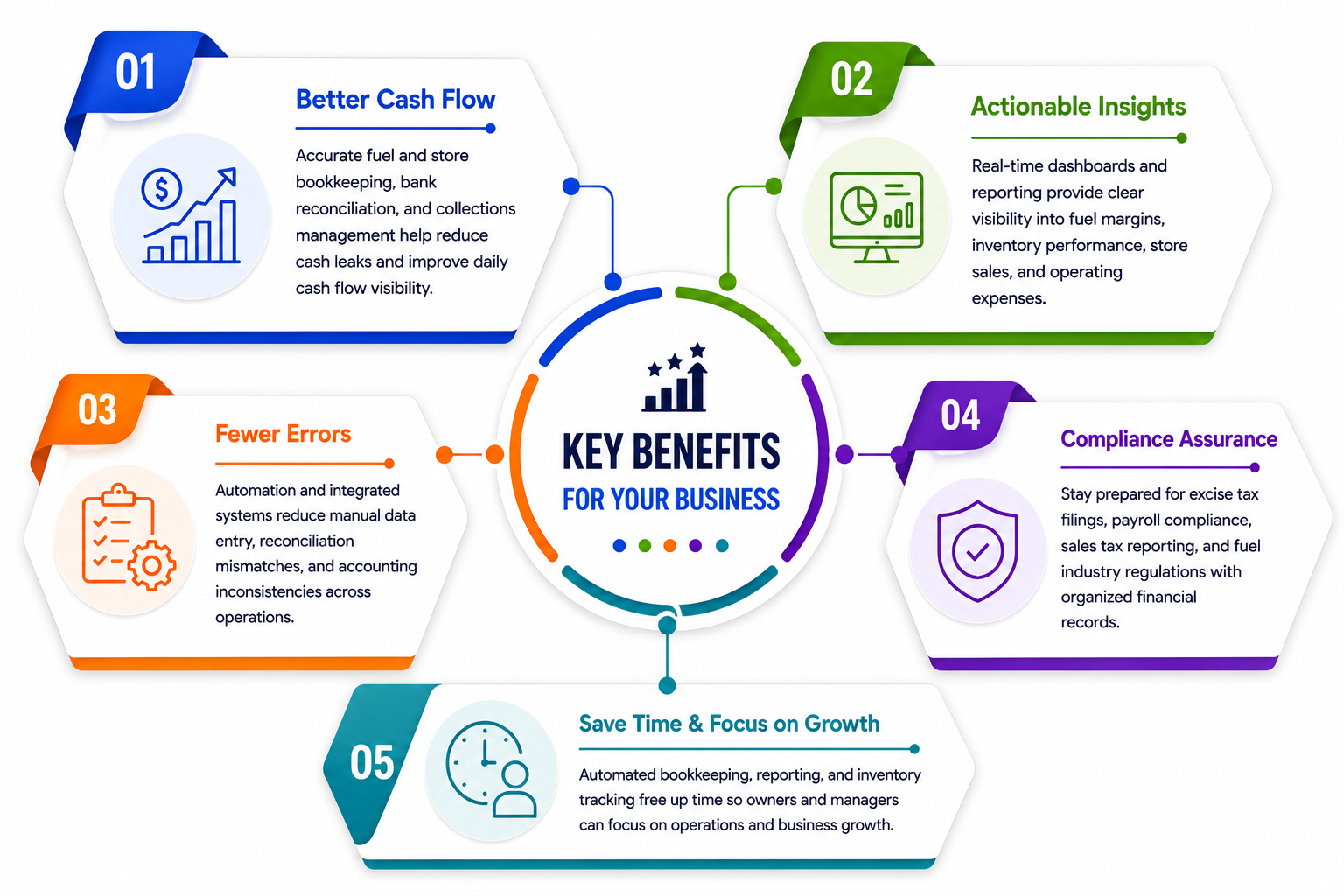
Better Cash Flow
Accurate fuel and store bookkeeping, bank reconciliation, and collections management help reduce cash leaks and improve daily cash flow visibility.
Actionable Insights
Real-time dashboards and reporting provide clear visibility into fuel margins, inventory performance, store sales, and operating expenses.
Fewer Errors
Automation and integrated systems reduce manual data entry, reconciliation mismatches, and accounting inconsistencies across operations.
Compliance Assurance
Stay prepared for excise tax filings, payroll compliance, sales tax reporting, and fuel industry regulations with organized financial records.
Save Time & Focus on Growth
Automated bookkeeping, reporting, and inventory tracking free up time so owners and managers can focus on operations and business growth.
Data-Driven Financial Strategy
KPI Dashboards
Track fuel margins, inside-store sales, inventory performance, labor costs, and daily cash flow with custom reporting dashboards.
Revenue Forecasting
Forecast revenue trends, manage fuel price fluctuations, and prepare for seasonal demand changes with accurate cash flow planning.
Profitability Analysis
Analyze profit margins by fuel category, product type, or store location to identify cost leaks and improve overall profitability.
Financial Planning
Plan future growth, equipment upgrades, staffing needs, and multi-location expansion with CFO-level financial guidance and budgeting support.
Case Study
Multi-Site Fuel & Convenience Retailer
Challenge
An owner-operator running several fuel and convenience locations had no reliable way to separate fuel margin from in-store margin. Daily POS totals, fuel drops and bank deposits were reconciled by hand and weeks in arrears, so shrinkage only came to light at the annual stocktake. Vendor invoices arrived in several formats and were matched inconsistently, leaving pricing discrepancies and rebates unclaimed. Management could see cash in the bank but could not say which site, or which product category, was actually making money.

Solution
Crownglobe rebuilt the chart of accounts so fuel and non-fuel performance report separately at every site. Transaction capture from the POS and fuel management system was automated and reconciled daily against bank and card settlements, surfacing variances within a day rather than at month-end. Inventory and stock-in-reserve tracking was tied back to purchase invoices, with vendor bills matched line by line against contracted pricing. Fuel and sales tax reports were scheduled to filing deadlines, and exception alerts were configured for margin drops and unusual shrink.
Results
Daily reconciliation replaced weeks-old manual work, giving the owner site-by-site and category-by-category margin within a day of trading. Shrinkage became visible continuously instead of once a year, and line-by-line invoice matching recovered pricing and rebate discrepancies that had previously been absorbed. Tax filings moved onto a fixed schedule, and the back-office time spent assembling numbers each month fell sharply, freeing the owner to focus on site operations and expansion.
Technology & Automation Solutions
Modern accounting technology and automation tools help gas station and convenience store owners improve accuracy, reduce manual work, and gain real-time financial visibility.

POS & Fuel Management Systems
Integrate POS platforms and fuel management systems like Petrosoft to automate sales tracking, fuel reconciliation, and inventory monitoring.
Cloud Accounting Platforms
Use QuickBooks Online or Xero for secure cloud bookkeeping, real-time reporting, and simplified multi-location financial management.
Payment & Scheduling Systems
Connect payment processors and operational tools to streamline customer transactions, vendor payments, and recurring billing workflows.

BI & Reporting Dashboards
Build custom dashboards with Power BI or Tableau to monitor fuel margins, inventory trends, daily sales, and operational performance.
Workflow Automation
Automate invoice entry, bank reconciliation, expense tracking, and financial reporting using AI-powered accounting and OCR tools.
Engagement Models
Start with Standard $125/ Per Month Ideal for steady-volume stores. Flat fee covers all standard accounting and reporting.
Start with Growth $245/ Per Month Fee adjusts with volume; suited for seasonal traffic.
Start with Virtual CFO $345/ Per Month .Includes daily bookkeeping plus strategic BI reporting and monthly review sessions.
FAQs
Bookkeeping for a gas station and convenience store includes daily sales capture, fuel vs. non‑fuel separation, deposit reconciliation, vendor invoice entry, inventory tracking, and tax-ready reporting. Because fuel profit can be only a few cents per gallon after expenses, clean categorization and reconciliation are essential to see true profitability.
You need fuel vs. non‑fuel separation because fuel and inside-store items typically have very different margin structures; combining them hides which stream is actually profitable. NACS notes average fuel profits after expenses can range roughly 5–10 cents per gallon, so misclassification can erase meaningful profit visibility.
Automation of bookkeeping for convenience store operations means integrating POS and fuel/back-office systems so sales, tenders, and inventory movements flow into accounting with fewer manual entries. The goal is to reduce human error and then focus staff time on reviewing exceptions and variances.
Yes, Petrosoft documentation describes integrating its CStoreOffice back-office system with QuickBooks Online by aligning the chart of accounts and copying transaction data into QBO for centralized reporting and reduced manual entry.
SIR (statistical inventory reconciliation) is an EPA-recognized internal release detection method for underground storage tanks that uses statistical analysis of inventory, delivery, and dispensing data. In accounting terms, SIR variance signals are operational “red flags” that should trigger investigation and documentation for shrink/theft/leak prevention.
We reconcile POS daily/weekly totals to bank deposits using standardized clearing accounts and exception review, so mismatches are caught early rather than at month-end. This is especially important in a high-volume industry where small discrepancies compound quickly.
We reduce manual entry by using integrations and automation to ingest summarized POS/fuel data into the ledger and then perform routine reconciliation and variance checks. Petrosoft positions its back-office tools around speeding up data entry and reconciliation to optimize c-store operations.
Yes, fuel delivery volumes and supplier invoices should be matched to validate costs, detect missing invoices, and reduce overcharge risk. This vendor matching is a central control in fuel accounting because it anchors COGS to real deliveries.
We use inventory variance routines (including SIR for fuel where applicable) and exception reporting to identify unusual losses or data issues. The EPA recognizes SIR as a release detection method, and Petrosoft describes its back-office approach as helping reduce shrink/spoilage.
Many operators must stay current on fuel excise tax obligations and related reporting, plus employment/payroll taxes and state/local sales tax rules. The IRS identifies Form 720 as the quarterly federal excise tax return and Publication 510 as the core excise tax reference.
If you have foodservice operations with tipped employees, you may need stronger tip recordkeeping and reporting routines. The IRS provides guidance stating tipped employees must report tips to their employer and employers must report wages/tips and file required employment tax forms.
Payroll Processing
Weekly dashboards should show fuel vs. non‑fuel gross profit, margin per gallon, inside sales trends, shrink/variance alerts, and deposit exceptions. NACS highlights that fuel profits after expenses can be only a few cents per gallon, making margin visibility a must-have KPI.
It can be secure when controls like MFA, RBAC, and audit logging are implemented. NIST recommends MFA as a key control for protecting internet-enabled services, and NIST logging guidance frames logs and log management as essential for event traceability and retention.
A basic integration and chart-of-accounts setup can often be completed quickly, then refined over the first monthly close cycle as exceptions are identified and rules are tuned. Petrosoft’s QBO integration approach explicitly aims to keep chart of accounts aligned and reduce discrepancies, which supports faster stabilization after setup.
Virtual CFO support is most valuable when you need pricing/cash planning guidance, expansion decisions, lender support, or multi-location performance management beyond routine bookkeeping. CFO-level reporting becomes more critical as fuel price swings and operational risks increase the need for proactive cash management.
Virtual CFO Services
Accelerate Your Business Growth
Discover our core solutions designed to streamline your financial operations and branding.
Fuel your profits, not your stress
Let Crownglobe handle the accounting details so you can focus on customers. Schedule your free consultation today to see how automation and expertise can transform your books.
Schedule a Free Consultation