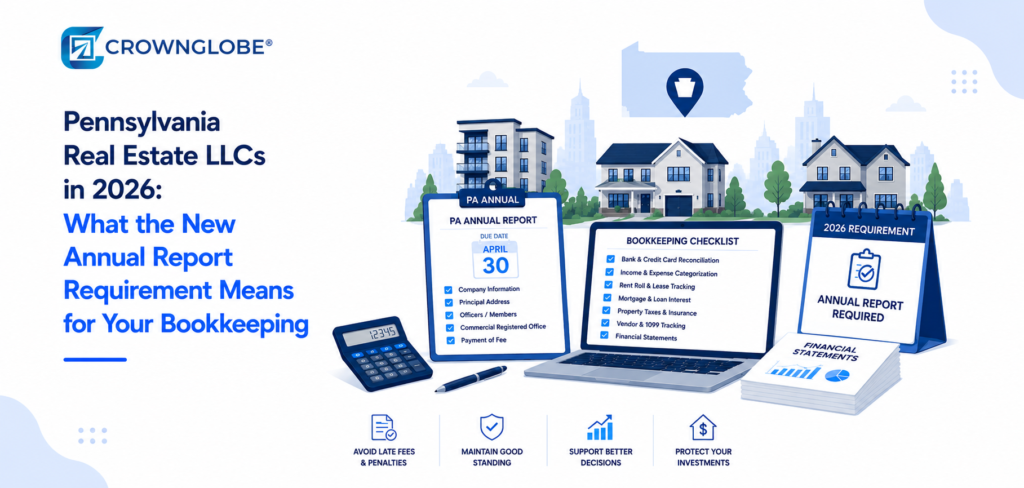
If you own a Pennsylvania real estate LLC the states new annual report requirement is not something to put off. With the 2025 reporting rules, in effect your real estate business must keep accurate records all year.
For owners filing is straightforward but ensuring the information, behind it is accurate, complete and backed by reliable records is a bigger challenge.
That is why strong real estate bookkeeping has become increasingly important. Good bookkeeping is important, for your business because it helps with tax preparation and also protects your business standing and supports compliance requirements.
Understanding Pennsylvania’s New Annual Report Requirement
For years, Pennsylvania operated differently from many other states by not requiring most domestic LLCs to submit annual reports.
Things changed when they introduced rules that said we have to do reports every year starting from 2025.
As a result Pennsylvania LLCs have a compliance obligation that business owners need to plan for every year with Pennsylvania LLCs needing to meet this obligation.
For people who invest in estate and for broker-principals, property managers and owners with multiple LLCs this change is a big deal. It reminds real estate investors and owners with LLCs that they need to keep their records organized and up, to date all year long instead of waiting until the last minute to get everything in order before a deadline.
It is important to remember that the annual report is not a tax return.
The information you report should match what is, in your ownership records, entity information and your business structure.
When bookkeeping records are incomplete or outdated, even relatively simple compliance tasks can become more complicated than they need to be.
Why This Matters for Pennsylvania Real Estate LLC Owners
Many real estate businesses choose the Limited Liability Company structure because the Limited Liability Company offers protection and flexibility as the real estate business grows.
Over time, however, those entities rarely stay the same.
New members join.
Properties are purchased or sold.
Management responsibilities change.
Additional entities may be created to support new investments.
As these changes accumulate, keeping accurate records becomes more challenging.
Professional real estate accounting is really important. It helps you keep track of everything and makes sure you are doing things correctly. When you have records like what you get from a real estate accountant or special bookkeeping software, it is easier to make good decisions for your real estate business.
A well-maintained accounting system helps business owners:
- Keep ownership records accurate
- Support annual compliance requirements
- Track activity across entities correctly
- Produce reliable financial statements
- Improve lender and investor reporting
- Simplify tax preparation
- Reduce year-end cleanup work
People who own businesses and keep track of their finances all year round usually do not have to spend a lot of time fixing mistakes when it’s time to report their finances.
The Connection Between Annual Reports and Bookkeeping
Many business owners view annual reports as purely administrative filings.
In practice, they often expose weaknesses in a company’s recordkeeping process.
Before filing, owners commonly ask:
Common Questions Business Owners Ask
- Is our registered office information current?
- Have ownership changes been properly documented?
- Are all LLCs still active and necessary?
- Do our financial records accurately reflect operations?
- Are entity records consistent across all business documents?
These questions are easier to answer when bookkeeping is done consistently.
Strong accounting, real estate businesses help to keep track of who owns what money is spent. What changes are made to the business throughout the year. Effective property accounting practices also help owners track entity performance, maintain accurate records, and support annual reporting requirements.
That documentation becomes invaluable when compliance requirements arise.
Bookkeeping Areas Pennsylvania Real Estate LLCs Should Review
Ownership and Entity Records
Many real estate investors operate more than one entity.
Some maintain separate LLCs for each property, while others use holding companies, management companies, and investment partnerships.
Before annual reporting deadlines, review:
- Ownership percentages
- Member records
- Registered business information
- Entity status
- Formation documents
Even small discrepancies can create avoidable filing issues later.
Financial Statement Accuracy
Accurate financial statements remain one of the strongest indicators of healthy bookkeeping.
Business owners should regularly review:
- Profit and Loss Statements
- Balance Sheets
- Cash Flow Statements
- Property-level reports
- Entity-level reports
Companies that invest in professional financial statement preparation services often identify reporting concerns long before they become compliance problems.
Bank and Credit Card Reconciliations
One of the most common issues we see involves accounts that have not been reconciled for months.
When transactions go unchecked, reporting accuracy gradually begins to deteriorate.
Before annual reporting season, make sure to:
- Reconcile all bank accounts
- Reconcile credit card accounts
- Verify loan balances
- Review owner distributions
- Validate intercompany transactions
These steps support both compliance and better financial decision-making. For businesses managing rental properties, consistent rental property accounting and accurate accounting for rental properties help ensure that reporting remains reliable throughout the year.
Common Real Estate Bookkeeping Mistakes That Create Compliance Problems
Mixing Personal and Business Transactions
This remains one of the most common mistakes among smaller real estate businesses.
When personal expenses are paid through business accounts, financial reporting becomes less reliable and compliance reviews become more difficult.
Poor Documentation of Ownership Changes
Real estate partnerships often evolve over time.
When ownership changes are not documented properly, entity records can quickly become inaccurate.
Delayed Bookkeeping
Many owners delay bookkeeping until tax season arrives.
Unfortunately this approach often results in missing transactions, reports and extra cleanup work.
Businesses relying on bookkeeping services, for real estate companies usually find it easier to stay organized and compliant all year. This is particularly true for brokerages and firms requiring bookkeeping for real estate agents or multi-property reporting support.
Inconsistent Reporting Across Multiple Entities
Multi-entity real estate structures require disciplined recordkeeping.
Each entity should maintain its own books, bank accounts, and reporting processes.
Keeping everything separate helps reduce confusion and improves reporting accuracy.
How Technology Can Help Pennsylvania Real Estate LLCs Stay Compliant
Modern accounting tools can simplify many aspects of bookkeeping.
Today’s real estate accounting software, QuickBooks for real estate, and other specialized platforms can help businesses:
- Automate transaction imports
- Improve reconciliation workflows
- Generate financial reports more efficiently
- Maintain organized documentation
- Strengthen audit readiness
Technology can certainly improve efficiency, but software alone is not a complete solution.
Even with the best accounting software, real estate investors still need setup, proper transaction coding, and regular reviews to work well.
Successful businesses use technology and good accounting processes. They also keep a close eye on things. Business owners can use QuickBooks or the best accounting software for real estate, but it is still helpful to have a professional look, at the numbers and give guidance to make sure everything is reported correctly.
Why Annual Reporting Is a Good Time for a Financial Health Check
The annual report requirement provides more than a compliance obligation.
It creates a natural opportunity to evaluate the overall health of your business.
Rather than viewing the filing as another administrative task, use it as a checkpoint to ask important questions:
- Are our financial reports accurate?
- Are properties performing as expected?
- Is cash flow improving or declining?
- Are ownership records fully updated?
- Are all existing entities still necessary?
Many Pennsylvania business owners use this period to complete a broader review of operations, financial performance, and internal processes.
For growing firms, combining year-end finalization and annual checkup services, professional bookkeeping support, and business tax filing assistance can help ensure records remain organized and compliance requirements stay on track.
Pennsylvania Real Estate LLC Annual Report Preparation Checklist
Entity Review
- Confirm entity information is current
- Verify ownership records
- Review registered office information
- Validate member records
Financial Review
- Update bookkeeping records
- Review financial statements
- Reconcile bank accounts
- Verify outstanding liabilities
Compliance Review
- Confirm filing deadlines
- Review entity status
- Validate documentation
- Ensure records remain organized
Operational Review
- Review property performance
- Evaluate cash flow trends
- Assess reporting processes
- Identify bookkeeping gaps
Practical Tip for Real Estate Owners
Do not wait until the annual report filing deadline is approaching to begin preparing your report.
Businesses that review their books quarterly usually have problems, with reporting and a lot less risk of not following the rules.
A good bookkeeping process really helps you find mistakes early keep records and reduce the stress that comes with filing deadlines, for your bookkeeping.
It is also an excellent opportunity to evaluate whether your current entity structure, reporting process, and accounting systems still support your long-term growth goals.
Conclusion
Pennsylvania’s annual report requirement has introduced a new compliance responsibility for real estate LLC owners, but it also presents an opportunity.
While filing may be straightforward for good information, behind it needs bookkeeping organized entity records and reliable financial reporting.
Strong real estate bookkeeping and real estate accounting practices help business owners file reports accurately reduce compliance risks and understand their financial position clearly.
Rather than seeing annual reporting as just a yearly chore use it to improve your records, get more accurate reports and build a better financial base, for future growth.
FAQ Section
Do Pennsylvania LLCs have to file an annual report in 2026?
Yes. Pennsylvania’s annual reporting requirement applies to LLCs and other business entities. Business owners should verify current filing deadlines and requirements directly with the Pennsylvania Department of State.
Does the annual report include financial information?
The annual report is not a tax return. However, maintaining accurate financial records helps ensure that supporting business information remains consistent, organized, and current.
Why does bookkeeping matter for annual report compliance?
Accurate bookkeeping supports ownership records, entity information, and financial reporting, making annual compliance requirements easier to manage and reducing the likelihood of filing issues.
Should real estate investors maintain separate books for each LLC?
In most situations, yes. Separate books improve reporting accuracy, simplify compliance, and provide clearer visibility into the performance of each property or entity.
What accounting software is best for real estate businesses?
The best solution depends on the size and complexity of the business. Many real estate owners use QuickBooks and other real estate accounting software platforms to improve bookkeeping efficiency and reporting accuracy.