12 questions. 2 answer patterns for each. 1 controlled pilot before expanding scope.
Outsourcing bookkeeping is not an all-or-nothing decision. The more useful question is not, “Can someone else do our books?” It is, “Which responsibilities can move outside the dispensary without weakening the operating controls and source records the books depend on?”
Bookkeeping for dispensaries sits directly between day-to-day operations and the accounting records. POS activity, cash, deposits, inventory records, supporting documents, and the general ledger still need to connect in a way that can be reviewed and explained.
For broader context on the delivery-model decision, see CrownGlobe's guide to in-house vs. outsourced bookkeeping.
The questions
Twelve Questions to Ask Before Outsourcing Dispensary Bookkeeping
1
Which bookkeeping tasks will you own, and which stay with our dispensary team?
- Strong answer
- The provider gives you a written responsibility map that names the recurring tasks it will perform, the records your team must provide, the approvals management retains, and the activities that remain outside the engagement.
- Weak answer
- “We handle everything.” It sounds convenient, but it leaves too much room for assumptions about cash, inventory, approvals, tax work, and operational records.
2
How will you reconcile POS sales, cash, deposits, and the general ledger?
- Strong answer
- The provider can walk you through the reports it uses, how sales and tender information are matched to deposits and accounting records, how differences are documented, and who follows up on exceptions.
- Weak answer
- POS totals are imported or posted with no clear process for proving them against cash, bank activity, or other source records.
3
How will inventory records connect to the books?
- Strong answer
- Purchasing, inventory adjustments, physical counts, accounting entries, and unexplained differences have named owners. The provider understands what information must come from operations and what needs to be reconciled before the books are closed.
- Weak answer
- Inventory is treated as someone else's problem even though inventory activity affects the accounting records.
4
How do you handle seed-to-sale or track-and-trace data where it applies?
- Strong answer
- The provider first asks which systems and regulatory records apply to your licenses, then explains how those records will be compared with POS, inventory, and accounting data where relevant.
- Weak answer
- The provider assumes every dispensary uses the same track-and-trace platform or treats regulatory data as interchangeable with accounting records.
Metrc is one example of a track-and-trace platform, but requirements vary by jurisdiction and license type.
5
How do you support COGS without making tax assumptions for us?
- Strong answer
- The provider focuses on accurate purchasing, inventory, cost, and supporting records, and clearly identifies where tax-sensitive decisions or positions require the appropriate tax professional.
- Weak answer
- The provider promises to “maximize COGS,” maximize deductions, or make broad tax claims before understanding the business, license structure, or applicable rules.
6
What exactly happens during month-end close?
- Strong answer
- The provider can explain the close checklist, reconciliations, review layer, supporting schedules, unresolved-item process, and what “closed” means for your engagement.
- Weak answer
- “We send financial statements every month” is the full explanation. Reports are useful only if the underlying accounts have been reconciled and reviewed.
7
Who reviews the work, and what happens when our main bookkeeper is unavailable?
- Strong answer
- You know who performs the work, who reviews it, how questions are escalated, and what backup coverage exists when the primary contact is unavailable.
- Weak answer
- The engagement depends entirely on one person, with no visible review process or continuity plan.
8
What records and access do you need from us?
- Strong answer
- The provider gives you a practical list covering bank and accounting access, POS reports, invoices, receipts, payroll information when relevant, inventory records, and the people responsible for answering questions.
- Weak answer
- You are told that outsourcing means your internal team will have little or nothing to provide.
The IRS emphasizes keeping records that support income, expenses, inventory, and other business transactions. Outsourcing bookkeeping does not eliminate the business's responsibility to maintain complete records.
9
How are cash differences and other exceptions handled?
- Strong answer
- Differences remain visible until they are investigated, documented, and resolved or formally escalated. The provider can tell you who is responsible for follow-up.
- Weak answer
- Differences are cleared with unexplained adjustments simply to make an account balance.
10
Which systems will you work in, and who owns mappings and integrations?
- Strong answer
- The provider identifies the accounting platform, POS, payment sources, inventory tools, and applicable track-and-trace systems, then explains who owns mappings, imports, integrations, and exception review.
- Weak answer
- “Our automation handles it” without a clear answer for who checks whether the data actually reconciles.
Software familiarity helps, but it does not replace a defined reconciliation process.
11
What is outside the bookkeeping scope?
- Strong answer
- The engagement spells out whether tax returns, payroll processing, sales or excise filings, historical cleanup, regulatory advice, controller work, CFO support, and other services are included or excluded.
- Weak answer
- The provider leaves the boundary vague and relies on “additional work” language whenever something falls outside routine bookkeeping.
Separate recurring cannabis bookkeeping services from tax, compliance, payroll, and advisory work that may require a different scope.
12
How will we transition or test the service before expanding scope?
- Strong answer
- The provider agrees on the starting records, access, responsibilities, deliverables, review points, and success criteria before broadening the engagement.
- Weak answer
- The business moves everything at once before the provider has demonstrated that the source data, handoffs, and review process work.
A controlled transition can surface missing records, unclear ownership, and system issues before they become recurring problems.
Your side
What the Dispensary Has to Keep In-House
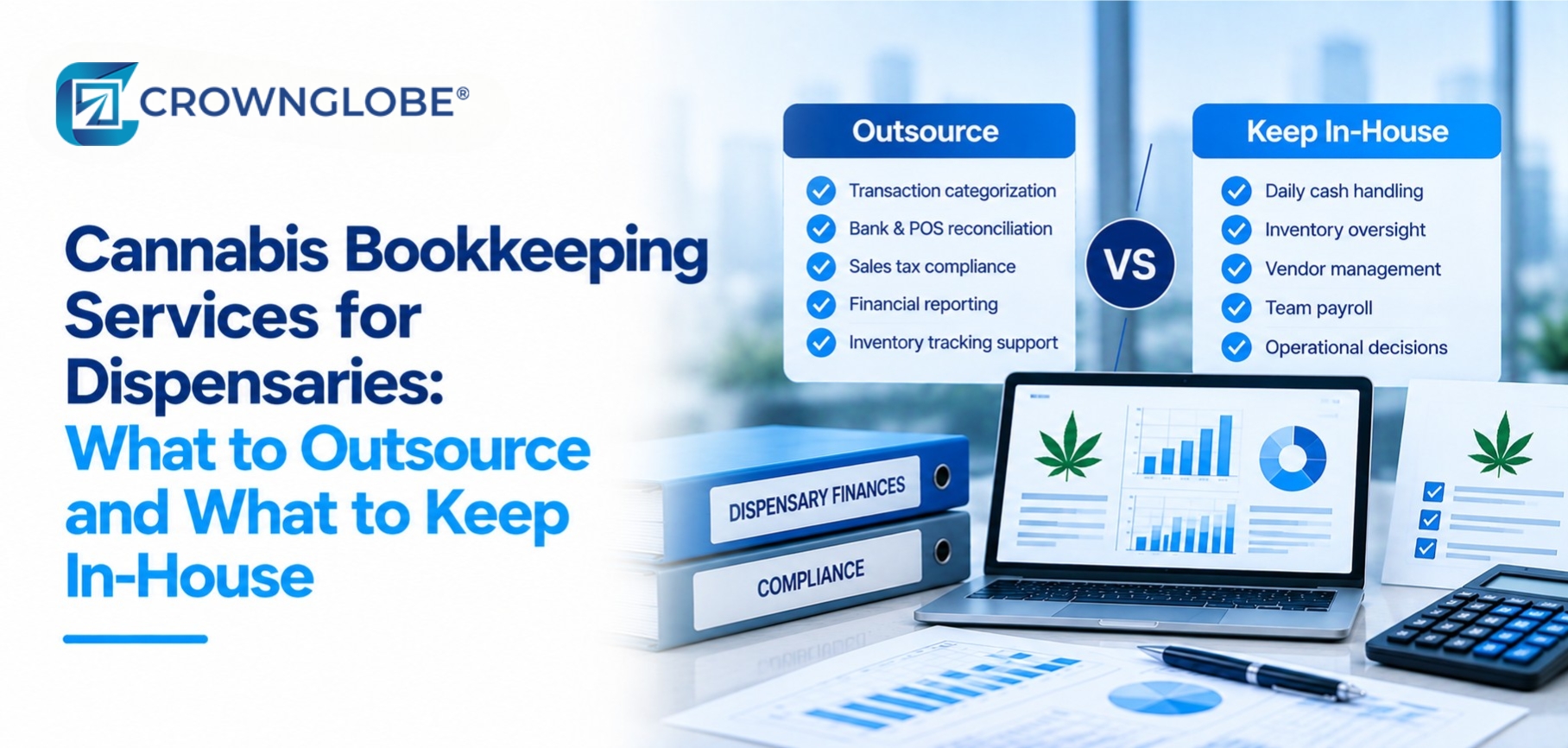
The most practical split is between physical and management ownership inside the dispensary and recurring financial execution on the provider side.
Keep operational ownership in-house
- Physical register, vault, and cash counts
- Physical inventory counts
- Capturing receipts, invoices, and other source records
- Documenting returns, voids, discounts, and operational adjustments
- Approving payments and material adjustments
- Maintaining required license and operating processes
- Responding to provider questions
- Management review and sign-off
Provider can execute or support when contracted
- Transaction coding and general-ledger maintenance
- Bank and POS-to-ledger reconciliation
- Accounts-payable bookkeeping
- Payroll journal entries when payroll processing is elsewhere
- Inventory-accounting reconciliation using records supplied by operations
- Month-end close and supporting schedules
- Financial reporting
- Clean bookkeeping schedules for tax/accounting handoff
The IRS advises businesses to maintain records supporting receipts, purchases, expenses, inventory, and other transactions, and to reconcile business accounts regularly. That makes the internal record handoff essential.
Before expanding
Structure a Pilot Instead of a Leap
A bounded pilot gives both sides a chance to test the working relationship before the scope expands.
1
Pick a bounded scope
Start with a practical unit such as one entity, one task set, one location, or one close cycle, depending on how your operation is structured.2
Write the deliverables down
Document the records to be provided, accounts to be reconciled, review steps, reports, timing expectations, exclusions, and owners on both sides.3
Watch the exceptions
Pay attention to what happens when a receipt is missing, a POS total does not tie, inventory information arrives late, or the provider needs a management decision.4
Review before expanding
Use the pilot to decide what should change before adding more entities, locations, tasks, or advisory work.For a broader view of outsourcing advantages and tradeoffs, see CrownGlobe's guide to the benefits of bookkeeping outsourcing.
The strongest outsourcing relationships start with explicit ownership. A useful provider should document what it owns, what the dispensary retains, what is shared, and how exceptions move between the two.
Questions
Questions Dispensary Owners Ask About Outsourcing Bookkeeping
Repeatable accounting execution is the clearest starting point: transaction coding, bank and POS reconciliation, general-ledger maintenance, month-end close, reporting, and agreed inventory-accounting support. Scope still depends on the dispensary's systems, team, licenses, and provider capabilities.
Keep internal ownership of physical cash and inventory counts, source records, approvals, license-related operating processes, and management decisions. An outsourced cannabis bookkeeper can use those records without owning the underlying operating events.
Typical scope can include transaction coding, reconciliations, AP bookkeeping, general-ledger maintenance, month-end close, reporting, and agreed inventory/COGS support. Tax, payroll, regulatory, cleanup, and CFO work should be separately identified.
Use a regular close cadence appropriate to the business. Bank, POS, inventory-related, and other material accounts should be reviewed consistently, with unresolved differences kept visible.
Yes, if the provider supports your systems and the engagement defines who owns access, mappings, data feeds, reconciliations, and exception follow-up. Verify capability with your actual POS, accounting, inventory, and track-and-trace tools.
Use a documented handoff covering the trial balance, reconciliations, open issues, inventory support, recurring journal-entry documentation, source-record access, close checklist, report definitions, and responsibilities. Confirm what your business receives before access is removed.
Sources & Further Reading
- Internal Revenue Service, Publication 583 Starting a Business and Keeping Records: irs.gov
- Internal Revenue Service, How should I record my business transactions?: irs.gov
- Metrc, official cannabis track-and-trace platform information: metrc.com
- U.S. Department of Justice / Drug Enforcement Administration, April 28, 2026 marijuana scheduling final rule, for current federal scheduling context where tax treatment is discussed: federalregister.gov
Disclosure: CrownGlobe provides outsourced accounting services and therefore has a commercial interest in this topic. Use the questions in this guide to evaluate CrownGlobe and other providers against the same scope, handoff, review, and continuity standards.
General information disclaimer: This article is for general informational purposes only and is not legal, tax, accounting, investment, or regulatory advice. Requirements and tax treatment can vary by entity, activity, license, jurisdiction, and facts. Consult appropriately qualified professionals for advice specific to your business.