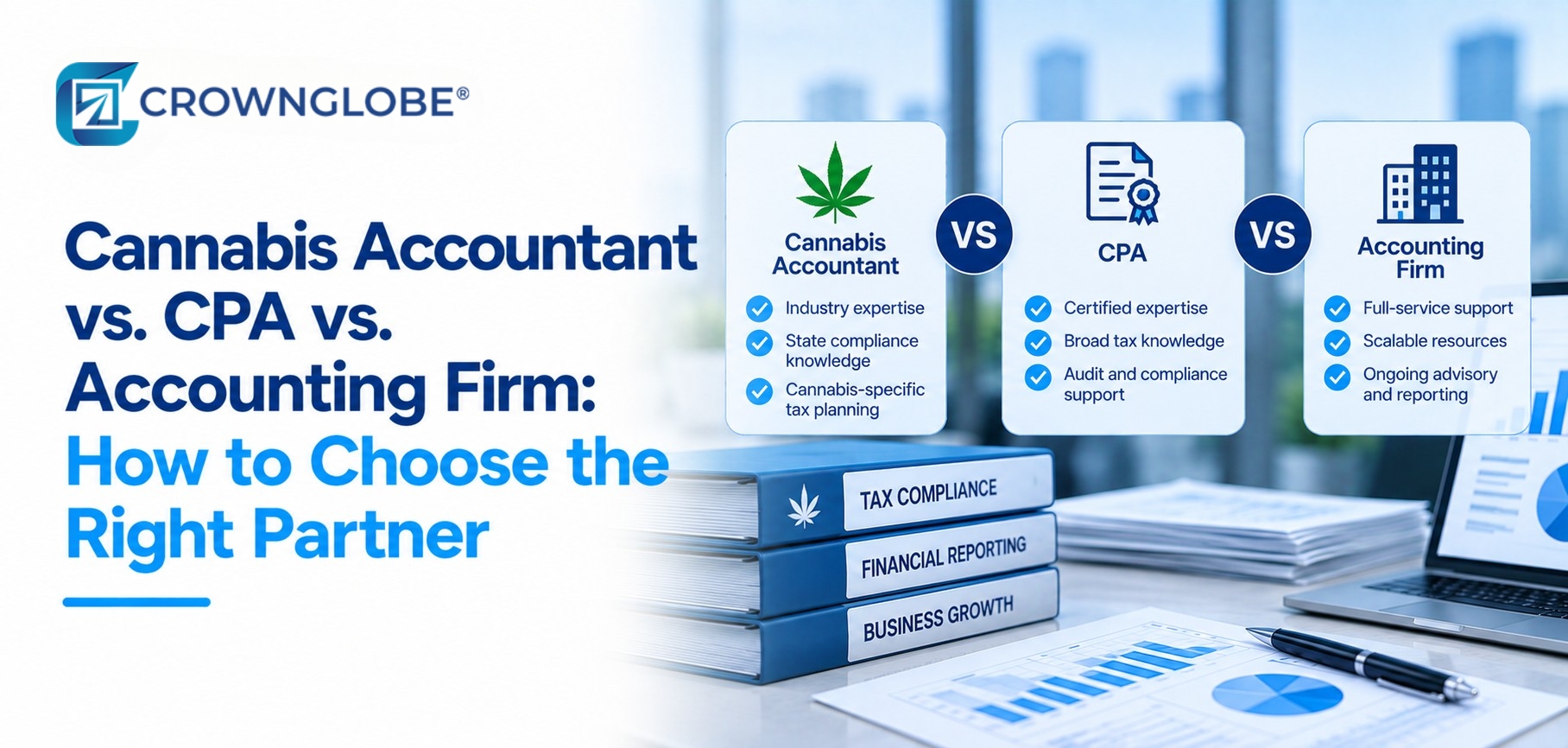
The verdict, before the reasoning
Choose a cannabis accountant ifYour main need is recurring accounting things, like closing books, reconciliations, schedules, reporting support and financial organization. The person must have relevant cannabis experience.
Choose a cannabis CPA ifThe engagement specifically calls for a state licensed CPA. The engagement also needs tax and representation capabilities that the individual CPA's qualified and engaged to provide. A CPA credential alone does not mean that every bookkeeping, inventory or operational workflow is included. Having a CPA credential is helpful. It does not cover all the day‑to‑day tasks.
Choose a cannabis accounting firm ifYou need a team to cover recurring accounting, inventory and cost accounting support, tax coordination, controls, reporting, systems and continuity.
Choose a hybrid model ifRecurring accounting is handled by one team while tax, legal, assurance or other specialist work stays with the professional.
The practical question is: what work must be owned, who is qualified to own it, who reviews it, and what happens when the scope becomes more complex?
01 · Scored
Cannabis Accountant vs. CPA vs. Accounting Firm: The Three Models, Scored
Start by separating the credential from the delivery model. “CPA” is a professional credential issued by state boards of accountancy. “Accountant” describes a role. “Accounting firm” describes an organization that may employ accountants, CPAs, tax professionals, controllers, and other specialists. Those labels can overlap.
Score each candidate from 1 to 5 based on the people and processes that will actually serve your business. The suggested weights below are a starting point, not an independent industry ranking.
| Dimension | Suggested weight | What to verify |
|---|---|---|
| Cannabis and license type experience | 25% | Relevant operator types, workflows, and review of your regulatory/accounting environment |
| Monthly close and reconciliation | 20% | Close calendar, reconciliations, schedules, review, and escalation |
| Credential and representation capability | 15% | The right licensed or authorized professional for work actually in scope |
| Inventory, cost accounting, and COGS | 15% | Costing method, source records, and reconciliation to the general ledger |
| Systems and data integration | 10% | Ownership across POS, track and trace where applicable, inventory, and accounting systems |
| Scalability and continuity | 10% | Backup coverage, documented procedures, and capacity to add complexity |
| Scope and pricing transparency | 5% | Written deliverables, exclusions, reviewers, data access, and exit terms |
Head to head: where each model can fit
For recurring accounting, strong cannabis accountants can be a better fit than a weak CPA firm. When several disciplines need to work together, a well structured firm may offer more depth and continuity. The title alone does not decide the outcome.
| Model | Often a good fit when | Verify before assuming |
|---|---|---|
| Cannabis accountant | Recurring books, close support, reconciliations, schedules, reporting, and operational accounting are the main need | Cannabis experience, review, inventory/COGS capability, backup coverage, and tax boundaries |
| Cannabis CPA | The engagement calls for a CPA credential, technical tax work, representation, or another service the CPA is qualified to provide | Cannabis workload, who does day to day work, recurring accounting scope, and specialist needs |
| Cannabis accounting firm | Several accounting functions need to work together with team continuity | Assigned professionals, credentials, review process, actual scope, and relationship ownership |
02 · Fit
Which Model Fits Your Cannabis Operation?
The best fit depends on how your operation works, not simply on company size.
A simpler single location operation may need disciplined monthly accounting and a dependable tax preparation relationship without paying for advisory capacity it does not use.
Cultivation, manufacturing, and other inventory intensive operations should put more weight on inventory movement, cost accounting, production data, and the reconciliation of operational systems to the general ledger.
Multi entity or multi state operators usually need stronger process documentation, intercompany discipline, close governance, reporting consistency, and backup coverage.
A fast growing operator may need accounting execution alongside cash planning, forecasting, and management reporting. That can make a broader firm or hybrid structure more practical.
An operator with assurance or other regulated professional service needs should verify the exact credentials and firm requirements that apply rather than assuming any CPA or accounting firm can provide them.
For a broader view of delivery models, see CrownGlobe's guide to in house vs. outsourced bookkeeping.
03 · Hybrid
When a Hybrid Model Makes More Sense
A hybrid model can work well when recurring execution and specialist work need different owners, as long as responsibilities are explicit.
The main risk is the handoff. Put ownership in writing so one provider does not assume the other reconciled inventory, reviewed a tax sensitive classification, or retained the supporting records. Define who prepares, reviews, approves, and retains each key item.
Recurring accounting team may own
- Reconciliations, close, schedules, and reporting production
- Inventory and cost accounting support
- Accounting system administration
Credentialed or specialist resource may own, when engaged
- Technical tax matters and IRS representation
- Assurance or attest services where applicable
- Specialized legal, regulatory, or planning work
04 · Diligence
What to Verify Before Choosing Any Cannabis Accounting Provider
Cannabis experience should show up in the provider's process, not just in its marketing. Use the same diligence with any cannabis accountant, cannabis CPA, or cannabis accounting firm, including CrownGlobe:
- Relevant experience: Which operator types and license structures has the team actually supported?
- Close process: What is reconciled each month, who reviews it, and how are unresolved items tracked?
- Inventory and COGS: How are operational records tied to the accounting records, and who investigates differences?
- Tax scope: Who prepares and signs returns, and who can represent the business if an IRS matter arises?
- Credentials: Which licenses or authorizations matter to the engagement, and how can you verify them?
- Systems: Who owns data extraction, mappings, integrations, and reconciliations across operational systems and the general ledger?
- Continuity: What happens if the primary person is unavailable or the account outgrows one person's capacity?
- Data ownership and scope: Which deliverables, exclusions, records, and exit terms are documented in writing?
Metrc describes its platform as a cannabis track and trace system used in regulated markets, but it is not universal to every state or license situation. The more useful question is whether the provider understands the systems and records that apply to your licenses and can reconcile them to the books.
For broader vendor diligence, see Choosing the Right Bookkeeping Outsourcing Partner: USA Business Edition.
05 · Switching
What It Costs to Change Providers
Switching cost belongs in the buying decision. A provider can look stronger on paper and still create disruption if the handoff is poorly designed.
1
Discovery
Document the current books, open reconciliation items, entities, licenses, systems, filing responsibilities, inventory records, reporting deadlines, and access.2
Design
Define the target close calendar, responsibilities, review steps, data flows, escalation rules, and which specialist work remains outside recurring accounting.3
Parallel validation
Where risk and complexity justify it, validate new outputs against prior processes before fully transferring responsibility. The purpose is to surface missing mappings, workarounds, and ownership gaps before they become recurring problems.4
Handover
Transfer the trial balance, reconciliations, inventory support, tax workpapers, prior returns and notices, system access, recurring journal entry support, close checklist, and reporting definitions.5
Stabilize
Review the early completed cycles for recurring issues, access problems, reporting gaps, and misunderstood responsibilities, then update the documented procedure.A provider selection decision gets easier when you stop asking which title sounds strongest and start asking which responsibilities must be owned every month. The right model is the one that gives each responsibility a qualified owner, a visible reviewer, and a workable backup plan.
Questions
Questions Cannabis Operators Ask Before Hiring
A cannabis accountant may perform recurring accounting, reconciliations, close support, reporting, inventory related accounting, and other finance work depending on experience and engagement scope. A CPA is a professional licensed by a state board of accountancy. Some CPAs specialize in tax, audit, advisory, or industry specific work; others may not handle day to day cannabis accounting. Verify both the credential and the actual services being provided.
Not universally. The professional you need depends on the work being performed, the jurisdiction, the engagement, and any specific tax, assurance, financing, regulatory, or representation requirement. Do not treat “CPA” as a blanket legal requirement for ordinary bookkeeping or accounting work.
Yes, provided the paid preparer meets IRS requirements, including having a valid PTIN. Representation rights are different: CPAs, enrolled agents, and attorneys have unlimited representation rights before the IRS, while other preparers may have limited or no representation rights depending on their status.
A firm becomes more compelling when you need continuity across multiple people, broader review, several accounting functions, multi entity or multi location support, more complex inventory and reporting workflows, or advisory capacity beyond one person's practical bandwidth. The firm still needs to identify the professionals actually assigned to your account.
Ask who will do and review the work, what cannabis businesses they have supported, how they handle monthly close and inventory reconciliation, which credentials are relevant to your engagement, who owns tax and representation work, how systems are integrated, what happens when the primary contact is unavailable, and what you receive if you leave.
It depends on the activity and licensing facts. A federal final rule effective April 28, 2026 moved FDA approved marijuana products and marijuana subject to qualifying state medical marijuana licenses to Schedule III and states that qualifying state licensees are no longer subject to the Section 280E deduction disallowance as a consequence of that change. Marijuana outside those categories remains Schedule I under the rule. The rule also says it does not determine any taxpayer's federal tax liability, so businesses should obtain advice based on their specific facts.
Sources & further reading
- U.S. Department of Justice / Drug Enforcement Administration, Schedules of Controlled Substances: Rescheduling of Food and Drug Administration Approved Products Containing Marijuana From Schedule I to Schedule III; Corresponding Change to Permit Requirements, effective April 28, 2026. govinfo.gov
- U.S. Code, 26 U.S.C. § 280E, Expenditures in connection with the illegal sale of drugs. govinfo.gov
- Internal Revenue Service, Understanding tax return preparer credentials and qualifications and PTIN requirements. irs.gov
- Metrc, official seed to sale / track and trace platform information. metrc.com
Disclosure: CrownGlobe provides outsourced accounting services and therefore has a commercial interest in this topic. Use the comparison framework to evaluate CrownGlobe and other providers against the same diligence criteria rather than treating the scorecard as an independent ranking.
General information disclaimer: This article is for general informational purposes only and is not legal, tax, accounting, investment, or regulatory advice. Requirements and tax treatment can vary by entity, activity, license, jurisdiction, and facts. Consult appropriately qualified professionals for advice specific to your business.