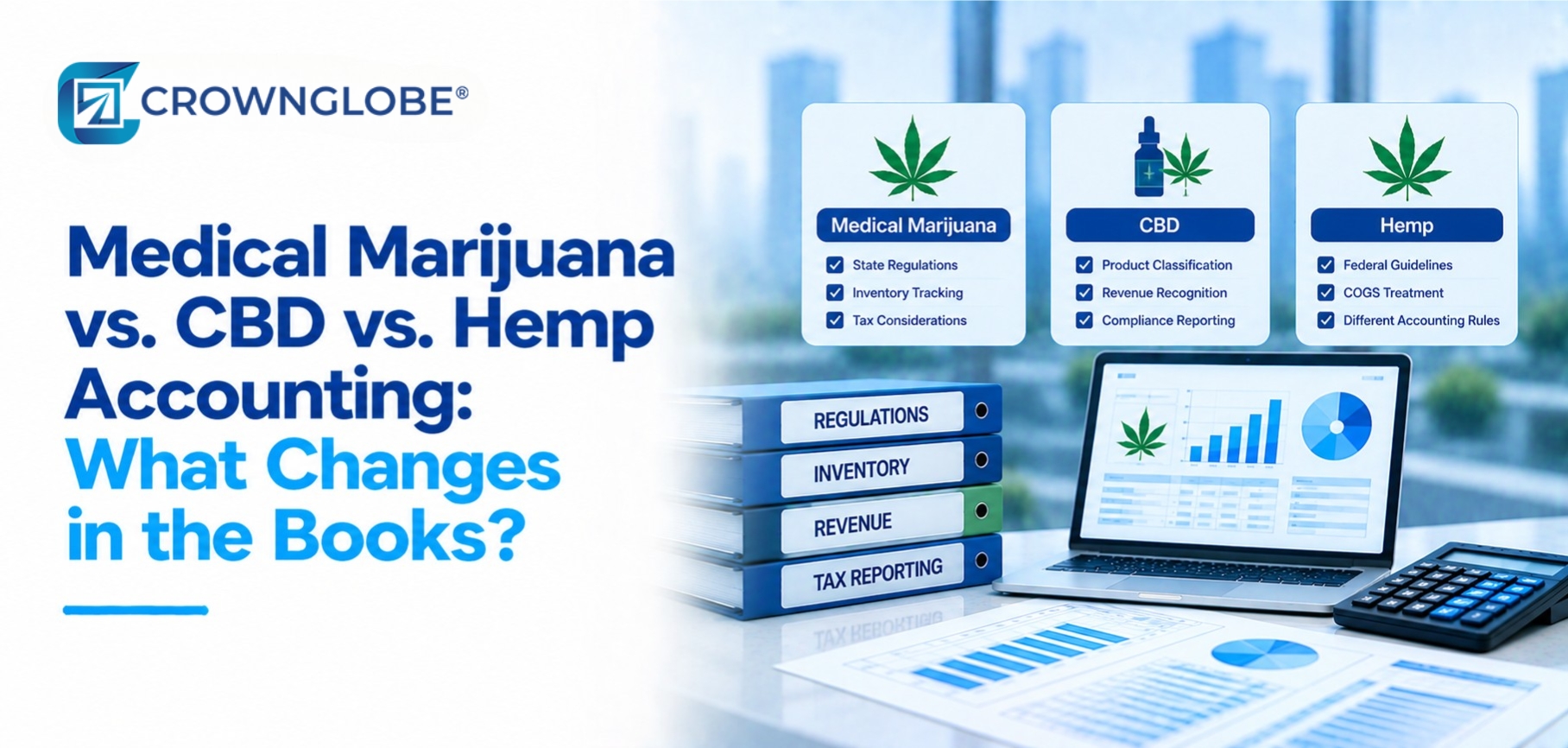
Across all three categories the foundation is the accurate books, supportable inventory, disciplined reconciliations, documented costs and a reliable monthly close. What has changed in marijuana accounting and, in the CBD and hemp equivalents is the regulatory and tax environment surrounding those records.
Medical Marijuana, CBD, and Hemp Accounting Compared
The useful comparison is not whether one category is easier to account for. Facts that change how revenue, inventory, costs, taxes and compliance records are organized are key, to restructuring records.
| Accounting dimension | Medical marijuana | CBD | Hemp |
|---|---|---|---|
| Federal classification | Qualifying state-licensed medical products moved to Schedule III in 2026; other marijuana activity must be evaluated separately | Depends on the product’s hemp status and how it is marketed | Governed by the federal hemp framework, with a revised definition scheduled for Nov. 12, 2026 |
| Inventory focus | Licensed inventory, product movement and reconciliation all need to be tracked and matched | SKUs, fulfillment, returns and processor settlements are all parts of managing sales and order processing | Crop/biomass, WIP, yield, testing, and finished goods |
| Operational source data | POS plus state-required tracking where applicable | Ecommerce, wholesale, marketplace, fulfillment, and inventory systems | Farm, processor, manufacturing, inventory, and testing systems |
| Tax analysis | Must reflect the exact activity and current federal treatment | Do not assume marijuana tax treatment merely because a product contains CBD | Generally analyzed separately from marijuana, subject to exact product and activity facts |
| Regulatory records | License- and state-specific | FDA/product rules plus state rules may matter | USDA/state hemp production and product rules may matter |
| Best ledger design | Entity/license/activity segmentation | Product/channel/SKU segmentation | Crop/batch/process/product segmentation |
In April 2026 the DOJ and DEA put FDA-approved marijuana products and those, under state medical-marijuana licenses into Schedule III. Broader marijuana rescheduling remained a federal process. Current DEA materials continue to identify that broader redesignation as a separate proceeding.
Section 280E applies to businesses trafficking in Schedule I or II controlled substances when the statutory conditions are met. The Treasury and the IRS later issued guidance, about the tax effects of changing the status of marijuana covering various activities.
For a company operating in adult-use, CBD or hemp sectors under one organization records must clearly separate revenue, expenses, inventory and documents, by activity.
What Should Stay Shared—and What Should Be Split?
Most operators do not need three accounting systems. A better way to handle marijuana accounting is to have a closing process and a controlled environment and use things, like entities, locations, classes, cost centers, SKUs or accounts to keep track of what is important.
Keep the core accounting discipline consistent
Business that deals with marijuana, CBD or hemp should receive bank and payment‑processor reconciliations keep documented purchasing records maintain reliable inventory subledgers, enforce accounts‑payable controls, reconcile payroll and complete a month‑end close that ties operational information back, to the general ledger ensuring that Business stays compliant.
Inventory is very important because inventory lies at the intersection of operations and financial reporting. Quantities, purchases, transfers, production activity, waste, returns and sales must all connect back, to the systems the business uses.
Those systems will differ by state and operating model. The accounting process should follow the company’s real source records rather than assume that every cannabis business uses the same platform or tracking method.
Split the books where the facts differ
Tracking becomes important when different legal companies have licenses, medical and adult-use activities happen at the same time CBD products go through online stores and hemp goes through growing, processing, making and selling.
The objective is to avoid complexity. The records should help the business make sense. Management can see profit by activity check inventory, track costs and provide clear info, for tax advisers without redoing the accounting after the end of the year.
For CBD accounting, the product and sales channel can drive much of the ledger design. Processor fees, marketplace deductions, returns, fulfillment costs, manufacturing costs and product-testing expenses can create a different accounting profile, for a state-licensed medical marijuana dispensary.
The FDA still has authority, over cannabis-derived products even if the material is considered hemp under law. Whether a CBD product can be marketed in a particular way therefore cannot be answered simply by saying it is “hemp-derived.”
Accounting for hemp business operations can change again depending on whether the company cultivates, processes or manufactures hemp and the grower focuses on hemp planted quantities, harvests, labor, inputs, testing, waste and hemp yield.
A processor or manufacturer may need to track biomass work, in process, conversion yield, packaging and finished goods costing in detail.
What to Verify Before Finalizing the Accounting Setup
Before changing the chart of accounts or adopting a tax treatment carefully review the underlying operating facts, in a consistent order.
- List all product categories the business offers and their classifications, in one line.
- Confirm which legal entity holds each license and which entity records each revenue stream.
- Separate medical, adult-use, CBD, and hemp revenue where those distinctions exist.
- Identify the operational source of truth for sales, inventory, production, and fulfillment.
- Confirm that POS, processor, inventory, bank, and general-ledger balances are reconciled on a defined schedule.
- Document how direct production costs, indirect costs, waste, returns, and transfers are captured.
- Track sales, excise, and other state taxes in the jurisdictions where they actually apply.
- Confirm what federal tax assumptions are being used for the current tax year and which activities they apply to.
- Review the Nov. 12, 2026 federal hemp-definition change if the business sells hemp-derived cannabinoid products.
- Assign responsibility for monitoring regulatory changes before they alter accounting or tax procedures.
The IRS says that good records help businesses prepare statements identify income, track expenses and basis prepare returns and support items reported on those returns.
What Changes When the Business Crosses Categories?
Some groups work in areas at the same time, like state-licensed medical marijuana, adult-use activity, hemp processing and a CBD online store and all these can be part of the same larger company.
A single accounting platform can still handle marijuana, CBD and hemp accounting needs effectively. What matters is whether the records stay separate enough to answer operational and tax questions without requiring management to rebuild the activity later.
A practical transition flow is straightforward:
Classify the product and activity
Before changing the accounting treatment.
Map each entity, license, revenue stream, and inventory pool.
Segment the ledger
With the minimum structure needed to preserve those distinctions.
Reconcile operational systems to the general ledger
In parallel until differences are understood.
Document the treatment and review it
When regulation, product status, or business structure changes.
Treasury and the IRS announced a guidance process addressing the tax consequences of the medical-marijuana rescheduling, including situations in which a business has more than one type of activity. A business should not assume one tax position automatically governs every cannabis-related activity.
Hemp businesses face a separate timing issue. Federal law has an updated definition that will go into effect on November 12 2026 with changes, about total THC and hemp-based cannabinoid products.
For operators affected by those definitions that date should trigger an accounting review of remaining a legal footnote, in the file.
“Treasury and the IRS plan to issue guidance to address the principal federal tax issues stemming from the Final Order.”
Questions Owners Ask
Qualifying state-licensed medical marijuana products moved to Schedule III in April 2026, while broader marijuana rescheduling remained separate. That makes it important for medical marijuana accounting to distinguish the licensed activity rather than rely on older blanket federal-tax assumptions.
Current filing positions should still be checked against the latest Treasury and IRS guidance because the agencies announced a tax-guidance process following the rescheduling action.
Section 280E disallows deductions and credits for qualifying businesses trafficking in Schedule I or II controlled substances.
Treasury has explained that the scheduling change affects the Section 280E analysis for activities no longer involving Schedule I or II substances, while mixed-activity and implementation issues require careful application of the current guidance. The exact business facts still matter.
No. CBD is a compound, not a complete legal or accounting classification.
A CBD company may operate as an ecommerce, wholesale, consumer-product, or manufacturing business, and FDA rules can still apply even when the material meets the hemp definition. The accounting should follow the actual product, sales channel, inventory, and regulatory facts.
It can share many of the same methods, particularly around crop, batch, work-in-process, yield, and finished-goods costing.
Hemp businesses also need records that support the applicable production and product framework. The federal definition of hemp is scheduled to change Nov. 12, 2026, so affected businesses should review product and inventory classifications before that date.
Yes, if the structure preserves the distinctions management, regulators, and tax advisers need.
One chart can use entities, locations, classes, departments, cost centers, product categories, or separate accounts to isolate activity. The practical test is whether revenue, inventory, costs, and tax-sensitive items can be traced without rebuilding the books manually.
At a minimum, reconcile bank accounts, payment processors, sales systems, inventory, purchases, payroll, and the general ledger.
Depending on the operation, also reconcile state tracking, ecommerce, fulfillment, production, tax, intercompany, and physical-inventory records. Differences should be documented and resolved rather than forcing balances to agree.
Sources & further reading
- U.S. Department of Justice April 2026 medical-marijuana Schedule III action. justice.gov
- U.S. Department of the Treasury / IRS tax guidance process following the DOJ final order. home.treasury.gov
- 26 U.S.C. §280E expenditures involving Schedule I and II controlled substances. uscode.house.gov
- USDA Agricultural Marketing Service Hemp Program FAQs. ams.usda.gov
- FDA regulation of cannabis and cannabis-derived products, including CBD. fda.gov
- 7 U.S.C. §1639o federal hemp definitions and scheduled amendment. uscode.house.gov
- IRS business recordkeeping guidance. irs.gov
CrownGlobe provides accounting, bookkeeping, and tax-related services. This article is general information, not legal, tax, investment, or regulatory advice. Cannabis laws and tax treatment can vary by product, activity, jurisdiction, license, and facts. Confirm current government guidance and obtain professional advice before changing legal, accounting, or tax positions.
Build Books That Match the Business You Actually Operate
If medical marijuana, CBD, hemp, or multiple cannabis activities flow through the same finance function, CrownGlobe can help map entities and product lines, strengthen reconciliations, organize the monthly close, and prepare tax-ready records. Book a consultation to review the accounting structure against your actual operating model.