Before You Change the Chart
Before you edit the cannabis chart of accounts collect information that explains how the business actually works, starting with the COA export, legal entities, locations, license or business functions POS categories, inventory stages, payroll departments, bank and payment accounts, tax-liability types recurring reports and the current QuickBooks or Xero setup. CrownGlobe's broader cannabis accounting and bookkeeping services cover the larger close and reporting context; this guide stays focused on ledger structure.
Prerequisites checklist
- Current chart of accounts export
- Entity and location map
- License or operating-function map
- POS revenue and tender categories
- Inventory stages and product-cost workflow
- Payroll departments or functions
- Bank, cash and payment accounts
- Tax-liability categories
- Current financial statements and management reports
- QuickBooks or Xero configuration
Six Steps, in This Order
Map the Business Before Naming Accounts
Start with the reporting structure by identifying entities, locations, business functions and recurring management questions and use system-supported reporting dimensions instead of creating separate GL accounts, for every store, department or activity.Build the Balance-Sheet Backbone First
A strong cannabis chart of accounts starts with the accounts that must reconcile every close. That includes cash, bank accounts accounts inventory, prepaids, fixed assets accounts payable, accrued liabilities, tax liabilities, debt and equity, with numbering that can vary but each balance-sheet account still needs a clear source, owner and repeatable reconciliation method.| Illustrative group | Example account types | Why they matter |
|---|---|---|
| 1000 Assets | cash/bank; A/R; inventory; prepaids; fixed assets | Reconciliation and balance-sheet integrity |
| 2000 Liabilities | A/P; accrued payroll; tax liabilities; debt | Close, remittance and cash planning |
| 3000 Equity | contributions; distributions; retained earnings as appropriate | Entity reporting |
Structure Revenue for Reconciliation and Margin Analysis
Revenue detail must be useful without rebuilding the POS in the ledger splitting product categories, channels or non-cannabis revenue while keeping discounts and returns visible using contra-revenue accounts, for discounts or returns with amounts needed for retailers, cultivators, manufacturers and distributors and placing sales in a 4000-series group in the chart of accounts.| Illustrative group | Example accounts | Purpose |
|---|---|---|
| 4000 Revenue | Cannabis revenue, by category or channel non-cannabis revenue discounts and returns. | POS mapping, reconciliation and margin analysis |
Separate Inventory and COGS From Operating Expenses
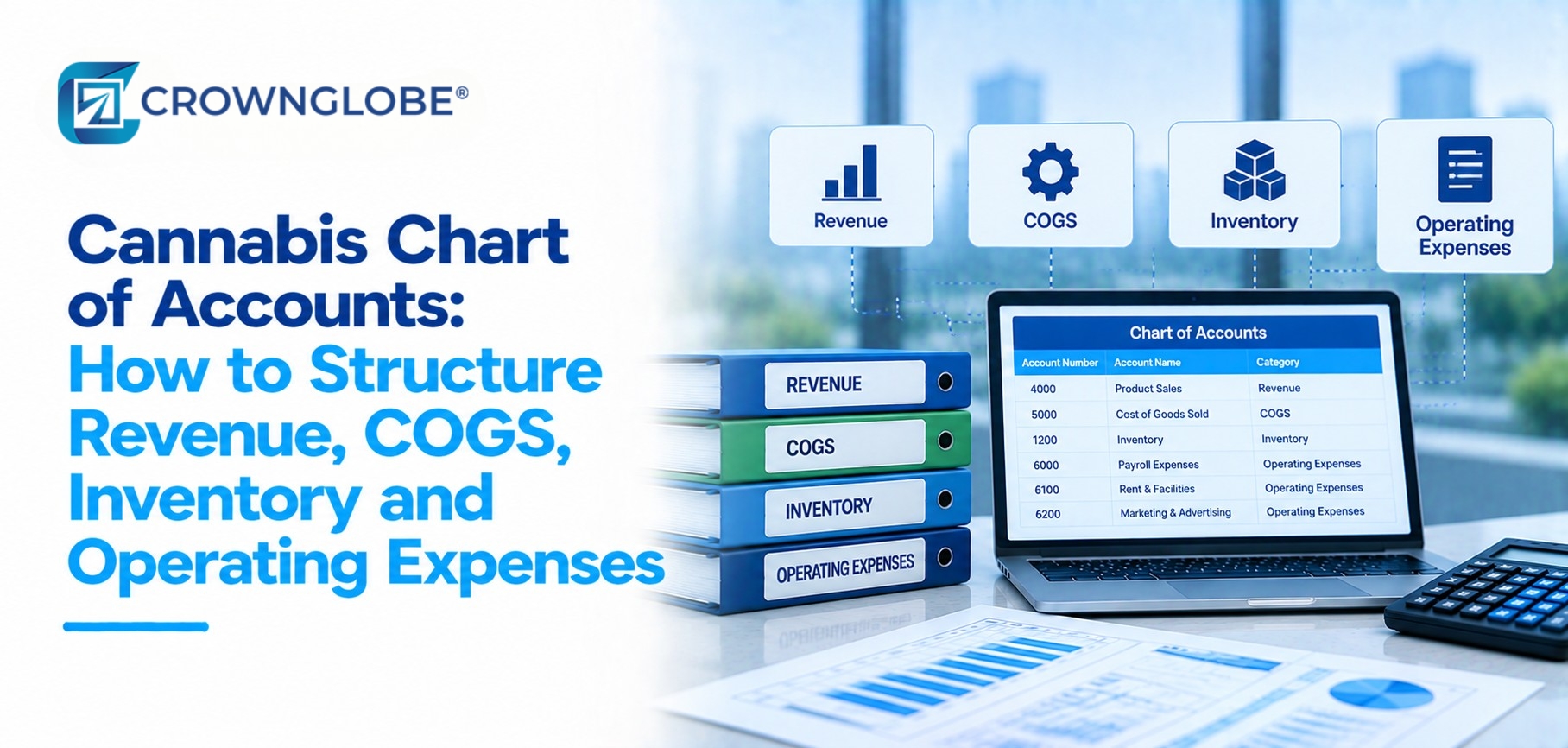
Inventory and cost of goods sold must be based on operational and accounting records not shortcuts using account names and for a cannabis business the 5000-series can track product cost, inventory relief, adjustments or production-cost pools while the 6000-series can track operating expenses, like payroll, occupancy, security, technology and professional fees by function.| Illustrative group | Example accounts | Purpose |
|---|---|---|
| 5000 COGS / production cost | purchased product cost; inventory relief; supported adjustments; production-cost pools where applicable | Inventory cost flow and gross-margin reporting |
| 6000 Operating expenses | payroll by function; occupancy; security; technology; professional fees; marketing; bank/merchant fees; G&A | Operating-performance reporting |
Keep Operating Expenses Detailed Enough to Manage, Not So Detailed They Become Noise
Operating expense detail should answer recurring questions about management, filing or reconciliation with categories, like payroll, occupancy, utilities, security, insurance, technology, professional fees, licensing, marketing, bank and merchant fees and G&A and must be maintainable so that two bookkeepers can code transactions consistently without confusion. A regulated retailer in another industry faces the same design tension. CrownGlobe's bookkeeping chart of accounts example shows why a useful chart should reflect the operating model rather than rely on generic categories alone.Implement in QuickBooks or Xero, Then Test the Mapping
After the design is approved, implement the design carefully. In QuickBooks accounting, that may involve account types, detail types, parent/subaccounts, inactive accounts and custom naming; in Xero bookkeeping, custom/imported accounts and tracking categories can support the approved structure. Do not import a new chart over historical books without a cleanup map. Preserve comparability by deciding what should be kept renamed, merged, inactivated or remapped before coding begins.| Existing item | Cleanup decision | Verification |
|---|---|---|
| Duplicate account | merge or inactivate after review | Historical balances remain traceable |
| Generic account | split only where recurring reporting need exists | New coding rule is documented |
| Old unused account | inactivate where appropriate | No live feed, mapping or recurring entry still uses it |
| Location-specific duplicate | consider supported dimension instead | Reporting still separates the location correctly |
Six Chart-of-Accounts Traps That Create Cleanup Work
- Copying a universal sample. A sample can provide ideas, but it cannot replace the business map behind the ledger.
- Duplicating every account by location. Use supported dimensions where they give the required reporting without unnecessary GL duplication.
- Using one generic Sales account. That can make reconciliation and margin analysis less useful.
- Relabeling operating expenses as COGS for a tax result. Account names do not create tax treatment.
- Using too much “Miscellaneous” or too much detail. Both make the chart harder to manage consistently.
- Renaming or importing without a historical map. Cleanup should preserve traceability and period-to-period comparability.
What a Working Cannabis Chart of Accounts Should Produce
Reconciled balance sheet
Cash, inventory, liabilities and clearing balances are supported by source documents. There is a repeatable reconciliation process.Usable revenue and gross-margin view
Sales categories map consistently without recreating the POS inside the general ledger.Supported inventory and COGS trail
Operational inventory and cost records show how value moves through inventory and cost of goods sold.Maintainable OPEX and dimensions
Account detail stays consistent while supported dimensions provide location or department views where appropriate.A useful chart of accounts is a reporting and control structure that makes the close easier to reconcile and financial statements more trustworthy.
Questions Cannabis Finance Teams Ask
Sources & Further Reading
- U.S. Code 26 USC §280E: https://uscode.house.gov/view.xhtml?edition=prelim&num=0&req=granuleid%3AUSC-prelim-title26-section280E
- DEA Marijuana Rescheduling Regulatory Actions: https://www.dea.gov/marijuana-rescheduling-regulatory-actions
- IRS Publication 334, Tax Guide for Small Business: https://www.irs.gov/publications/p334
- QuickBooks Add an account to your chart of accounts: https://quickbooks.intuit.com/learn-support/en-us/help-article/chart-accounts/add-account-chart-accounts-quickbooks-online/L0mCv3AKn_US_en_US
- Xero Add or edit an account in your chart of accounts: https://central.xero.com/0/article/Add-or-edit-an-account-in-your-chart-of-accounts
This article provides general information about bookkeeping structure, chart-of-accounts design and accounting workflows for cannabis businesses. It is not legal or tax advice, and the illustrative account groups and numbers are not a universal or required chart of accounts.
Tax treatment depends on current law and the underlying facts. Account placement or naming does not by itself determine deductibility, capitalization or compliance, and software configuration does not create cannabis-specific legal or tax compliance.
Build a Chart of Accounts Your Team Can Actually Maintain
A well-designed cannabis chart of accounts should help the team reconcile the balance sheet, understand revenue and gross margin, trace inventory and COGS, and keep operating expenses consistent. It should be simple enough to maintain while still supporting the reports management actually uses. CrownGlobe can help review, clean up and implement that structure in QuickBooks or Xero without treating a sample account list as a substitute for the operating model behind the books.