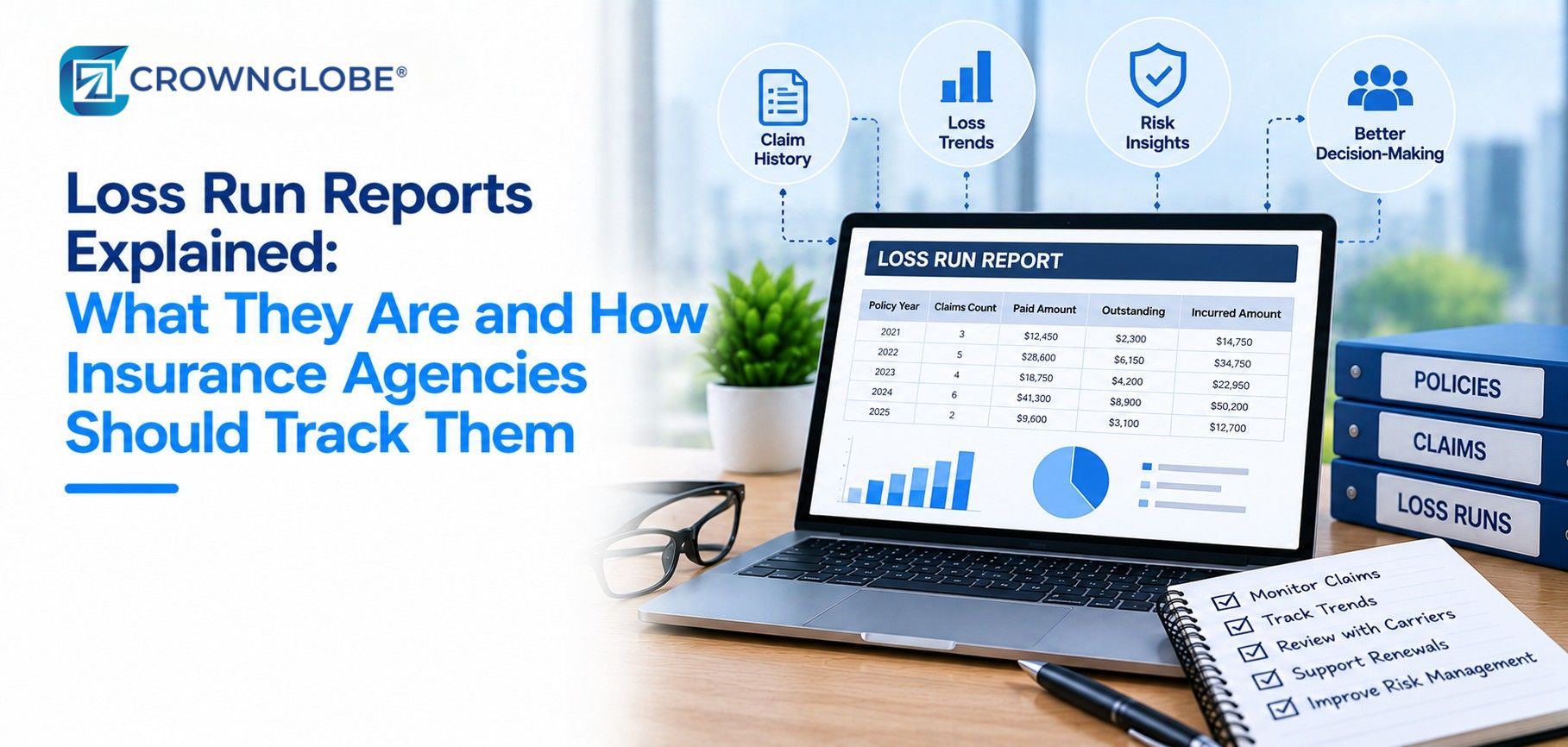
Loss run reportDefinition
A carrier-generated record of claims activity for a policy or account. It commonly shows the policy period, claim number, date of loss, claim status, amounts paid, reserves, and a valuation date that indicates how current the information is.
For an agency, knowing what is a loss run is only the starting point. The harder part is making sure the right reports are requested, reviewed, and routed before a renewal or remarketing submission depends on them. Because carrier formats vary, the agency's process should center on common fields, clear ownership, and visible follow-up.
Methodology and sourcing
This guide explains common loss-run concepts using current carrier and agency-facing references. It does not assume one universal form, one carrier turnaround time, or one required history period. Underwriting requests, carrier procedures, and state rules can differ, so the specific request and applicable carrier or regulator should control when a detail matters.
Two jobs
The Two Jobs a Loss Run Needs to Do
1. Give the underwriter a claims-history view
Insurance loss runs give underwriters a structured view of an account's claims experience. Details such as dates of loss, claim status, paid amounts, reserves, and loss descriptions can help show patterns in frequency and severity and whether material claims remain open. That context matters, but it is only part of the underwriting picture. A clean report does not guarantee a lower premium, and one open claim does not determine an underwriting decision on its own.2. Give the agency a controlled workflow
For producers, CSRs, and account managers, the report also becomes an operating record. Someone needs to identify the prior carrier and policy, request the report, follow up, confirm that the information is current, flag exceptions, and move the reviewed document into the renewal or remarketing file. That work sits naturally beside other insurance agency bookkeeping and accounting workflows that depend on accurate carrier-facing records and consistent follow-through.Vocabulary
The Terms You Will Meet
Policy periodThe coverage period associated with the policy shown on the report.
Date of lossThe date the incident giving rise to the claim occurred.
Claim numberThe carrier's identifier for a specific claim.
Valuation dateThe date through which the report's claim values and status are current.
Paid amountAmount the carrier reports as already paid on the claim.
ReserveAmount the carrier has set aside or estimated for future claim costs.
Incurred amountA carrier-reported measure of claim cost to date, often reflecting paid amounts and reserves; labels and components can vary.
Open / closed / reopenedThe carrier's current status for the claim.
FrequencyHow often losses occurred over the period being reviewed.
SeverityHow large or costly individual losses were.
Tracking
What an Agency Should Track
A useful process starts before the report lands in someone's inbox. The goal is not simply to save another PDF. It is to make ownership, timing, and exceptions visible throughout the renewal workflow.
A practical tracker can include:
| Track | Why it matters |
|---|---|
| Insured/account | Keeps the request tied to the correct client record. |
| Carrier and policy | Shows exactly where the report must come from. |
| Line of business | Helps separate requests when an account has multiple coverages. |
| Requested history period | Records what the underwriter or submission requires. |
| Request date and owner | Establishes accountability. |
| Next follow-up date | Prevents an outstanding request from disappearing into email. |
| Received date | Confirms completion of the request step. |
| Valuation date | Helps identify information that may need refreshing. |
| Open-claim or data exception | Creates a visible queue for review. |
| Renewal/submission destination | Makes the final handoff explicit. |
The process can live in an AMS, workflow platform, spreadsheet, or another controlled system. The specific tool matters less than having a reliable view of status, ownership, and exceptions. The same discipline can support commission reconciliation and carrier statement workflows.
Controls
Four Controls That Keep Loss Runs Renewal-Ready
- Start from the actual renewal or submission need.Identify the carriers, policies, and history periods required for the account in front of you. Do not assume every underwriter asks for the same number of years.
- Check the report when it arrives.Confirm the account and policy details, valuation date, expected claims, and whether any claim status or amount appears incomplete or inconsistent with the agency's records.
- Age outstanding requests.Track how long requests remain open and assign the next follow-up. That turns a shared-inbox problem into a managed queue with clear ownership.
- Escalate exceptions before handoff.Open claims, stale reports, missing policies, or unclear data should be visible before the submission reaches the underwriter.
These are operating controls, not regulatory requirements. A carrier's process and any state-specific request rights or deadlines may differ.
The questions
The Questions Agency Teams Actually Ask
A loss run report is a carrier-generated record of claims activity for a policy or account. It commonly identifies the policy period and individual claims, along with dates of loss, claim status, paid amounts, reserves, and a valuation date. The exact layout and terminology vary by carrier.
A loss run is the claims-history record an insurer provides for a policy or account. Agencies and insureds often use it during renewal or remarketing because it gives an underwriter a current view of prior losses and open claim activity.
Common fields include the insured or policy information, policy period, claim number, date of loss, loss description, claim status, paid amount, reserve, and valuation date. Some reports include additional breakdowns. These are common fields, not a universal format.
Loss runs help an underwriter assess claims experience, including the pattern, frequency, severity, and current status of losses. They add important context to underwriting, but they do not determine pricing or coverage outcomes by themselves.
Give each request an owner, request date, follow-up date, carrier and policy reference, required history period, status, received date, valuation date, and exception flag. The aim is to create a visible queue instead of relying on scattered email follow-ups. For broader workflow design, see CrownGlobe's guide to what to automate and what to keep manual.
Confirm that the report belongs to the correct insured and policy, covers the requested period, has a useful valuation date, and includes the expected claims. Review open or reopened claims, then flag missing or inconsistent information for follow-up with the appropriate carrier contact.
The carrier is the source of the official loss run. The agency may coordinate the request, track status, and maintain an internal tracker, but that internal record does not replace the carrier's report.
It varies. Underwriters often request several years of claims history, and agency references commonly discuss three to five years, but there is no single period that applies to every account or carrier. Follow the specific underwriting request for the submission at hand.
Paid losses are amounts the carrier reports as already paid on a claim. A reserve is an amount the carrier has set aside or estimated for future claim costs. Reports may present related claim-cost measures differently, so use the carrier's own labels rather than forcing one formula across every report.
The valuation date shows how current the reported claim amounts and statuses are. A report generated earlier in the renewal cycle may no longer reflect later payments, reserve changes, closures, or reopenings. Whether a newer report is needed depends on the underwriting request and carrier process.
Make them visible in the renewal workflow. Confirm the current carrier-reported status and identify any information the underwriter has requested. The agency's role is to coordinate accurate information and follow-up, not to determine claim outcomes or change carrier claim status.
Keep the request in an aged follow-up queue, document the request and contacts, and escalate through the carrier's available service channels as appropriate. Do not assume one national response deadline. If a legal right or deadline matters, check the applicable state insurance department or other relevant authority.
Yes. Reports can vary in layout, labels, claim-cost breakdowns, and the amount of detail shown. That is why an agency process should focus on a common set of fields and exceptions rather than expecting one universal form.
Tie review to the renewal or submission workflow and to material claim updates. If the valuation date no longer meets the underwriter's needs, a refreshed report may be appropriate. This is an operating decision, not a universal legal cadence.
Misunderstandings
Six Things Not to Assume About Loss Runs
- "Every carrier uses the same form." Carrier formats and labels vary.
- "Every carrier must respond on the same deadline." Carrier procedures and state rules can differ.
- "Every underwriter always wants exactly three or five years." The requested history period depends on the account and submission.
- "A closed claim can be ignored." Closed claims still form part of the account's historical loss pattern.
- "A clean loss history guarantees a lower premium." Loss experience is only one part of underwriting.
- "Our internal summary can replace the carrier report." Internal tracking supports the workflow; it is not the official carrier loss run.
A useful loss-run tracker should make four things clear at a glance: who owns the request, how long it has been outstanding, whether the report is current enough, and what exception still blocks handoff. The system matters less than consistent visibility.
Sources & further reading
This article is for general informational purposes only and is not insurance, legal, underwriting, claims-handling, tax, or accounting advice. Carrier formats, underwriting requirements, and state rules can vary. Confirm current requirements with the relevant carrier, underwriter, state insurance department, and qualified professional as appropriate.