Trucking Bookkeeping and Accounting Services
Trucking accounting is not general bookkeeping. A carrier’s books have to carry fuel-tax jurisdiction data, driver settlements, factoring advances and per-truck cost allocation — detail a general bookkeeper is not set up to capture.
Compliance travels with the truck. Every state your drivers run through can create an IFTA reporting obligation and a payroll withholding question, and those obligations grow with each lane you add.
CrownGlobe helps carriers, fleets and owner-operators run finance as one system — bookkeeping, IFTA and multi-state filing, driver settlements, payroll, tax readiness and CFO-level reporting on cost per mile and per-truck profitability.
Load & Revenue Tracking
Record revenue load by load across brokered freight, direct shippers and dedicated lanes, then tie every settlement back to the deposit that actually cleared the bank.
Fuel & Maintenance Cost Control
Tag fuel-card transactions, tolls, tyres and repair invoices to the right tractor and trailer so cost per mile is measured rather than estimated.
Driver Settlements & Payroll
Run company-driver payroll alongside owner-operator and lease-purchase settlements, including advances, escrow, deductions and reimbursements.
IFTA & Multi-State Compliance
Compile mileage and fuel-purchase records by jurisdiction each quarter, and keep payroll registrations current in every state your drivers operate.
Service mapping for trucking companies and fleets
We map CrownGlobe’s standard finance stack onto how a carrier actually operates — per-truck cost centres, settlement cycles that follow your pay week, and fuel-tax records built from the same data your books already use.
Whether you run one truck or forty, the same reporting spine applies: clean books, correct settlements, current filings, and numbers you can price freight against.
Contact Us
Trucking Bookkeeping (Per-Truck)
Reconciled books with a trucking chart of accounts, so revenue, fuel, maintenance and driver pay are comparable truck by truck and consolidate cleanly at the fleet level.

Driver Payroll & Settlements
Settlement and payroll workflows that keep W-2 company drivers, 1099 owner-operators and lease-purchase drivers on separate, correct tracks as the fleet scales.

IFTA & Tax Filing Support
Quarterly IFTA preparation from mileage and fuel-purchase records, plus multi-state registration support and year-end readiness for the business return.

Virtual CFO for Fleet Growth
Cash-flow forecasting, rate and lane analysis, truck-addition modelling and lender-ready packages when you finance equipment or open a new terminal.

Dashboards & Automation
Replace spreadsheet reconciliation with automated feeds from your TMS, ELD, fuel cards and factoring company, reporting into dashboards that refresh with the books.
Industry-specific challenges trucking companies face
Carriers carry compliance and cost complexity that a single-location business never encounters — and most of it moves with the truck.
Multi-state IFTA complexity
Fuel tax is owed by jurisdiction, not by company. Miles and fuel purchases have to be captured per state every quarter, and ELD data rarely reconciles to fuel-card data without work.
Owner-operator vs. company-driver classification
W-2 drivers, 1099 owner-operators and lease-purchase drivers each carry different pay, deduction and filing treatment. Getting the boundary wrong is expensive to unwind later.
Factoring and cash-flow gaps
Factored invoices, advances, reserves and chargebacks mean the cash that lands is never the invoice amount. Books that record gross revenue hide the real cash position.
Volatile fuel and maintenance costs
Fuel and repair costs swing month to month and truck to truck. Without per-unit allocation, a fleet average conceals which tractors are actually losing money.
Per-diem and deduction tracking
Driver per-diem, tolls, scale fees and small road expenses are easy to lose and hard to reconstruct at year-end without a disciplined capture process during the quarter.
No per-truck profitability view
Most carriers can see whether the company made money. Far fewer can see which trucks, lanes and drivers made it — which is the number that decides pricing and growth.
Equipment, permits & insurance timing
Tractors, trailers, IRP registration, UCR, the heavy-vehicle use tax and insurance premiums all arrive as large, uneven charges. Without accrual and correct finance treatment, the balance sheet stops reflecting what the fleet owns and a single month can look like a loss the operation never had.
Unbilled detention and accessorials
Detention, layover, lumper fees and stop-offs are earned on the road and lost in the paperwork. Revenue that is never invoiced never appears as a gap — it simply never arrives.
Trucking Bookkeeping Services
Accurate books, correct settlements and current filings — delivered on the schedule your pay week already runs on.

Daily Bookkeeping & Bank Reconciliation
Revenue, fuel, tolls, maintenance and factoring deposits recorded and reconciled against your bank and factoring statements, on a trucking-specific chart of accounts.

IFTA & Multi-State Sales Tax
Quarterly IFTA preparation from mileage and fuel-purchase records, plus multi-state sales-and-use tax support so your authority stays compliant everywhere you run.

Driver Payroll & 1099 Settlements
Payroll for company drivers and correct settlement processing for owner-operators and lease-purchase drivers, including advances, escrow and recurring deductions.

Per-Truck & Fleet Financial Reporting
Profit-and-loss and cash-flow statements broken out by truck, terminal or division, so you can see where margin is actually being made and where it is leaking.

Business Tax Filing & Entity Structuring
Business return preparation and owner-operator filing support, with guidance on LLC and S-Corp structuring as the fleet and the driver mix change.

Fleet Growth & Equipment Advisory
Modelling for adding trucks, financing equipment and pricing freight, run against your own cost-per-mile numbers rather than industry averages.
Industry-Specific Benefits
Improved Cash Flow
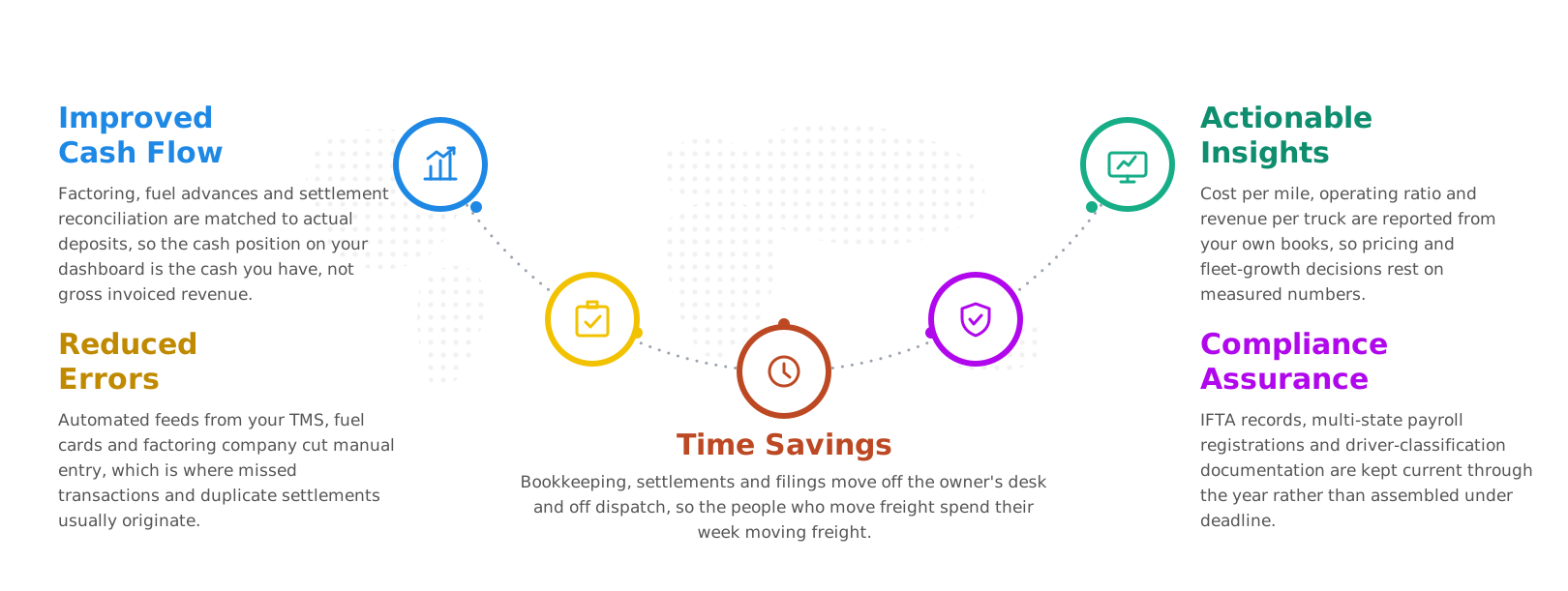
Factoring, fuel advances and settlement reconciliation are matched to actual deposits, so the cash position on your dashboard is the cash you have, not gross invoiced revenue.
Reduced Errors
Automated feeds from your TMS, fuel cards and factoring company cut manual entry, which is where missed transactions and duplicate settlements usually originate.
Time Savings
Bookkeeping, settlements and filings move off the owner’s desk and off dispatch, so the people who move freight spend their week moving freight.
Compliance Assurance
IFTA records, multi-state payroll registrations and driver-classification documentation are kept current through the year rather than assembled under deadline.
Actionable Insights
Cost per mile, operating ratio and revenue per truck are reported from your own books, so pricing and fleet-growth decisions rest on measured numbers.
Data-Driven Financial Strategy
Virtual CFO support and business intelligence built on the same ledger your bookkeeping runs on.
Fleet KPI Dashboards
Live views of cost per mile, deadhead percentage, operating ratio and per-truck margin, built in Power BI from your accounting data.
Cash-Flow Forecasting
Forward cash forecasts that account for freight seasonality, fuel-price movement, factoring fees and equipment payment schedules.
Lane & Truck Profitability
Analysis of which lanes and which tractors are genuinely profitable once fuel, maintenance and driver pay are fully allocated.
Equipment Financing Support
Lender-ready financial packages for adding tractors and trailers, refinancing existing equipment or opening a terminal.
Budgeting & Growth Planning
Annual budgets and truck-addition models, so growth decisions are backed by projected cash impact rather than gut feel.
Case Study
Atlanta Transport Co.
Per-Truck Reporting Across a Mixed Driver Fleet
Atlanta Transport Co., running a mix of company drivers and owner-operators, was reconciling settlements, fuel-card statements and factoring deposits by hand each week. Revenue was recorded at invoice value rather than at the amount that cleared, so the cash position on the books never matched the bank, and costs sat in fleet-level accounts that could not be attributed to individual tractors.
CrownGlobe’s trucking specialists rebuilt the chart of accounts around per-truck cost centres, connected the TMS, fuel-card and factoring feeds so advances, reserves and chargebacks post automatically, and separated the settlement process for W-2 drivers from the 1099 owner-operator run. Quarterly IFTA preparation was moved onto the same mileage and fuel data the books already carried, removing a parallel spreadsheet.
The result was a reporting pack the owner could act on: cash reported at the amount actually received, cost per mile calculated per tractor rather than averaged, and a settlement cycle that closed on schedule without weekend reconciliation.
Technology & Automation Solutions
We work inside the systems a carrier already runs, rather than asking the fleet to re-key data into ours.

TMS Platforms
Load, settlement and driver-pay data pulled from transportation management systems such as McLeod, Axon and TruckingOffice.

ELD & Fuel Cards
Mileage and fuel feeds from ELD providers such as Motive and Samsara, and fuel cards including EFS, Comdata and WEX, tagged at truck level.

Accounting Software
QuickBooks Online and Xero, configured with a trucking chart of accounts and per-truck classes or tracking categories from day one.

Factoring Integrations
Reconciliation support for freight-factoring providers, matching advances, reserves, fees and chargebacks to the deposits they relate to.

Business Intelligence
Microsoft Power BI dashboards for cost per mile, operating ratio and per-truck profitability, refreshed alongside the monthly close.
Engagement Models
Standard
$125/ Per Month
Suited to owner-operators and small carriers that need accurate monthly bookkeeping, bank and fuel-card reconciliation, quarterly IFTA preparation and organised records for the year-end return.
Growth
$195/ Per Month
Adds controller-level oversight for growing fleets: driver settlements, multi-state payroll coordination, factoring reconciliation, cash-flow management and regular cost-per-mile reporting.
Virtual CFO
$295/ Per Month
Strategic CFO support for multi-truck carriers: forecasting, lane and per-truck profitability analysis, equipment-financing packages, KPI dashboards and expansion planning.
FAQs
Answer: A carrier’s ledger has to carry things a general set of books never sees: fuel tax owed by jurisdiction, settlements that differ by driver type, factoring advances and chargebacks that change what cash actually arrives, and cost allocation down to the individual tractor. A general bookkeeper can record the transactions, but usually not in a structure that supports IFTA preparation or cost-per-mile reporting.
Answer: Yes. We compile distance travelled and fuel purchased in each jurisdiction for the quarter, cross-check the mileage against your ELD trip records and the fuel against your card statements, and prepare the return for filing with your base jurisdiction.
Answer: They run on separate processes. W-2 company drivers go through payroll with withholding and employer filings; 1099 owner-operators and lease-purchase drivers go through a settlement run with their own deductions, escrow and advance treatment. Keeping the two apart is what keeps classification, deductions and year-end filings correct for each.
Answer: Load by load. We match factored invoices, factoring fees, reserve releases, fuel advances and chargebacks against the deposits that actually cleared your bank, so the books show the cash received rather than the gross invoice value. This is usually the single biggest correction we make to a carrier’s existing ledger.
Answer: Yes. We connect to common transportation management systems, ELD providers and fuel-card programmes including EFS, Comdata and WEX, so settlement and cost data flows into your books instead of being re-keyed. Where a direct connection is not available, we work from the provider’s export on a set schedule.
Answer: Yes. Drivers crossing state lines can create withholding and registration obligations beyond your home state. We track where your drivers run, flag where a registration is likely to be required, and keep filings current in the states you are registered in. Where a position is genuinely uncertain, we will say so and recommend a specialist opinion rather than guess.
Answer: Through a capture process that runs during the quarter rather than at year-end: per-diem days recorded against settlement runs, and tolls, scale fees, permits and small road expenses coded as they arrive from the fuel card or driver submission. Reconstructing a year of road expenses in April is where most deductions are lost.
Answer: Every engagement includes a monthly profit-and-loss and cash-flow statement. Growth and Virtual CFO engagements add trucking-specific reporting — cost per mile, operating ratio and revenue per truck — and Virtual CFO adds forecasting and lane-level profitability. Reporting cadence is set to your pay week rather than a generic calendar.
Answer: Yes, provided fuel, maintenance and driver pay can be attributed to a specific unit. We set the chart of accounts up with per-truck cost centres and tag fuel-card and repair transactions to the tractor at the point of entry, which is what makes a real per-unit figure possible rather than a fleet average divided by trucks.
Answer: Yes. The Standard engagement is built for owner-operators and very small carriers — monthly bookkeeping, reconciliation, quarterly IFTA preparation and clean records for the year-end return, without the controller-level services a larger fleet needs.
Answer: It depends on your profit level, how you pay yourself, how many trucks you run and your state’s treatment — there is no single right answer for carriers. We model the options against your actual numbers and coordinate the filing if a change makes sense. See LLC and S-Corp setup for the mechanics.
Answer: Yes. Catch-up work is scoped separately from ongoing bookkeeping, because the effort depends on how many months are open and how much source data survives — bank feeds, fuel-card statements, settlement records and factoring reports. See Catch up Bookkeeping.
Answer: Tractors, trailers and major components are set up as fixed assets with the finance or lease treatment recorded correctly from the start, so the balance sheet reflects what you own and what you owe. Depreciation method and timing are decided with your tax position in view rather than defaulted.
Answer: Yes. Virtual CFO engagements include lender-ready packages — profit and loss, balance sheet, cash-flow statement and supporting schedules — prepared in the format equipment financiers and banks typically ask for when a carrier adds units.
Answer: Onboarding starts by connecting your bank, TMS and fuel-card feeds and mapping the chart of accounts to a trucking structure. How long that takes depends mainly on how much of a bookkeeping backlog exists and how accessible your historical records are. We scope it before you commit.
Accelerate Your Fleet’s Financial Operations
The core CrownGlobe services that carriers pair with trucking bookkeeping.
Get your fleet’s books on the road
Carriers run better when settlements close on time, IFTA is prepared from data you already have, and cost per mile is a number you can trust. Book a free consultation and we will walk through your current setup, where the reconciliation gaps are, and what a trucking-specific finance stack would look like for your fleet.
Schedule a Free Consultation