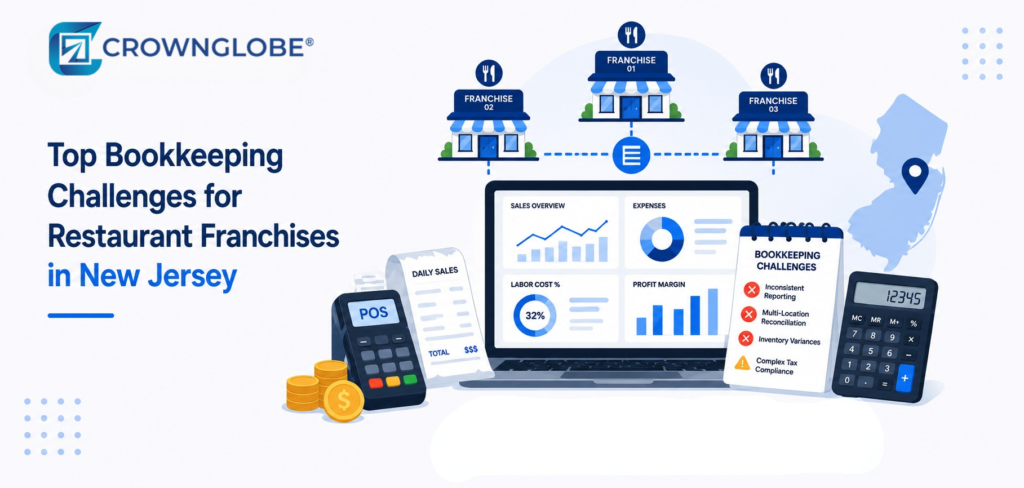
Running a restaurant franchise is demanding by nature. When you layer in New Jersey’s tax environment, labor regulations, and multi-location operations, bookkeeping becomes far more complex than most owners expect.
In many cases, the challenge is not effort. It is a structure.
Most franchise owners work hard, but the financial systems of most franchise owners were not made to handle a lot of growth. As the business grows, those gaps start to show.
Strong accounting for franchises is what separates stable multi-unit operations from those constantly reacting to financial issues. It is not just about recording transactions. It is about building a financial system that keeps every location aligned, compliant, and predictable.
Let’s walk through the most common bookkeeping challenges restaurant franchises face in New Jersey and how to approach them in a practical, scalable way.
1. Multi-Location Financial Complexity
The Problem
Restaurant franchises usually do not work alone. Each location develops its own:
- Revenue patterns
- Expense behavior
- Staffing structure
- Inventory movement
Without a system, many franchisees use spreadsheets or separate tools to manage their work. Over time, this creates:
- Inconsistent reporting across locations
- Delayed visibility into performance
- Errors when consolidating financials
Why It Breaks at Scale
What works for one location often breaks when you have three, five, or ten. Small inconsistencies multiply quickly. It is really hard to compare performance or make decisions without a proper franchise accounting system in place, for the franchise accounting system.
The Fix
A centralized bookkeeping franchise system with a standardized chart of accounts changes everything. It allows:
- Clean consolidation across all locations
- Clear visibility into location-wise profitability
- Better, faster decision-making
At this stage, professional franchise bookkeeping services are not optional. They become a foundation for growth, especially when you are managing bookkeeping for franchises across multiple locations.
2. Sales Tax Compliance in New Jersey
The Problem
New Jersey’s sales tax rules for restaurants can be nuanced. Franchise owners must manage:
- What is the difference between items and non-taxable items.
- Delivery and service charges
- Location-specific compliance variations
Without a clear system, it is common to see:
- Overpayment of taxes
- Underreported liabilities
- Missed filing deadlines
Common Mistake
A frequent issue is relying on POS data without proper reconciliation. When manual adjustments are layered in without structure, errors become inevitable.
The Fix
A well-designed franchise accounting and tax framework, often delivered through structured franchise accounting services, ensures:
- Accurate tax mapping within POS systems
- Automated reconciliation processes
- Consistent and timely filings
For franchises operating in states a structured approach is crucial to prevent small compliance gaps from becoming bigger problems.
3. Payroll and Tip Reporting Challenges
The Problem
Restaurant franchises have a lot of things to manage when it comes to payroll:
- Hourly wages and overtime
- Tip pooling and reporting
- Compliance with labor regulations
Even small mistakes can cause problems with following the rules. Affect the trust that employees have in the company.
Why It Happens
In setups, payroll, POS and accounting systems work separately which causes problems and makes mistakes more likely.
The Fix
Integrating payroll within your accounting franchise system brings structure and accuracy. It helps:
- Automate tip calculations
- Maintain compliance
- Reduce manual effort
Payroll is often where operational trust is built. When systems are clean, everything runs more smoothly.
4. Inventory and Cost Control Issues
The Problem
Food costs are one of the largest expenses in restaurant operations. Without proper tracking:
- Shrinkage goes unnoticed
- Waste increases over time
- Margins gradually decline
Why It Matters
Many franchise owners focus heavily on revenue but overlook cost leakage. This creates a false sense of profitability.
The Fix
A connected cloud bookkeeping software for franchise businesses allows:
- Real-time inventory visibility
- Accurate cost of goods sold tracking
- Better margin control
When supported by consistent financial statements preparation, it gives you a true picture of performance, not just surface-level numbers.
5. Lack of Real-Time Financial Visibility
The Problem
Most franchise owners review their financials at the end of the month. By then:
- Issues have already affected margins
- Decisions are delayed
- Cash flow becomes harder to manage
What Owners Actually Need
- Daily visibility into sales
- Weekly tracking of key costs
- A clear view of cash position
The Fix
This is where virtual CFO services for franchise businesses and Power BI visualization for financial reporting become valuable within a modern franchise accounting system.
Instead of static reports, you gain:
- Live dashboards
- Location-level performance insights
- Trend analysis that supports better decisions
Finance should guide operations as they happen, not after the fact.
6. Inconsistent Systems Across Franchise Units
The Problem
Different franchise locations often operate with:
- Different accounting tools
- Different processes
- Different reporting formats
This lack of consistency creates challenges during:
- Financial consolidation
- Audits
- Strategic planning
The Fix
Standardizing processes through accounting bring structure and reliability to restaurant franchises. It ensures:
- Consistent reporting across locations
- Stronger compliance
- Systems that scale with your business
For restaurant operators, aligning everything with a structured restaurant bookkeeping service for franchise businesses approach is a critical step forward.
7. Poor Cash Flow Management
The Problem
Restaurant franchises typically operate on tight margins. Cash flow challenges often arise due to:
- High fixed operating costs
- Inventory purchases
- Payroll obligations
- Delayed financial visibility
Common Misconception
Profitability does not always mean cash flow for a business because many businesses appear to be profitable but they actually struggle with liquidity, for the business.
The Fix
A disciplined accounting for franchise business approach includes:
- Weekly cash flow tracking
- Forward-looking forecasting
- Active expense management
This is where virtual CFO support provides real value by helping maintain predictable and stable cash flow.
8. Manual Processes and Lack of Automation
The Problem
Manual bookkeeping often leads to:
- Increased errors
- Delays in reporting
- Higher operational workload
Why It Is Risky
As my franchise expands, manual tasks get really slow. Create bottlenecks that hurt the whole operation.
The Fix
Implementing finance automation helps streamline operations by making financial tasks easier and faster:
- Connecting POS systems directly to accounting
- Reducing manual data entry
- Accelerating reporting cycles
Automation is not, about replacing people it helps remove work so your team can focus on making higher-value decisions with automation.
9. Compliance and Year-End Challenges
The Problem
Many franchise owners approach compliance only at year-end. This often results in:
- Last-minute adjustments
- Missed deductions
- Higher-than-expected tax liabilities
The Fix
Consistent bookkeeping throughout the year, supported by:
- Tax filing services
- Year-end finalization and annual checkup services
ensures accuracy, reduces stress, and keeps everything aligned well before deadlines.
Why Franchise Accounting Requires a Specialized Approach
Restaurant franchises do things in their way and that is really different, from how other businesses work.
They require:
- Multi-unit financial tracking
- Standardized reporting structures
- Ongoing compliance across locations
- Integrated systems that communicate effectively
This is why specialized accounting services and experienced franchise accountants are so important for building accounting systems for franchises.
If you want to learn more, you can look at our resources, on franchise accounting fundamentals.
Final Thoughts
Bookkeeping challenges in restaurant franchises are rarely accidental. They are usually the result of systems that were not designed for scale.
When systems are disconnected, reporting is delayed, and compliance becomes reactive; problems are bound to surface.
With the right franchise accounting services, supported by standardized processes and automation, these franchise accounting challenges can be addressed with confidence.
The goal is not complexity.
It is clarity.
Clear numbers. Predictable cash flow. Scalable operations.
If your systems are starting to feel stretched as you grow, the systems are worth reviewing rather than later.
FAQ
What is franchise accounting for restaurants
Franchise accounting focuses on managing finances across multiple locations using standardized systems to ensure accurate reporting, compliance, and scalability.
Why is bookkeeping different for restaurant franchises
Restaurant franchises deal with multi-location operations, inventory complexity, payroll requirements, and varying tax rules, which require a more structured bookkeeping approach.
What software is best for franchise bookkeeping
Cloud-based systems that integrate POS, payroll, and accounting functions tend to work best for franchise businesses.
How can I improve cash flow in my restaurant franchise
Improving cash flow starts with consistent tracking, cost control, and forecasting through a structured accounting system.
Do I need outsourced accounting for my franchise
Outsourced accounting helps bring consistency, improve compliance, and provide expert insight, especially as your franchise grows.