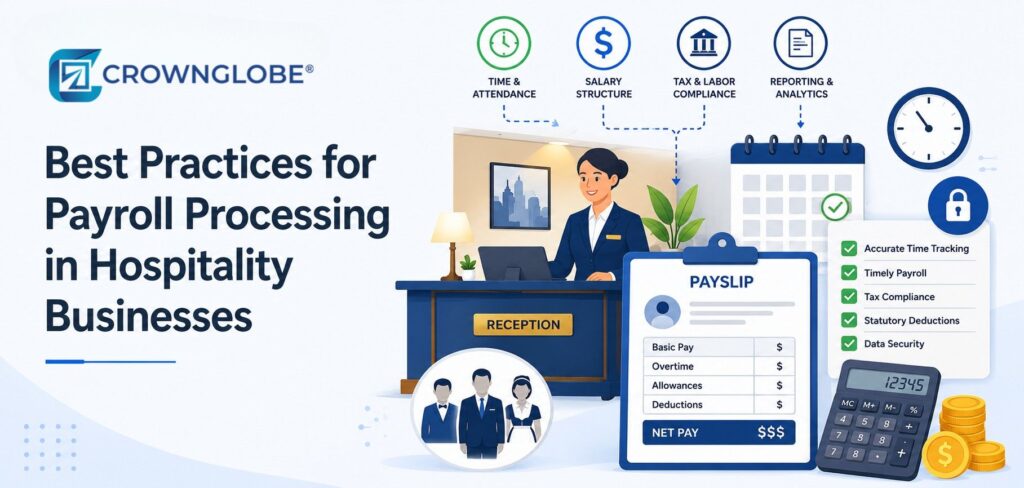
Payroll in hospitality goes far beyond simply paying employees on time. It directly influences compliance, employee trust, and the financial stability of your business.
Hotel owners in places like New Jersey, Texas, Florida, Illinois and the Carolinas have to deal with payroll, which’s a complicated part of running a hotel because of things like rotating shifts and seasonal staffing, for the hotel.
This is where structured hotel bookkeeping becomes essential. When payroll is supported by accurate and timely financial data, often through experienced hotel bookkeeping services, it becomes far more predictable, compliant, and easier to manage.
Why Payroll Processing Is More Complex in Hospitality
Hospitality businesses operate in a way that naturally adds complexity to payroll.
You are not dealing with a fixed workforce or static schedules. Instead, payroll is influenced by changing demand, staffing flexibility, and regulatory requirements.
You are typically managing:
- Hourly and salaried employees
- Overtime and shift-based pay variations
- Seasonal hiring and employee turnover
- Tips and service-related income
- Multi-state compliance in some cases
Without a structured system in place, these moving parts can quickly create inconsistencies. This is why many businesses adopt accounting and bookkeeping for hotels that integrates payroll into the broader financial structure.
Snippet Insight
What makes payroll processing difficult in hotels?
Frequent staff changes and varying schedules make payroll in hospitality more complex than, in other industries.
Common Payroll Challenges Hotel Owners Face
In most cases, payroll challenges are not caused by lack of effort. They stem from gaps in systems and processes.
Inconsistent Time Tracking
Time tracking systems often give wrong hours and cause payroll problems.
Misclassification of Employees
If a company classifies employees as time, part-time or contract workers incorrectly, the company can get in trouble with the law and have to pay penalties for employees.
Payroll Tax Errors
Mistakes in tax calculations or tax filings can cause financial problems and risks of being audited by the tax people, at the tax office.
Limited Real-Time Visibility
Without current data, payroll decisions become reactive rather than controlled.
These are the areas where structured bookkeeping for hotels adds real value by ensuring payroll data remains accurate and aligned with financial reporting.
Best Practices for Payroll Processing in Hospitality
A well-managed payroll system is built on consistency, visibility, and integration.
1. Align Payroll with Operational Data
Payroll should reflect how your business actually operates.
Track staffing based on:
- Occupancy trends
- Seasonal demand
- Department-level performance
When payroll aligns with operational metrics, labor costs become easier to manage. This is where integrating payroll with hotel bookkeeping services, often delivered by the best hotel bookkeeping services providers, brings much-needed clarity.
2. Use Automated Payroll Systems
Manual payroll processes introduce unnecessary risk.
With automation:
- Time tracking connects directly to payroll
- Tax calculations are handled systematically
- Payments are processed accurately and on schedule
Modern systems, especially when combined with cloud based hotel bookkeeping software, reduce administrative effort while improving consistency.
3. Maintain Accurate Employee Records
Accurate employee information is very important, for following rules and working efficiently.
Make sure you maintain:
- Updated classifications
- Correct wage structures
- Complete documentation for tax purposes
A structured process supported by a reliable hotel bookkeeping service and an experienced bookkeeper hotel specialist ensures your payroll records remain audit-ready at all times.
4. Reconcile Payroll with Financial Statements
Payroll should always connect back to your financial reporting.
Regular reconciliation ensures:
- Payroll expenses align with financial statements
- Liabilities are properly recorded
- Discrepancies are identified early
This level of discipline is a core part of strong hotel accounting and bookkeeping services.
5. Stay Compliant with Payroll Regulations
Accurate employee information is crucial, for following rules and working efficiently.
You need to manage:
- Federal payroll tax requirements
- State-specific labor regulations
- Overtime and wage compliance rules
Recent IRS and state-level enforcement trends have increased scrutiny in this area.
Working with structured tax filing and compliance services helps reduce risk and maintain consistency. It is also helpful to review avoiding common tax mistakes in the hotel business to better understand where issues typically arise.
6. Monitor Payroll as a Percentage of Revenue
Labor is one of the largest cost drivers in hospitality.
Tracking payroll relative to revenue allows you to:
- Identify inefficiencies early
- Adjust staffing levels appropriately
- Improve overall profitability
With tools like Power BI visualization, payroll trends become easier to understand and act on in real time.
7. Integrate Payroll with Your Accounting System
Disconnected systems create unnecessary complexity.
When payroll is fully integrated with your accounting system:
- Data flows automatically
- Manual errors are minimized
- Reporting becomes more accurate and timely, which is critical for maintaining consistency across your hotel bookkeeping processes
This is why many growing businesses adopt bookkeeping services for hotels that focus on integration and automation.
The Role of Technology in Payroll Efficiency
Technology is reshaping payroll management across hospitality.
With cloud-based hotel bookkeeping software and finance automation tools, you gain:
- Real-time visibility into payroll data
- Automated compliance tracking
- Faster and more consistent processing cycles
When combined with structured financial statements of preparation, payroll becomes part of a broader financial strategy rather than a standalone task.
Payroll in Multi-Location Hospitality Businesses
For hotels operating across states such as Georgia, Pennsylvania, or North Carolina, payroll complexity increases significantly.
You need to manage:
- Different state tax requirements
- Varying labor laws
- Multiple payroll schedules
Centralized systems supported by hotel bookkeeping services USA help maintain consistency and control across all locations.
How Outsourced Accounting Improves Payroll Processing
As operations grow, internal systems often reach their limits.
This is where outsourced accounting support creates measurable improvements.
You gain:
- Consistent payroll processes
- Reduced compliance risk
- Better financial visibility
- Access to experienced professionals
When combined with virtual CFO advisory, payroll becomes part of a more strategic approach to cost control and business growth.
Where Hotels Typically Lose Money in Payroll
Even well-managed hotels experience inefficiencies in payroll.
Common areas include:
- Overstaffing during low occupancy periods
- Untracked or excessive overtime
- Payroll errors that result in overpayments
- Inefficient handling of tips and service charges
For hotels with dining operations, bookkeeping for hotel restaurants adds another layer that needs careful management.
What You Should Do Next
If payroll feels complex or inconsistent, begin with a simple assessment:
- Are your payroll processes automated or still manual?
- Do payroll costs align with your revenue patterns?
- Are your systems integrated or operating separately?
- Is your payroll compliant across all locations?
If these answers are unclear, the issue is not effort. It is structure.
Using hotel bookkeeping services helps to make the system more organized, which makes things clearer reduces the chance of errors and makes the hotel run smoothly.
Having an accounting system, for your hotel is really important because it helps you build the right foundation for your hotel.
Final Thought
Payroll is not just an administrative function. It is a critical part of your financial system.
When a hotel has bookkeeping, the payroll is accurate and follows all the rules and it also works well with the hotel’s business goals.
This is what helps hospitality businesses to work with confidence to manage their costs in a way and grow in a way that is good for them.
FAQ Section
What is the biggest payroll challenge in hospitality businesses?
Managing fluctuating staffing levels, overtime, and compliance requirements makes payroll significantly more complex in hospitality.
How does hotel bookkeeping help with payroll processing?
Accurate hotel bookkeeping ensures payroll data is properly recorded, aligned with financials, and compliant with regulations.
Should hotels automate payroll processing?
Yes, automation reduces manual errors, improves compliance, and ensures timely and accurate payments.
How can hotels reduce payroll costs?
By aligning staffing with occupancy trends, monitoring labor as a percentage of revenue, and improving operational efficiency.
Is outsourcing payroll a good option for hotels?
Outsourcing improves consistency, reduces compliance risk, and gives access to professionals who understand hospitality payroll requirements.