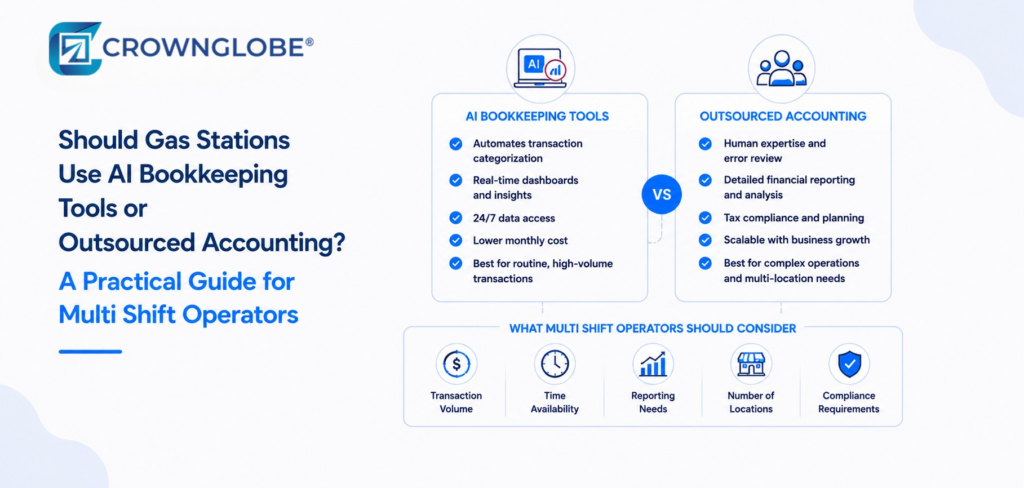
Artificial intelligence is changing the way businesses handle accounting, and fuel retailers are no exception.
As bookkeeping platforms continue adding AI capabilities, many fuel retailers are asking a practical question:
Should we rely on AI bookkeeping tools, or is outsourced accounting still the better option?
For people who own a gas station and a convenience store it is not a choice, between one or the other.
Fuel retail operations involve far more complexity than many owners expect. Multiple shifts, fuel deliveries and inventory management generate lots of data that needs to be recorded and reviewed accurately same with merchant settlements, lottery transactions, prepared food sales, payroll administration and tax compliance.
AI tools can automate accounting tasks but they cannot identify operational issues investigate exceptions or give strategic financial guidance that growing fuel retailers need.
That is why many successful operators are not choosing between automation and accounting support. They are using both.
Why This Question Matters More Than Ever
The average convenience store and gas station processes thousands of transactions every week.
Many operators manage:
- Fuel sales
- Inside store sales
- Prepared food programs
- Tobacco sales
- Lottery activity
- Credit card transactions
- Vendor invoices
- Employee payroll
As transaction volume grows, traditional manual bookkeeping becomes increasingly difficult to maintain.
This is one reason more business owners are exploring AI bookkeeping software, automated accounting platforms, and Finance Automation solutions.
The appeal is obvious:
- Reduce manual work
- Improve reporting speed
- Lower administrative costs
- Gain faster visibility into financial performance
But faster processing does not automatically mean better financial reporting.
Snippet Answer: Can AI Replace Bookkeeping for Gas Stations?
AI bookkeeping tools can do things like automate transaction processing and routine reporting. Gas stations and convenience stores still need professional accounting help for things, like inventory management and financial decision making.
What AI Bookkeeping Tools Do Well
Artificial intelligence has become remarkably effective at handling repetitive accounting tasks.
Many modern platforms can automatically:
- Import bank transactions
- Categorize expenses
- Match invoices
- Process receipts
- Identify duplicate entries
- Generate standard reports
- Perform preliminary reconciliations
Using QuickBooks Bookkeeping or Xero Bookkeeping is really helpful because the artificial intelligence features, in QuickBooks Bookkeeping and Xero Bookkeeping can reduce the work and make QuickBooks Bookkeeping and Xero Bookkeeping more efficient.
This is really helpful for businesses that’re open all the time or have many shifts at one or more places.
Faster Transaction Processing
AI tools perform exceptionally well when handling large volumes of repetitive transactions.
For example, they can automatically categorize:
- Fuel purchases
- Utility expenses
- Merchant processing fees
- Vendor invoices
- Routine operating expenses
Tasks that once consumed hours of bookkeeping time can often be completed in a fraction of the time.
Better Document Organization
Many AI powered accounting systems can automatically process:
- Vendor invoices
- Receipts
- Purchase orders
- Statements
The software extracts key information and records transactions automatically, reducing paperwork and improving recordkeeping consistency.
Where AI Bookkeeping Falls Short
Despite rapid advancements, AI still has limitations, especially in fuel retail accounting.
A gas station and convenience store works differently from a typical retail business the gas station and convenience store has many accounting challenges.
Fuel Inventory Variances
AI can identify that a variance exists.
What it often cannot determine is why the variance occurred.
Examples include:
- Missing fuel deliveries
- Meter calibration issues
- Inventory shrinkage
- Vendor billing errors
- Tank measurement discrepancies
These situations usually require investigation and operational knowledge.
That is why many operators implement controls similar to those discussed in Fuel Variance Investigation Dashboard: Catch Meter Issues, Delivery Errors, and Losses Earlier.
Vendor Rebates and Promotional Programs
Many fuel retailers receive:
- Fuel rebates
- Tobacco incentives
- Beverage allowances
- Vendor marketing support
These programs often vary by supplier. They can change throughout the year.
Without proper review, rebate income can be overlooked or recorded incorrectly, resulting in distorted profitability reporting and inaccurate financial analysis.
This challenge is explored further in Accounting for Convenience Store Operations within Gas Stations: Managing Dual Revenue Streams.
Sales Tax Compliance
Tax compliance remains one of the areas where human expertise is especially important.
Fuel retailers often deal with:
- Sales tax reporting
- Fuel tax requirements
- Lottery reporting obligations
- Multistate operations
Businesses should also maintain consistency with the NAICS code for gas station and convenience store and the appropriate activity code for gas station and convenience store.
AI can assist with processing transactions, but tax interpretation and compliance decisions still require professional judgment.
Many operators rely on Business Tax Filing and Multistate Sales Tax Filing support to help reduce compliance risk.
Why Outsourced Accounting Continues to Deliver Value
Professional outsourced accounting services provide value than just processing transactions as experienced accounting professionals review financial data and help owners make informed business decisions, with professional outsourced accounting.
More Reliable Financial Statements
Financial reports only have value when they accurately reflect the business.
Professional accounting teams routinely verify:
- Inventory balances
- Fuel margins
- Expense accruals
- Payroll entries
- Vendor liabilities
- Cash balances
The result is stronger Financial Statements Preparation and more reliable month end reporting.
Multi Shift Operational Oversight
Businesses operating multiple shifts often encounter issues such as:
- Cash over and short variances
- Deposit discrepancies
- Incomplete shift documentation
- Store level reporting inconsistencies
- Inventory tracking challenges
These situations usually require human review and operational analysis rather than automated categorization.
Many operators address these concerns through remote accounting support combined with Finance Automation.
Better Business Decisions
Software can generate reports.
Experienced advisors help business owners understand what those reports mean.
As operations grow, that distinction becomes increasingly valuable.
For example:
- Should staffing levels be adjusted?
- Are fuel margins trending in the wrong direction?
- Which product categories generate the highest returns?
- Is inventory turning fast enough?
- Does expansion make financial sense?
Questions like these often require Virtual CFO guidance rather than software alone.
Resources such as Power BI Dashboard Blueprint for Gas Stations: KPIs That Actually Move Cash Flow demonstrate how financial data can support better operational decisions.
The Strongest Approach Often Combines Both
Many owners assume they must choose between AI and outsourced accounting.
In reality, the most effective financial systems often combine both.
A modern accounting structure may include:
- AI powered transaction processing
- Automated invoice capture
- Automated bank reconciliations
- Professional bookkeeping review
- Monthly financial statement analysis
- Virtual CFO guidance
- Cash flow forecasting
- Performance dashboards
This approach provides the efficiency of automation while maintaining the accuracy and oversight of experienced professionals.
Multi Location Operators Benefit the Most
For operators managing a chain of convenience stores and gas stations, combining automation with professional review often produces the strongest results.
Automation handles routine processing.
Accounting professionals focus on:
- Exception reporting
- Margin analysis
- Inventory review
- Cash flow forecasting
- Growth planning
This model aligns closely with How a Multi-Location Franchise Used Finance Automation + Power BI to Get Decision-Ready Reporting Every Month.
What Buyers and Lenders Want to See
Whether evaluating a gas station for sale in Pennsylvania or one in Virginia, Florida or New Jersey lenders and buyers want to know one thing, about a gas station and convenience store:
Reliable financial information.
They want confidence that:
- Revenue is accurate
- Inventory is reconciled
- Margins are reliable
- Expenses are properly recorded
- Compliance requirements are being met
The same expectations apply to a gas station and convenience store, a Wawa convenience store and gas station or an independent operator preparing for growth.
Strong accounting systems boost financing chances, business value and lender trust.
How Technology Continues to Evolve
The field of accounting technology is really moving forward quickly.
Many modern systems now combine:
- AI transaction processing
- Automated invoice capture
- Merchant settlement matching
- Payroll processing
- Power BI Visualization
- Exception reporting dashboards
The secure gas stations and convenience stores use technology along, with strong internal controls and professional oversight instead of just relying on automation.
This approach also supports things like PCI DSS v4.x which’s important for Gas Stations that process card payments, after March 31 2025.
Conclusion
AI bookkeeping tools have become valuable productivity tools for fuel retailers.
Financial systems reduce work speed up transaction processing and improve access to financial information, for the financial systems.
However for a gas station and convenience store, with shifts, more transactions or multiple locations, automation alone is not usually enough.
The best financial results come from combining Finance Automation, professional Bookkeeping, outsourced accounting, remote accounting support, payroll processing and Virtual CFO guidance.
Technology can automate processes.
Experienced professionals help make sure the company makes decisions and has stronger financial controls which leads to sustainable business growth, for the company.
FAQ Section
Should a gas station use AI bookkeeping software?
Yes. AI bookkeeping tools can improve efficiency, automate routine tasks, and reduce manual data entry. However, they deliver the best results when paired with professional accounting oversight.
Can AI manage fuel inventory accounting?
AI can assist with inventory tracking, but fuel variances, delivery discrepancies, and inventory investigations typically require human review and operational expertise.
Is outsourced accounting better than hiring an internal bookkeeper?
For many small and mid sized fuel retailers, outsourced accounting provides broader expertise, stronger controls, and lower overhead than maintaining a full internal accounting department.
What accounting tasks should remain under human review?
Fuel inventory reconciliation, vendor rebates, tax compliance, payroll review, month end closing, financial statement analysis, and cash flow planning should generally receive professional oversight.
What is the best accounting setup for a multi-location gas station business?
Many operators benefit from a combination of AI bookkeeping tools, Finance Automation, outsourced accounting, Virtual CFO support, and Power BI reporting dashboards that provide visibility across all locations.