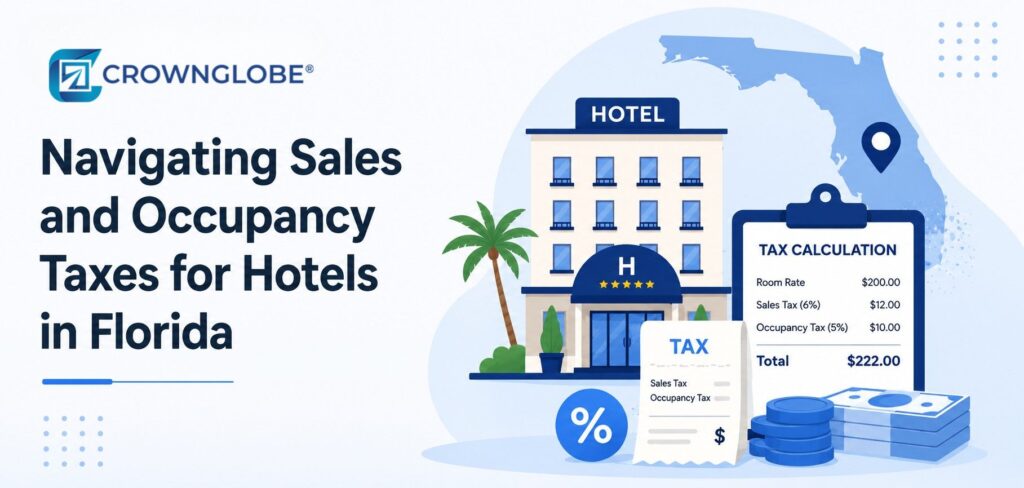
If you run a hotel in Florida, taxes are not just a compliance requirement. They directly influence your cash flow, reporting accuracy, and overall financial stability.
Across Florida, Texas, Illinois, and the Carolinas, many hotel owners face the same challenge. Revenue flows through multiple systems; tax rules vary by location, and reporting often becomes reactive instead of structured.
This is where hotel bookkeeping starts to play a much more strategic role. It is not just about recording transactions. It is about building a system that keeps your tax obligations accurate, timely, and fully aligned with your financial data. This is exactly why many owners move toward the best hotel bookkeeping services as their operations grow.
Understanding Sales and Occupancy Taxes in Florida
Hotels, in Florida usually handle two kinds of taxes:
State Sales Tax
Hotels are required to collect Florida state sales tax on room rentals and certain related services.
This generally includes:
- Room charges
- Short-term stays
- Bundled or packaged services
Local Tourist Development Tax
The occupancy tax is set by the county. It is different in different locations.
Each county has its tax rate and its own reporting requirements, which makes things more complicated for businesses that operate in multiple counties, like the county.
Snippet Insight
What makes Florida hotel taxes complex?
I have to deal with state taxes and county taxes. They both have their own set of rules and things that I need to do.
That is why relying on basic bookkeeping hotel practices is not enough. You need structured accounting and bookkeeping for hotels that can handle this level of complexity with consistency.
Why Tax Compliance Is Challenging for Hotels
From a financial systems perspective, hotels operate with built-in complexity.
You are managing:
- Multiple revenue streams
- OTA commissions with timing differences
- Food and beverage operations
- Varying tax rules across jurisdictions
Without a plan things get really tough. It is easy to get lost:
- Underreport or overreport taxes
- Miss filing deadlines
- Misclassify taxable and non-taxable transactions
This is typically the point where many owners begin to see the value of professional hotel bookkeeping services.
Common Sales and Occupancy Tax Mistakes
Most tax issues are not caused by negligence. They come from gaps in systems and processes.
1. Incorrect Revenue Classification
Room revenue, service charges, and third-party bookings are often not categorized correctly.
2. Ignoring County-Level Variations
Occupancy tax rules differ by county, and overlooking these differences can create compliance issues.
3. Delayed Reporting
When bookkeeping is not updated regularly, tax filings become reactive and error-prone.
4. Incomplete OTA Reconciliation
OTA payouts rarely align perfectly with reported revenue unless reconciled properly.
These are exactly the types of issues that structured bookkeeping for hotels is designed to prevent.
How Hotel Bookkeeping Supports Tax Compliance
A well-structured hotel bookkeeping service ensures that your financial data and tax reporting are always aligned. Whether you work with an in-house team or an experienced hotel bookkeeper, consistency in execution is what drives accuracy.
This includes:
- Accurate recording of all revenue streams
- Clear separation of transactions and non-taxable transactions helps in accurate tax calculation.
- The company needs to make sure that the numbers match up correctly across all the systems, like PMS and POS and the accounting platforms.
- Timely and reliable financial reporting
When your system is built correctly, compliance becomes a natural outcome of your process, not something you fix at the end.
This is what defines strong hotel accounting and bookkeeping services and differentiates a basic setup from a fully structured hotel bookkeeping service built for hospitality businesses.
The Role of Technology in Florida Tax Management
Modern hotel operations require systems that can keep up with real-time activity.
With cloud based hotel bookkeeping software, you gain:
- Real-time visibility into taxable revenue
- Automated categorization of transactions
- Faster and more reliable reconciliation
When combined with tools like Power BI visualization for financial reporting, you can clearly track tax liabilities as they develop, rather than discovering them at filing time.
This shift allows you to move from reactive compliance to proactive financial control.
Multi-State Operations and Florida Tax Complexity
If your business operates in states like Georgia, Texas or North Carolina in addition, to Florida things get really complicated.
You now need to manage:
- Different tax rates
- Different filing timelines
- Different compliance requirements
This is where many businesses rely on hotel bookkeeping services USA to maintain centralized control and consistent reporting across locations.
Practical Tax Management Framework for Hotels
From a systems standpoint, tax compliance should follow a consistent and repeatable structure.
Step 1: Capture Accurate Revenue
Make sure all the systems work together and the data is consistent, in all the systems.
Step 2: Categorize Transactions Correctly
ease keep items and non-taxable items separate, for clarity.
Step 3: Reconcile Regularly
Monthly reconciliation really helps people avoid getting surprises at the end of the year with the reconciliation.
Step 4: Track Tax Liabilities
Maintain clear visibility into upcoming obligations.
Step 5: File on Time
Consistency reduces both risk and penalties.
This structured approach is what separates basic bookkeeping services for hotels from a truly strategic financial system.
Where Hotels Typically Lose Money in Taxes
Even well-managed hotels can lose money due to inefficiencies in their systems.
Common areas include:
- Overpayment caused by incorrect classification
- Penalties from delayed or missed filings
- Gaps in OTA reconciliation
- Inefficient handling of food and beverage taxes
Managing the books, for a hotel restaurant is a job that requires a lot of careful attention to the hotel restaurants bookkeeping.
How Outsourced Accounting Improves Tax Accuracy
As operations grow internal processes often get too slow.
This is where outsourced accounting support begins to make a measurable difference.
You gain:
- Consistent and structured reporting
- Better visibility into tax obligations
- Reduced compliance risk
- Access to experienced financial professionals
When combined with virtual CFO advisory, tax planning becomes part of your broader financial strategy, not just a compliance requirement.
Compliance Trends Hotel Owners Should Be Aware Of
The government is watching businesses that work in different places very closely now.
Key focus areas include:
- Sales tax accuracy
- Payroll tax compliance
- Multi-state reporting requirements
A system that is supported by tax filing and compliance services really helps you stay aligned, with the regulations that are always changing.
For context it can be helpful to review guidance on how to avoid common tax mistakes, in the hotel business.
What You Should Do Next
If managing taxes feels complex, start with a simple review:
Are your revenue streams accurately tracked?
Do you have real-time visibility into tax liabilities?
Are your systems integrated or operating in silos?
Are your filings consistent and on time?
If the answers are unclear, the challenge is not effort. It is structure.
Moving toward a more organized system supported by hotel bookkeeping services and reliable hotel accounting and bookkeeping services brings clarity and control back into your operations, especially when built on integrated financial systems designed for hospitality businesses.
Final Thought
Sales and occupancy taxes are not just compliance requirements. They are part of how your financial system functions.
With strong hotel bookkeeping in place, tax management becomes predictable, accurate, and aligned with your business operations.
That is what allows you to operate with confidence and scale without unnecessary risk.
FAQ Section
What taxes do hotels in Florida need to collect?
Hotels must collect Florida state sales tax along with local occupancy or tourist development taxes, which vary by county.
Why is hotel tax compliance complex in Florida?
Because hotels must manage both state and local taxes, often with different rates, rules, and filing timelines.
How does hotel bookkeeping help with tax compliance?
Accurate hotel bookkeeping ensures revenue is tracked properly, transactions are categorized correctly, and filings are completed on time.
What happens if hotel taxes are reported incorrectly?
Errors can lead to penalties, audits, and cash flow issues due to overpayment or underpayment.
Should hotels outsource bookkeeping for tax management?
For growing hotel businesses, outsourcing improves accuracy, consistency, and compliance across locations.