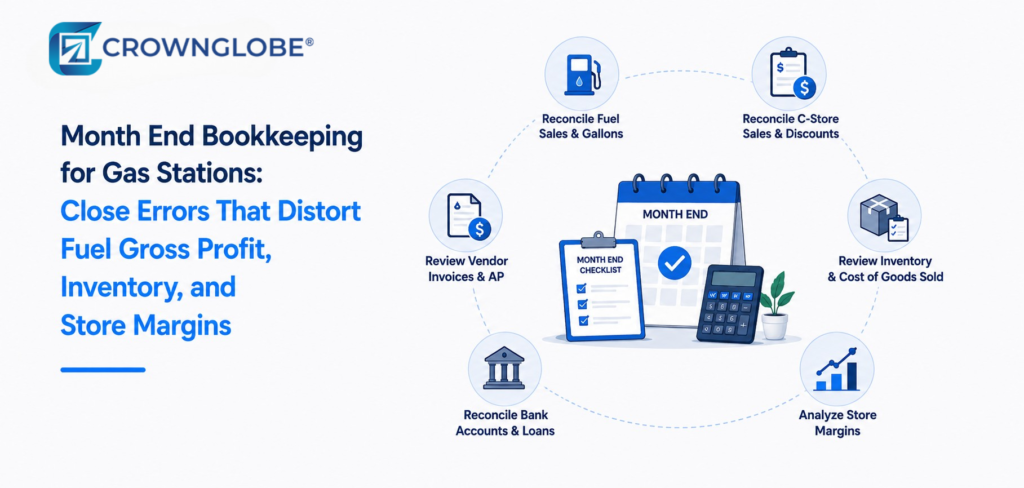
For many fuel retailers, month end reports can feel frustrated.
Sales volumes look healthy, but fuel gross profit seems lower than expected. Inventory balances move unexpectedly. Store margins fluctuate from month to month without a clear explanation.
In many cases, business is not a problem.
The real issue is the end of the closing process.
Whether you operate a single convenience store and gas station or oversee multiple locations across Illinois, Texas, Florida, Virginia, Pennsylvania, North Carolina, South Carolina, Georgia, Arkansas, Iowa, New Jersey, or Tennessee, reliable financial reporting starts with a disciplined month end bookkeeping process.
Why Month End Closing Matters
Most owners spend their time focused on running the business.
Fuel deliveries arrive.
Customers purchase fuel and merchandise.
Employees serve customers.
Bills get paid.
Operations move forward every day.
But if accounting records are not closed properly at month end, the financial statements generated from those records may not tell the full story.
A well managed month end close helps answer important questions such as:
- Are fuel margins improving or shrinking?
- Is inventory being tracked accurately?
- Which departments are generating the strongest returns?
- Are labor costs aligned with sales performance?
- Have all expenses been recorded correctly?
- Is cash flow supporting future growth?
This is why professional Bookkeeping and Gas Station and Convenience Stores Bookkeeping services place so much emphasis on month end procedures.
Snippet Answer: Why Is Month End Bookkeeping Important for Gas Stations?
Month end bookkeeping helps ensure fuel purchases, inventory balances, vendor invoices, revenue, expenses, and tax liabilities are recorded accurately. Without a structured closing process, fuel gross profit and store margin reporting can quickly become unreliable.
Error #1: Fuel Inventory Is Not Reconciled
Fuel inventory is typically one of the largest assets on a fuel retailer’s balance sheet and plays a major role in overall profitability.
Many operators still depend on supplier reports or sales information from the point of sale system without checking the actual inventory levels of the products they have in stock.
Common issues include:
- Missing fuel deliveries
- Meter discrepancies
- Inventory shrinkage
- Data entry mistakes
- Timing differences between invoices and deliveries
Even relatively small discrepancies can materially impact reported fuel gross profit.
This is one reason many operators implement practices discussed in Fuel Variance Investigation Dashboard: Catch Meter Issues, Delivery Errors, and Losses Earlier.
Error #2: Fuel Purchases Are Recorded in the Wrong Period
Timing matters more than many owners realize.
A fuel delivery received near the end of the month but recorded in the following period can significantly distort profitability.
The result may include:
- Higher profit in one month
- Lower profit in the next month
- Inconsistent gross margin reporting
A strong closing process ensures fuel purchases, invoices, and inventory adjustments are recorded in the correct accounting period.
This becomes especially important for operators using QuickBooks Bookkeeping or Xero Bookkeeping.
Error #3: Fuel Revenue and Store Revenue Are Combined
A gas station and convenience store is not a single revenue stream business.
Fuel margins operate very differently from:
- Grocery sales
- Beverage sales
- Tobacco sales
- Lottery activity
- Prepared food programs
When all revenue is combined into a single category, it becomes difficult to see which areas of the business are performing well and which need attention.
Accurate reporting should separate:
- Fuel Revenue
- Grocery Revenue
- Beverage Revenue
- Tobacco Revenue
- Prepared Food Revenue
- Lottery Revenue
This approach aligns closely with Accounting for Convenience Store Operations within Gas Stations: Managing Dual Revenue Streams.
Error #4: Vendor Rebates Are Missing
Vendor rebates often represent an important source of profitability.
Examples include:
- Tobacco incentives
- Beverage promotions
- Fuel supplier rebate programs
- Marketing allowances
Unfortunately, rebates are often recorded late or overlooked entirely.
When this happens, profitability appears lower than it actually is.
The impact becomes even greater for operators managing a chain of convenience stores and gas stations where rebate programs may represent a meaningful annual contribution to earnings.
Error #5: Merchant Fees Are Not Reconciled
Card payments account for a substantial portion of sales at modern gas stations and convenience stores.
Yet merchant processing fees are often recorded inconsistently.
Common issues include:
- Missing processor deductions
- Duplicate expense entries
- Unreconciled settlement reports
- Incorrect treatment of fuel surcharges
These issues can affect both profitability reporting and cash flow visibility.
Many operators improve accuracy through Finance Automation and Power BI Visualization tools that compare settlements directly against sales activity.
Error #6: Store Inventory Is Not Adjusted
While fuel inventory receives significant attention, inside store inventory is often overlooked.
This can impact:
- Grocery margins
- Beverage profitability
- Tobacco performance
- Prepared food costs
Without regular inventory adjustments, financial statements may not accurately reflect business performance.
Many operators uncover these issues during year end counts or while following Best Practices for Retail Inventory Management.
Error #7: Expenses Are Recorded Late
Delayed expense recognition remains one of the most common bookkeeping challenges.
Examples include:
- Utility invoices
- Payroll accruals
- Repairs and maintenance costs
- Insurance expenses
- Equipment servicing
When expenses are recorded weeks after they occur, monthly reports lose accuracy.
Professional outsourced accounting and remote accounting teams typically follow structured month end checklists to ensure all expenses are captured before closing the books.
Error #8: Cash Over and Short Variances Are Ignored
Small cash variances often appear harmless.
However, recurring over and short balances can point to:
- Training issues
- Process weaknesses
- Theft concerns
- Reconciliation errors
Over time, these differences can have a noticeable impact on store margins.
This issue is explored further in Cash Over/Short and Missing Deposits: Exception Reporting Automation for Convenience Stores.
Error #9: Financial Statements Are Reviewed Too Late
Many operators do not receive financial statements until weeks after month end.
By that point, valuable time has already been lost.
The most effective operators review:
- Profit and loss statements
- Balance sheets
- Fuel margin reports
- Inventory summaries
- Cash flow reports
within days of closing the month.
Reviewing financial statements promptly helps management identify trends early and address issues before they become larger operational challenges.
Error #10: No Standardized Closing Process Exists
Perhaps the most common issue is the lack of a formal month end procedure.
Every month should include a structured process such as:
Month End Close Checklist
- Reconcile fuel purchases
- Verify fuel inventory balances
- Reconcile fuel sales
- Review store inventory
- Record vendor rebates
- Reconcile merchant processing activity
- Review payroll accruals
- Record outstanding expenses
- Review sales tax liabilities
- Finalize financial statements
Consistency is what transforms bookkeeping data into reliable business intelligence.
What Lenders, Investors, and Buyers Expect
Whether you are reviewing a gas station and convenience store for sale in NJ, preparing a gas station and convenience store for sale in Florida, or evaluating a gas station and convenience store for sale in Pennsylvania, accurate month end reporting plays an important role.
Lenders and buyers want confidence that:
- Fuel margins are accurate
- Inventory balances are reliable
- Revenue classifications are appropriate
- Expenses are fully recorded
The same expectations apply to operators of a shell gas station and convenience store, a wawa convenience store and gas station, or independent locations preparing for expansion.
Reliable reporting also supports compliance with the NAICS code for gas station and convenience store and the appropriate activity code for gas station and convenience store.
How Technology Improves Month End Accuracy
Modern accounting technology has made month end closing far more efficient than it was only a few years ago.
Many fuel retailers now rely on technology solutions such as:
- QuickBooks Bookkeeping
- Xero Bookkeeping
- Finance Automation
- Power BI Visualization
- Virtual CFO support
These solutions help automate reconciliations, reduce manual work, and provide real time visibility into business performance.
Many operators also benefit from insights shared in Power BI Dashboard Blueprint for Gas Stations: KPIs That Actually Move Cash Flow and Virtual CFO for Gas Stations in Texas: Turn Daily POS Data into Weekly Decisions.
Conclusion
When financial reports cannot be trusted, making informed business decisions becomes much harder.
For a gas station and convenience store, month end bookkeeping errors can affect fuel gross profit, inventory balances, store margins, cash flow visibility, and tax reporting.
The strongest operators are not always the ones generating the highest sales.
They are often the operators who have the clearest understanding of their numbers.
A disciplined month end close process creates the foundation for stronger profitability, better operational visibility, improved lender confidence, and long term business growth.
FAQ Section
What is the biggest month end bookkeeping mistake gas stations make?
Failing to reconcile fuel inventory is one of the most common and costly mistakes because it directly affects reported fuel gross profit.
Why do fuel margins fluctuate from month to month?
Fuel margins may change because of inventory timing differences, delayed invoice recording, pricing changes, missing vendor rebates, or reconciliation errors.
Should fuel and store revenue be reported separately?
Yes. Separating revenue streams provides a much clearer view of profitability and operational performance.
How quickly should month end financial statements be reviewed?
Most operators should review financial statements within a few days of closing the month so that issues can be identified and addressed quickly.
Does professional bookkeeping improve month end reporting?
Yes. Professional bookkeeping, outsourced accounting, and virtual CFO services help ensure reconciliations are completed accurately and financial reports provide reliable information for decision making.