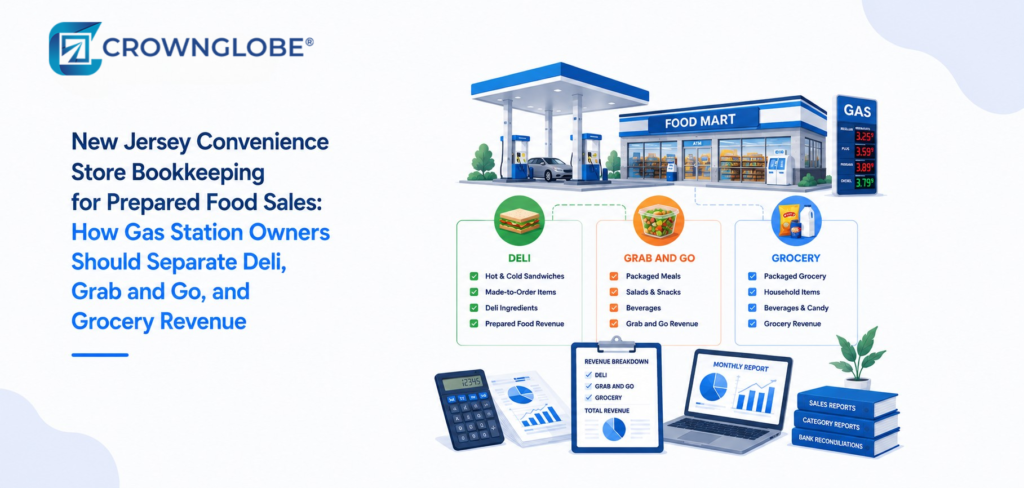
The gas station and convenience store is now more, than just a place to get fuel.
Across New Jersey many independent operators now make a lot of money from things like food, deli counters, coffee, grab and go for meals, drinks and retail items which are often more profitable, than fuel sales.
Despite this change, many store owners still record all sales under one revenue category.
This can create a lot of problems, like reporting challenges, tax compliance concerns, inventory issues. Missed opportunities to improve the profitability of the business.
If you own a convenience store and gas station in New Jersey separating deli grab and go and grocery revenue is very important, for your bookkeeping.
Why Revenue Separation Matters More Than Ever
Many store owners look at their profit and loss statements and mainly focus on total sales.
The thing is that every dollar of revenue does not make the amount of profit, for the company.
Consider the typical margin profile across different revenue streams:
| Revenue Category | Typical Margin Profile |
| Fuel Sales | Low margin |
| Grocery Products | Moderate margin |
| Packaged Beverages | Moderate to high margin |
| Prepared Food | High margin |
| Fresh Deli Items | High margin |
| Tobacco Products | Lower margin but high volume |
When all revenue is combined into a single category, it becomes difficult to answer important business questions:
- Which departments are generating the strongest profits?
- Which products deserve more shelf space?
- Is the deli operation performing as expected?
- How are labor costs affecting prepared food profitability?
- Which inventory categories need closer attention?
This is why professional Gas station and convenience stores bookkeeping should always include department level revenue tracking.
Understanding the Difference Between Deli, Grab and Go, and Grocery Revenue
Many owners view these categories as similar because they are all sold inside the store.
From an accounting, operational, and tax perspective, however, they are very different.
Deli and Prepared Food Revenue
This category typically includes:
- Made to order sandwiches
- Hot food items
- Breakfast sandwiches and prepared breakfast products
- Pizza
- Fresh deli meals
- Heated food products
Unlike traditional retail products, these sales often involve:
- Direct labor
- Food preparation processes
- Equipment maintenance
- Additional compliance requirements
Because the cost structure is different, tracking this revenue separately is critical for understanding profitability.
Grab and Go Revenue
Grab and go products generally include:
- Prepackaged sandwiches
- Salads
- Ready made meals
- Refrigerated snacks
- Fresh packaged food items
These products often have different turnover rates than made to order deli items.
Keeping them in a separate category allows owners to better monitor:
- Product waste
- Expiration losses
- Vendor performance
- Sales trends
Those insights can have a direct impact on profitability.
Grocery and Retail Merchandise Revenue
This category commonly includes:
- Chips
- Candy
- Packaged snacks
- Household products
- Grocery items
- Soft drinks
- Energy drinks
These products are sold at gas stations. Also, at convenience stores. The way people buy them and the way stores manage them is really different, from prepared food programs.
Treating them separately creates a much clearer picture of store performance.
New Jersey Sales Tax Considerations
One of the biggest reasons revenue categorization matters is sales tax compliance.
In New Jersey, certain prepared food items may be treated differently for tax purposes than traditional grocery products.
The taxability of something can depend on a lot of factors such, as the taxability:
- How the product is prepared
- Packaging methods
- Is the item meant to be used or eaten away
- Whether food is heated or served
Gas station and convenience store owners should work closely with bookkeeping and tax professionals. This is so that gas station and convenience store transactions are classified correctly. Reporting gas stations and convenience stores should also be correct. Use the right NAICS code for gas station and convenience store and the right activity code for gas station and convenience store. This helps keep everything in tax filings and financial reporting, for gas stations and convenience stores.
When revenue categories are not properly separated, businesses may face:
- Sales tax reporting errors
- Underpayment risks
- Increased audit exposure
- Penalties and interest
This becomes especially important as foodservice operations expand.
Many businesses that utilize professional Multistate Sales Tax Filing support find that properly structured revenue categories significantly reduce compliance headaches and reporting errors.
The Financial Reporting Advantage
Revenue separation is really not about following the rules, for revenue separation.
It is also about gaining visibility into what is actually driving your business.
When financial statements clearly separate revenue streams, trends become much easier to identify.
For example a monthly review might show that:
- Fuel sales increased by 2%
- Grocery sales remained flat
- Deli sales increased by 18%
- Grab and go sales declined by 10%
Without detailed bookkeeping, those insights are often hidden inside a single sales number.
That is one reason many growing operators invest in professional Financial Statements Preparation and outsourced accounting solutions tailored specifically for retail and fuel businesses.
How Proper Bookkeeping Improves Profitability
The most successful operators do not focus only on revenue.
They focus on profitability by department.
Imagine two stores generating $100,000 in monthly inside sales.
Store A records everything in one category.
Store B separates:
- Deli
- Grab and Go
- Grocery
- Tobacco
- Beverage
Store B can quickly identify:
- High margin opportunities
- Slow moving products
- Inventory waste
- Labor inefficiencies
Management decisions are based on data than assumptions, about the company.
This approach aligns closely with the best practices discussed in Accounting for Convenience Store Operations within Gas Stations: Managing Dual Revenue Streams and Optimizing Your Retail Operations: The Power of Professional Retail Bookkeeping.
The Role of POS Integration
Many bookkeeping problems actually begin at the point of sale.
If products are not categorized correctly inside the POS system, accounting records become less reliable from the start.
Owners should regularly review whether their POS platform separates:
- Prepared foods
- Deli items
- Grocery merchandise
- Beverages
- Tobacco products
- Lottery activity
into distinct reporting categories.
Modern systems that work with QuickBooks Bookkeeping, Xero Bookkeeping and Finance Automation tools can automatically map those categories into accounting records, with QuickBooks, Xero and Finance Automation.
The result is manual work, better accuracy in reporting and stronger controls, over finances.
Common Bookkeeping Mistakes New Jersey Operators Make
Recording All Store Sales in One Revenue Account
This is still one of the common bookkeeping errors people make.
While it might make data entry easier it removes the visibility we need to make business decisions.
Ignoring Food Cost Tracking
Prepared food can be very profitable. Only when the food costs of the prepared food are carefully watched.
It is really hard to figure out the profits or find out what is going wrong with the business without proper categorization of things.
Mixing Inventory Categories
Combining deli inventory with grocery inventory often creates valuation and reporting challenges.
Separate inventory accounts provide much better visibility into product performance and inventory management.
Failing to Review Monthly Financial Statements
Many owners focus primarily on cash balances and bank activity.
The problem is that profitability issues often appear in financial reports long before they affect cash flow.
Regular financial reviews help identify trends early and support better decision making.
This is where Virtual CFO support can provide significant value.
How Power BI Can Improve Visibility
As foodservice operations grow, spreadsheets often become difficult to manage and maintain.
Many operators are turning to Power BI Visualization solutions to gain deeper insight into:
- Department sales trends
- Product category performance
- Food margins
- Inventory turnover
- Labor efficiency
- Store profitability
For multi location operators, dashboards provide a centralized, real time view of performance across every store.
This approach complements strategies discussed in Power BI Dashboard Blueprint for Gas Stations: KPIs That Actually Move Cash Flow and Multi Location Benchmarking in Power BI: Compare Store Performance Across Georgia and Tennessee in One View.
What Lenders and Buyers Want to See
Whether you are seeking financing or preparing a gas station and convenience store for sale in NJ, financial reporting quality matters.
Lenders and buyers want confidence that management understands:
- Revenue composition
- Margin drivers
- Inventory controls
- Operational performance
Businesses with organized bookkeeping and department level reporting typically move through due diligence more smoothly. Whether you are owning a convenience store and gas station today or preparing a future sale, detailed revenue reporting helps buyers understand the true performance of each department and reduces questions during the review process.
Building a Stronger Accounting Foundation
The ultimate goal is not simply tax compliance.
The goal is building a financial system that helps owners make smarter business decisions every month.
A strong bookkeeping framework should include:
- Department level revenue tracking
- Inventory controls
- Monthly reconciliations
- Sales tax reviews
- Financial statement analysis
- Year end planning
Many operators also combine Bookkeeping, Business Tax Filing, payroll processing, and year end finalization and annual checkup services into a single, coordinated financial management process.
Conclusion
As foodservice continues to become a larger profit driver for New Jersey operators, separating deli, grab and go, and grocery revenue is no longer just a bookkeeping best practice.
It is a business necessity.
Accurate revenue categorization helps with bookkeeping and sales tax. It also improves financial reporting and gives a clearer understanding of what is truly driving the revenue categorization and profitability.
Every gas station and convenience store gets a foundation for growth better cash flow management and more confident decision making with this level of visibility, for the gas station and convenience store.
The operators who know where their money is coming from are the ones who do well and succeed with the internet companies over a time.
FAQ Section
Should deli sales and grocery sales be recorded separately?
Yes. Deli sales typically involve different labor costs, food costs, inventory management practices, and tax considerations than grocery products. Separating these categories provides more accurate financial reporting and profitability analysis.
Why is revenue categorization important for gas stations and convenience stores?
Revenue categorization helps owners understand department performance, improve inventory management, strengthen tax compliance, and make more informed business decisions.
Can my POS system automatically separate deli and grocery revenue?
Most modern POS systems can categorize products by department. When properly configured and integrated with your bookkeeping system, they can automatically separate and report sales by category.
How often should financial statements be reviewed?
Monthly reviews are generally recommended. Waiting until year end can delay the identification of profitability issues and limit opportunities to improve performance throughout the year.
Does revenue separation help when selling a gas station business?
Yes. Buyers and lenders generally prefer businesses with organized financial records and clear visibility into revenue and profitability by department. Strong reporting can help support smoother due diligence and valuation discussions.