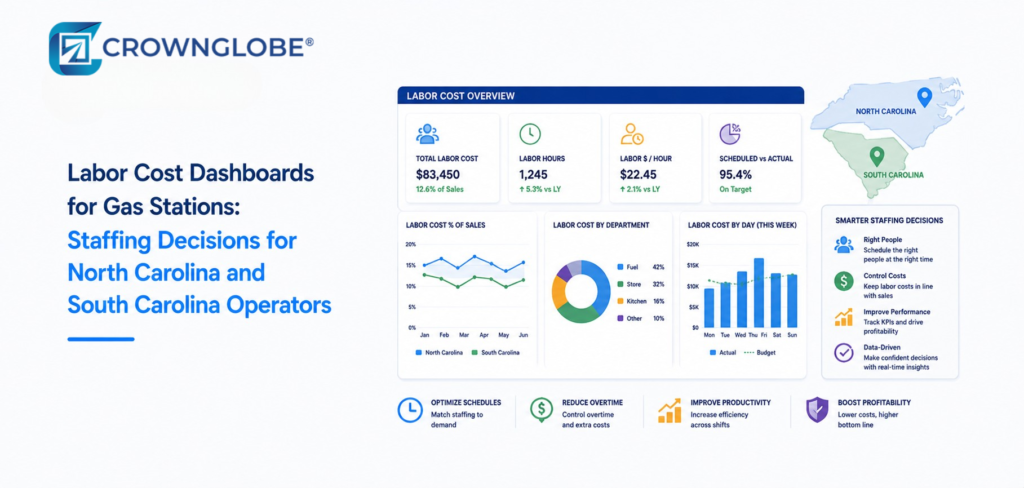
Running a gas station and convenience store in North Carolina and South Carolina requires you to keep an eye on costs, especially labor costs, at the gas station and convenience store.
Labor is something you can control. Without the right data staffing decisions are made based on instinct instead of insight, about labor.
That is where labor cost dashboards and a Chief Financial Officer led approach begin to make a difference, with labor cost dashboards.
Why Labor Costs Matter More Than You Think
For gas stations and convenience stores, labor costs are one of the biggest expenses, and even small inefficiencies can quietly erode the profitability of gas stations and convenience stores over time.
Common challenges include:
- Overstaffing during slower hours
- Understaffing during peak traffic
- Limited visibility into labor cost by location
- No clear link between labor spends and sales performance
For convenience store and gas station operators or those managing a chain of them, these problems do not stay isolated. They compound across locations.
Snippet Answer: What Is a Labor Cost Dashboard?
A labor cost dashboard is a tool that helps business owners make decisions about staffing by showing them labor costs hours worked and how well their staff is doing.
The Hidden Problem: Labor Without Visibility
Most operators review total payroll numbers but rarely analyze how labor is performing.
Looking at payroll alone does not answer important operational questions:
- Are you staffed correctly during peak hours?
- Which locations are consistently overstaffed?
- Is labor aligned with your revenue patterns?
Without reporting, labor starts to feel like a fixed expense instead of something you can manage actively.
For convenience store and gas station owners, not having enough visibility often means missing chances to increase profits.
Key Metrics Every Operator Should Track
A good labor dashboard shows you a few things instead of giving you too much data to look at.
Labor Cost as a Percentage of Sales
This shows how much of your revenue is being consumed by labor.
Tracking this across locations helps you identify:
- Stores with higher labor costs
- Operational inefficiencies
- Performance trends over time
Sales per Labor Hour
This is one of the most practical measures of efficiency.
It tells you how much revenue each labor hour is generating.
Lower numbers may point to:
- Overstaffing
- Inefficient scheduling
- Productivity gaps
Labor Hours by Shift
Breaking labor down by shift provides a more detailed view of operations.
You can quickly identify:
- Overstaffed time periods
- Understaffed peak hours
- Scheduling patterns that need adjustment
Overtime and Compliance Tracking
Labor dashboards should also highlight:
- Overtime costs
- Wage compliance
- Scheduling consistency
This is especially important in states, like North Carolina and South Carolina, where labor expectations and compliance requirements can vary a lot.
Why Traditional Reporting Falls Short
Many operators still depend on spreadsheets or basic payroll summaries to manage payroll information, for the operators and the payroll.
While familiar, these tools create limitations:
- Data is often delayed
- Reports are static and hard to act on
- No real-time visibility
- Difficult to compare multiple locations
For a gas station and convenience store business, this approach quickly becomes inefficient as you grow.
By the time issues surface, they have already affected your margins.
How Power BI Transforms Labor Management
Power BI visualization shifts your approach from reactive to proactive.
You get to see what is happening in your operations now instead of looking at reports later.
What a Labor Dashboard Can Show
- Labor cost by location
- Sales versus labor comparisons
- Daily and weekly trends
- Shift-level performance
- Overtime tracking
When paired with finance automation systems that keep your data updated in real time, your data updates continuously, allowing you to monitor performance as it happens.
From Data to Action: The CFO Perspective
Data alone does not drive results. The real value comes from how you interpret and apply it.
A virtual CFO helps you:
- Identify overstaffed locations
- Align schedules with sales patterns
- Benchmark performance across stores
- Plan to hire based on actual demand
This is super valuable when buying a gas station and convenience store in North Carolina or moving into areas, like Virginia or Georgia where performance benchmarks differ by location.
Multi-Location Benchmarking for Labor Efficiency
If you operate multiple gas stations and convenience stores, labor performance will naturally vary by location.
This can be influenced by:
- Customer traffic patterns
- Store size and layout
- Local wage rates
- Management practices
A centralized dashboard allows you to:
- Compare stores side by side
- Identify top-performing locations
- Standardize staffing strategies
For a chain of convenience stores and gas stations, this level of visibility is essential for scaling efficiently.
Aligning Labor with Revenue
One of the most effective shifts you can make is treating labor as a variable cost tied directly to revenue.
Instead of fixed schedules, staffing should adapt based on:
- Sales trends
- Time of day
- Seasonal demand
This approach ensures labor supports growth instead of limiting profitability.
Compliance and Financial Structure
Labor tracking should also align with proper financial and regulatory standards.
You need to ensure:
- Alignment with the NAICS code for gas station and convenience store
- Accurate reporting using the activity code for gas station and convenience store
- Proper payroll processing and tax filing with streamlined payroll processing systems
Accurate records also support requirements such as Florida gas station and convenience store insurance and multi-state compliance.
Common Mistakes That Increase Labor Costs
Many operators unintentionally drive-up labor costs due to:
- Fixed schedules that do not reflect demand
- Limited performance tracking
- Ignoring key efficiency metrics
- Lack of benchmarking across locations
- Treating labor as a fixed expense
These challenges are especially common when evaluating gas stations and convenience stores for sale without detailed financial insights.
Practical Weekly Workflow for Labor Optimization
A simple weekly process can significantly improve labor efficiency:
Step 1: Review Labor Percentage of Sales
Identify stores exceeding targets
Step 2: Analyze Sales per Labor Hour
Compare performance across locations
Step 3: Evaluate Shift Performance
Adjust schedules where needed
Step 4: Monitor Overtime
Control unnecessary costs
Step 5: Take Action
Implement improvements for the upcoming week
This routine helps shift your approach from reactive to proactive management.
Tax and Financial Considerations
Labor is one of your largest deductible expenses, but only when tracked accurately.
Proper reporting helps you:
- Maintain clean records for tax filing
- Prepare reliable financial statements with structured financial statements preparation
- Stay compliant across multiple states
For help check out Maximizing Tax Deductions and Credits for Retail Stores and Tax Planning Strategies, for Retail Stores.
How Crownglobe Supports Labor Optimization
Crownglobe works with gas station and convenience store owners to build systems that improve labor visibility and control.
This includes:
- Bookkeeping and outsourced accounting
- Virtual CFO services
- Finance automation
- Power BI dashboards
- Payroll processing and compliance
- Year-end financial checkups
The focus of this is to give you reliable data so you can make confident staffing decisions about your staff and the people you are going to hire for staffing.
Conclusion
Labor is one of the controllable expenses, in a gas station and convenience store, but the thing is, labor is often not used in the best way.
With the dashboards and a CFO-led approach, you get the visibility to match staffing with actual performance.
The North Carolina and South Carolina operations have cost control, improved efficiency and a stronger operation, across North Carolina and South Carolina.
FAQ Section
How can labor dashboards improve gas station profitability?
They provide visibility into staffing efficiency, helping you reduce unnecessary labor costs and improve scheduling decisions.
What is a good labor cost percentage for gas stations?
It varies by location but typically ranges between 10% to 15% of sales depending on store size and operations.
How often should labor performance be reviewed?
Weekly reviews are recommended to identify trends and make timely adjustments.
Can Power BI help with staffing decisions?
Yes. Power BI dashboards provide real-time insights into labor costs and performance across locations.
Is labor-cost tracking important when buying a gas station?
Absolutely. It helps evaluate operational efficiency when reviewing gas stations and convenience stores for sale.