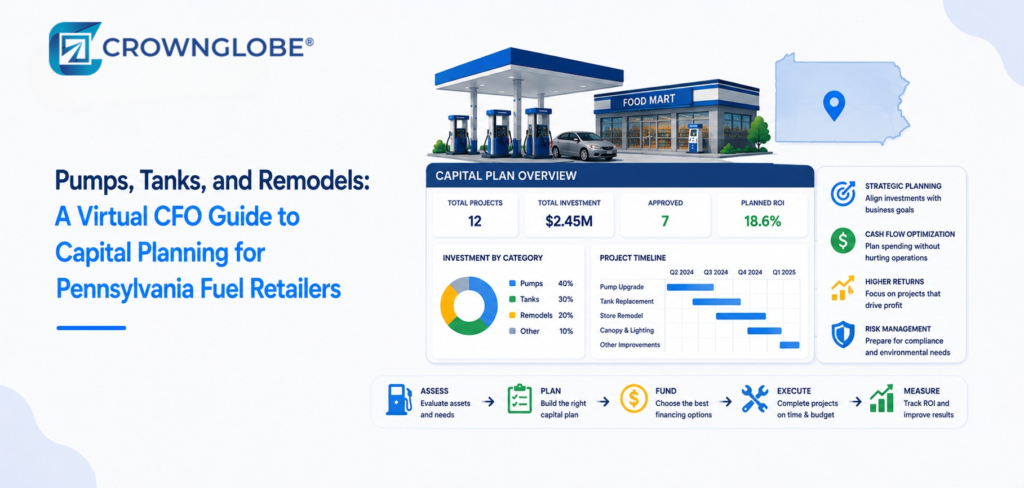
Running a gas station and convenience store in Pennsylvania is not about managing daily operations; it is also about making big decisions like replacing old fuel pumps or remodeling the store.
These expenses are not routine; they are investments that directly affect your business’s cash flow, profitability, and the overall value of your business.
For convenience stores and gas station owners or managers, planning to spend money is crucial. If you have one store or many of your choices affect how well, you do it in the run. Without a plan, even needed upgrades can hurt your finances. Convenience stores and gas stations need to make smart choices about spending to succeed.
This is where a virtual CFO perspective becomes especially valuable. This thing brings orders to these decisions. Helps make sure that each investment supports the long-term growth of the company rather than causing short-term strain on the investment.
Why Capital Planning Matters for Fuel Retailers
Fuel retail is inherently capital intensive. Unlike many other retail models, you are managing both physical infrastructure and high-volume daily transactions.
Typical capital investments include:
- Fuel pumps and dispensers
- Underground storage tanks
- Environmental compliance upgrades
- Store remodels and layout enhancements
- POS and payment system upgrades
Each of these business decisions carries term financial implications that affect how your business operates today and how it performs and is valued in the future.
For operators evaluating a gas station and convenience store for sale in Pennsylvania or nearby markets like New Jersey or Virginia, capital planning also plays a direct role in deal structure and valuation.
Snippet Answer: What Is Capital Planning for Gas Stations?
Capital planning is the process of evaluating, prioritizing, and financing long-term investments such as fuel infrastructure upgrades and store improvements while maintaining stable cash flow and profitability.
The Hidden Risk: Poor Timing of Capital Investments
Many gas stations and convenience stores approach capital decisions reactively.
A pump fails. A tank reaches compliance limits. A nearby competitor upgrades their store.
The investment gets made, but the financial impact is not always fully considered in advance.
This often leads to:
- Cash flow pressure from large upfront costs
- Financing decisions made without proper analysis
- Spending on upgrades that do not deliver strong returns
- Delayed ROI due to poor timing or execution
Without a plan, issues can hurt operations and long-term finances.
A CFO Framework for Capital Planning
A Chief Financial Officer or CFO led approach brings discipline and clarity to the decision-making process, for a gas station and convenience store operation or a convenience store and gas station operation.
Prioritizing High-Impact Investments
Not every upgrade delivers the same level of return.
A structured evaluation focuses on:
- ROI from pump upgrades compared to store remodels
- Impact on fuel volume and inside store sales
- Your competitive position within the local market
For instance, upgrading pumps may improve throughput and customer flow, while a well-planned remodel can significantly increase high-margin in-store sales.
Cash Flow Forecasting Before Investment
Before committing any capital expense, it is critical to understand your cash position in detail.
This includes:
- Available cash reserves
- Projected weekly and monthly cash flow
- Existing debt obligations and financing capacity
Operators who rely on strong financial statements of preparation and forward-looking forecasts have a much clearer view of whether an investment is sustainable.
Financing Strategy and Cost of Capital
Most capital investments require some form of financing. Choosing the right structure is key.
Common options include:
- Equipment financing
- SBA loans
- Lines of credit
A CFO evaluates:
- Cost of capital versus expected return
- Impact on ongoing cash flow
- Flexibility of repayment terms
This becomes particularly important when comparing decisions such as expanding locally versus acquiring a gas station and convenience store for sale in Florida.
Pumps and Tank Upgrades: Long-Term Planning
Fuel infrastructure is one of the most significant capital areas in your business.
Replacing pumps or upgrading tanks are decisions that have long-term implications they should not be treated as routine maintenance.
Important factors include:
- Environmental compliance requirements
- Expected lifespan of equipment
- Impact on fuel sales and throughput
- Operational downtime during installation
Operators using structured gas station and convenience stores bookkeeping systems are better positioned to track these investments accurately and plan depreciation effectively.
Store Remodels: Driving Inside Sales Growth
While fuel brings customers in, your convenience store drives profitability.
A well-executed remodel can improve:
- Customer experience
- Product visibility and layout
- Sales of higher-margin categories
However, remodeling decisions should always be backed by financial analysis.
A CFO approach evaluates:
- Incremental revenue potential
- Expected payback period
- Impact on labor and operating costs
For operators managing multiple convenience stores and gas stations, comparing remodel performance across locations becomes an important part of decision-making.
Multi-Location Capital Planning Strategy
As you expand across states like Pennsylvania, Georgia, or North Carolina, capital planning becomes more complex, especially for operators owning a convenience store and gas station across multiple markets.
You need to:
- Prioritize investments across locations
- Maintain consistency in upgrade strategies
- Compare ROI across different markets
Using Power BI visualization, you can monitor performance metrics across locations and identify where capital investment will deliver the strongest return.
Evaluating gas stations and convenience stores for sale or planning expansion is when this level of insight is especially valuable for gas stations and convenience stores.
Compliance, Tax, and Structural Considerations
Capital investments also carry important tax and compliance implications.
You need to ensure:
- Proper classification aligned with the NAICS code for gas station and convenience store, especially when understanding the difference between gas station and convenience store revenue streams for accurate reporting
- Accurate reporting using the activity code for gas station and convenience store
- Consistent asset tracking and depreciation
Additionally, requirements such as Florida gas station and convenience store insurance highlight the importance of maintaining accurate and consistent financial reporting across multiple states.
From a tax perspective, capital investments may qualify for:
- Section 179 deductions
- Bonus depreciation
You can get information by looking at Maximizing Tax Deductions and Credits for Retail Stores and Tax Planning Strategies, for Retail Stores.
Common Capital Planning Mistakes
Many operators encounter similar issues:
- Making reactive investment decisions
- Skipping cash flow forecasting before spending
- Overinvesting in upgrades that do not generate strong returns
- Ignoring long-term maintenance cycles
- Operating without clear financial visibility
These challenges are particularly common among operators reviewing gas stations and convenience stores for sale without a structured financial framework in place.
Practical CFO Workflow for Capital Planning
A structured capital planning process typically follows these steps:
Step 1: Asset Assessment
Evaluate the current condition of pumps, tanks, and store infrastructure
Step 2: Financial Analysis
Assess ROI, payback period, and impact on cash flow
Step 3: Prioritization
Rank investments based on urgency and expected return
Step 4: Financing Plan
Select the most efficient funding approach
Step 5: Monitoring
Track performance after implementation
This way every investment matches my term financial goals.
How Crownglobe Supports Capital Planning
Crownglobe works with gas station and convenience store owners to build structured financial systems that support capital-intensive operations.
This includes:
- Virtual CFO services focused on capital planning
- Finance automation for real-time visibility
- Bookkeeping and outsourced accounting
- Financial statements preparation
- Payroll processing and compliance
- Year-end financial checkups
The goal is straightforward: to help you make informed investment decisions with clarity and confidence.
Conclusion
Capital investments in pumps and tanks are normal when running a gas station and convenience store.
The real difference between investments is the way those investments are planned and executed.
You get an idea of where to invest and how to pay for it with a good Chief Financial Officer plan.
This helps you protect your cash flow to make your business more profitable and build a more resilient business over time.
FAQ Section
What are the biggest capital expenses for gas stations?
Fuel pumps, underground tanks, environmental compliance upgrades, and store remodels are typically the largest capital investments.
How do I plan capital investments for a gas station?
A structured approach that includes ROI analysis, cash flow forecasting, and a clear financing strategy is essential.
Are fuel equipment upgrades tax deductible?
Yes. Many capital investments qualify for tax benefits such as Section 179 and bonus depreciation.
How often should gas stations remodel their stores?
Most operators plan remodels every 5 to 10 years, depending on competition and market conditions.
Can a CFO help with capital planning?
Yes. A CFO provides financial analysis, forecasting, and strategic guidance to ensure investments support long-term profitability.