Running a gas station and convenience store means handling lots of transactions for fuel sales, in-store purchases, and various payment methods.
In this environment, small cash handling mistakes can add up fast. Quietly cut into profitability over time.
Many operators only find out about these problems at the end of the month when it is too late to fix the problems or figure out what caused the problems.
Exception reporting automation helps you see what is going on in your operations, so you can find problems early and fix exception reporting automation issues before they hurt your performance.
Why Cash Over/Short and Missing Deposits Matter
Cash discrepancies are often seen as everyday problems, but they are early signs of bigger operational or financial problems, with the company’s cash.
For convenience store and gas station owners or managers, these issues can quickly multiply across locations.
Common risks include:
- Unrecorded or delayed deposits
- Employee handling errors
- Gaps in internal controls
- Potential misuse of funds
Things can go wrong when we do not have a system in place to deal with daily operations, and these problems often remain hidden.
Snippet Answer: What Is Cash Over/Short?
Cash over/short is the difference between the expected cash balance based on POS sales and the actual cash counted at the register or deposited in the bank.
Consistent discrepancies usually mean there are problems, with processes, internal controls, or how we reconcile things.
The Hidden Problem: Lack of Real-Time Visibility
Most gas stations and convenience stores still use reconciliation or basic POS summaries.
The challenge is not the absence of data. It is the delay in identifying issues.
Common gaps include:
- No daily reconciliation between sales and deposits
- Limited tracking of cash variances by shift or employee
- No system to flag missing deposits
- Lack of centralized reporting across locations
Whether you are owning a convenience store and gas station or expanding into multiple states, delayed visibility often leads to avoidable losses.
What Should Be Monitored Daily
A strong financial control system focuses on daily exception tracking, not just monthly reporting.
Cash Over/Short by Register and Shift
You need clear visibility into:
- Expected versus actual cash balances
- Variances by shift or cashier
- Patterns over time
This helps figure out if discrepancies one-time things or if they keep happening and need attention.
Deposit Matching
Every deposit should be matched against recorded sales.
This includes:
- Cash deposits
- Card settlements
- Timing differences
Missing or delayed deposits remains one of the most common and overlooked issues in gas stations and convenience stores.
Store-Level and Multi-Location Trends
For operators managing multiple locations, trend visibility becomes even more important.
A well-designed dashboard should highlight:
- Locations with frequent discrepancies
- High-risk stores
- Regional patterns across states like New Jersey, Pennsylvania, or Virginia
This level of insight is especially valuable when evaluating gas stations and convenience stores for sale or planning expansion.
Why Spreadsheets Fail for Exception Tracking
Many operators still rely on spreadsheets to track cash discrepancies.
While they may work in the early stages, spreadsheets introduce limitations as operations grow:
- Manual data entry errors
- Delayed updates
- No real-time alerts
- Difficulty managing multiple locations
For a gas station and convenience store business, this approach does not scale effectively.
How Exception Reporting Automation Works
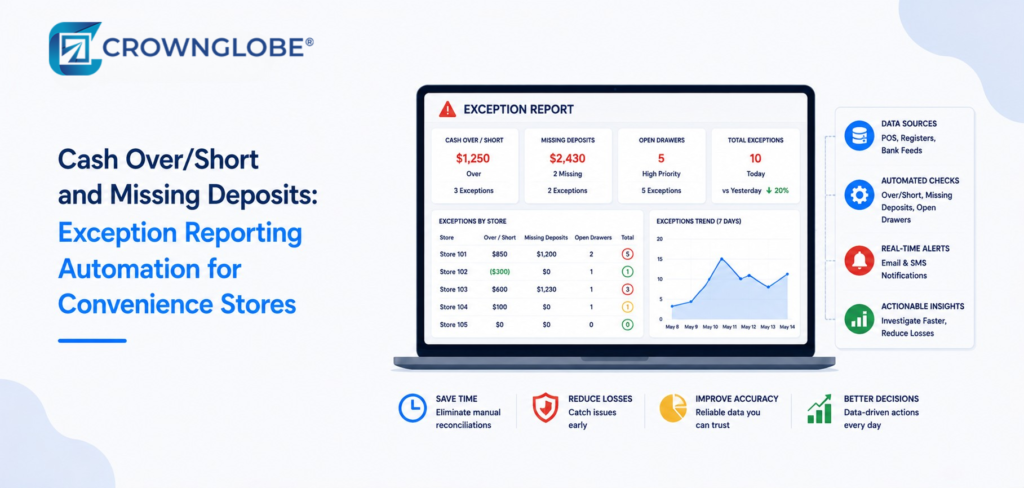
Exception reporting automation shifts your focus from reviewing everything to focusing only on what needs attention.
This helps determine whether discrepancies are isolated from incidents or part of a recurring pattern that requires attention.
Data Integration
Automation connects:
- POS systems
- Accounting software
- Bank feeds
- Fuel systems
This creates a unified and consistent flow of data across your business.
Operators who combine finance automation with remote accounting services often see immediate improvements in both accuracy and efficiency.
Real-Time Alerts
The system flags:
- Cash over/short beyond defined thresholds
- Missing or delayed deposits
- Unusual transaction patterns
This allows you to act immediately, rather than waiting until the end of the month.
Exception-Based Dashboards
With Power BI visualization, you can monitor:
- Cash discrepancies by location
- Deposit matching status
- Trends over time
This gives you a clear, actionable view of your financial position at any given moment.
CFO Perspective: Turning Exceptions into Control
From a CFO standpoint, exception reporting is not just about identifying problems. It is about preventing them.
A structured system supports:
- Accurate financial statements preparation
- Reliable cash flow tracking
- Strong internal controls
- Better decision-making
This is especially important when reviewing a gas station and convenience store for sale in Florida, New Jersey or Pennsylvania or when analyzing performance across states, like Florida, New Jersey and Pennsylvania.
Multi-Location Complexity and Risk
If you run convenience stores and gas stations, the risk gets bigger, with each extra location.
Small differences in places can quickly add to a significant financial effect.
A centralized dashboard helps you:
- Compare locations side by side
- Identify high-risk stores
- Standardize processes across all sites
This level of control is essential for scaling operations with confidence.
Compliance and Financial Structure
Accurate cash tracking also supports regulatory compliance.
You need to ensure:
- Proper classification aligned with NAICS code for gas station and convenience store
- Correct reporting using the activity code for gas station and convenience store
- Accurate tax reporting and documentation
It also supports requirements such as Florida gas station and convenience store insurance, where reliable financial reporting is critical.
Common Mistakes That Lead to Cash Issues
Many operators encounter similar challenges:
- Skipping daily reconciliation
- Relying only on summary reports
- Ignoring small discrepancies
- Not tracking deposits consistently
- Lack of standardized processes
These issues are especially common among operators evaluating gas stations and convenience stores for sale without a structured financial system.
Practical Workflow: Automated Exception Reporting
A structured workflow typically follows these steps:
Step 1: Data Capture
POS, fuel, and banking data are captured automatically
Step 2: Reconciliation
Sales and deposits are matched daily
Step 3: Exception Detection
The system flags discrepancies
Step 4: Review and Action
You investigate and resolve issues
Step 5: Reporting
Data flows into dashboards and financial reports
This approach ensures consistency, accuracy, and control across your operations.
Tax and Financial Impact
Accurate exception tracking strengthens your financial and tax position.
It helps you:
- Maintain clean records for tax filing
- Identify deductible discrepancies or losses
- Prepare accurate year-end financial statements
For further insights, refer to Maximizing Tax Deductions and Credits for Retail Stores and Tax Planning Strategies for Retail Stores to improve your overall tax efficiency.
How Crownglobe Helps Gas Station Owners
Crownglobe supports gas station and convenience store owners with systems designed to improve financial visibility and control.
This includes:
- Bookkeeping and outsourced accounting
- Virtual CFO services
- Finance automation
- Power BI dashboards
- Payroll processing and compliance
- Year-end financial checkups
The focus is practical and results-driven: helping you identify issues early and make confident financial decisions.
Conclusion
Cash over or short issues and missing deposits are risks that can quietly reduce the profitability of a company over time.
For a gas station and convenience store, consistent visibility into these areas is essential.
With automated exception reporting and a CFO-led approach, you shift from reactive problem-solving to structured financial control.
This shift not only protects your margins but also creates a stronger, more scalable business.
FAQ Section
What causes cash over/short in gas stations?
It is typically caused by cashier errors, incorrect change of handling, or gaps in reconciliation processes.
How can missing deposits be detected?
By matching POS sales with bank deposits daily using automated systems.
Why is exception reporting important?
It highlights discrepancies in real time, allowing faster resolution and stronger financial control.
Can automation reduce cash discrepancies?
Yes. Automation minimizes manual errors and improves visibility across operations.
How often should cash reconciliation be done?
Daily reconciliation is recommended to prevent small issues from becoming larger financial problems.