When dental practice owners usually worry about money problems like having to pay their employees or spending more on things, like rent and equipment or not making as much money as they used to from dental work.
Yet one of the problems that can hurt a company’s profitability is often ignored.
Aged receivables.
In medical practices doctors and staff stay very busy, with full schedules and good production numbers but owners still wonder:
“Why does cash flow always feel tighter than it should?”
“Why are we regularly moving money between accounts?”
“Why do the financial results feel different from what the production reports suggest?”
More often than not the answer, to your question is actually sitting right there in the Accounts Receivable Aging Report.
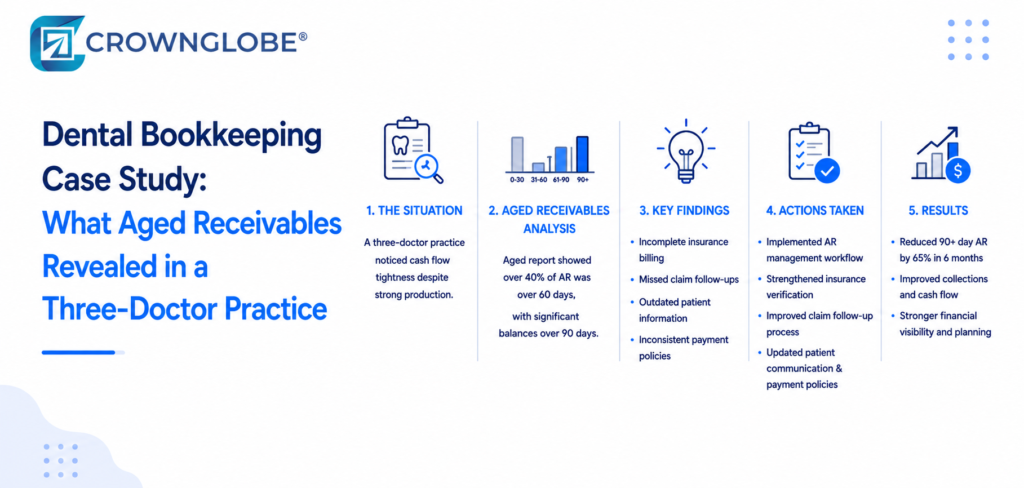
This dental bookkeeping case study is a three-doctor practice that found some financial problems when it looked at its money that people owed them.
While some details have been changed for confidentiality the lessons learned still apply to practices in Florida, Texas, New Jersey and other states, across the US.
The Situation: Strong Production but Ongoing Cash Flow Pressure
The practice of the company had really enjoyed years of growth that was very consistent.
It worked with three providers, a growing team and steady patient demand and from what I could see the business looked like it was doing really well.
Key indicators included:
- Consistent monthly production
- Stable patient volume
- Increasing collections
- Healthy year-over-year revenue growth
The ownership team was still having a lot of trouble with the money coming and going out of the business.
The company was making products but the money they had, in the bank was not going up as fast as the production of the products was.
Initially the leadership team wondered if payroll expenses, delays, in insurance reimbursement or increasing costs were to blame.
A deeper review through monthly dental bookkeeping revealed a very different story.
What the Aging Report Revealed
One of the first reports reviewed was the Accounts Receivable Aging Report.
The findings caught the ownership group off guard.
The practice was carrying more than $280,000 in outstanding receivables.
Even more concerning was how those balances were distributed:
- Less than 50 percent was considered current
- Balances in the 30 to 60 day category continued to grow
- 60 to 90 day receivables were increasing month after month
- More than $90,000 had remained unpaid for over 120 days
The practice had become highly focused on production while losing visibility into collections performance.
This is a challenge we frequently see in bookkeeping for dentists.
Production reflects the value of services delivered.
Collections reflect the cash that actually arrives.
Without monitoring both consistently, it becomes difficult to evaluate financial performance accurately.
Quick Answer: Why Aged Receivables Matter
Aged receivables can quietly create several business challenges:
- Reduced cash flow
- Delayed insurance collections
- Inaccurate profitability reporting
- Increased write-off exposure
- Delayed growth initiatives
- Greater operational stress
Strong dental bookkeeping helps identify these issues early, before they begin affecting larger business decisions.
The Root Causes Behind the Receivables Growth
After reviewing accounting records, practice management reports, and insurance activity, several patterns became clear.
Insurance Claims Were Not Being Followed Consistently
A number of insurance claims remained unpaid for extended periods without structured follow-up.
The team assumed payments would eventually arrive.
Many claims for reimbursement needed paperwork or had to be sent in again before the money could be given back, to the people who made the claims.
Without a formal process, aging balances continued to accumulate.
Patient Balances Were Not Reviewed Regularly
Patient receivables were also contributing to the problem.
While many balances looked small on their own all together they added up to a lot of cash that was still owed.
The front office team was doing a job, with patients and schedules but the front office team was not giving the same attention to follow up on bills that the front office team needed to collect from patients.
Reporting Focused More on Production Than Collections
Monthly management meetings consistently emphasized production.
Collections performance received far less discussion.
As a result, leadership missed early indicators that receivables were becoming a growing concern.
This is one reason experienced dental accountants review production, collections, and aging reports together rather than treating them as separate metrics.
How Better Dental Accounting Improved Visibility
The dental practice started doing a review in a more organized way. They got help from accounting services that know about work. The people in charge worked with an accountant who has experience, with dentists and advisors who know about accounting. This helped them see how well they were doing with getting paid and what was going on with the money they were owed. It also helped them understand how their practice was doing financially with the dental accounting services.
The objective was not simply to collect overdue balances.
It was to create long-term financial visibility.
The process included:
- Monthly aging reviews
- Insurance reconciliations
- Collections trend analysis
- Accounts receivable monitoring
- Financial Statements Preparation
Within a few months, leadership had a much clearer understanding of what was truly happening inside the business.
Why Production Alone Does Not Measure Success
One of the things I learned from this experience was the difference, between production and collections and it really made me think about production and collections in a new way.
The practice of the company consistently generated than $300,000, in monthly production.
At first, ownership viewed those numbers as confirmation that the practice was financially strong.
However, a meaningful portion of production was not being converted into timely collections.
That distinction matters.
The company uses cash to pay for things, like payroll, rent, supplies, debt obligations and operating expenses not production reports.
Strong dental accounting and bookkeeping helps connect production, collections, profitability and cash flow into one financial picture, for dentists.
The Technology Improvements That Supported Results
The practice also invested in improving financial visibility through better reporting tools.
Using QuickBooks Bookkeeping, integrated practice management systems, and customized reporting dashboards, the ownership team gained deeper insight into:
- Collection percentages
- Insurance reimbursement timing
- Aging trends
- Provider performance
- Cash flow forecasting
Many growing practices now combine QuickBooks for dentists with Finance Automation and Power BI Visualization tools to monitor financial performance more proactively.
Technology alone does not solve receivables challenges.
However it helps us see problems earlier so we can fix them before they get big.
Results After Six Months
Six months after implementing these improvements, the results were noticeable.
Aged receivables were reduced substantially.
More importantly, financial visibility improved dramatically.
Leadership could now confidently answer questions such as:
- Are collections keeping pace with production?
- Which insurance carriers are creating payment delays?
- Which patient balances require immediate follow-up?
- How much cash flow is available to support future growth?
The practice also strengthened budgeting and forecasting discussions through ongoing Virtual CFO support and outsourced accounting services. The combination of specialized dental practice bookkeeping and guidance from accountants for dental practices gave ownership greater confidence in future planning and growth decisions.
As financial visibility improved, so did decision-making.
Common Warning Signs Other Practices Should Watch For
Many dental practices face similar challenges without realizing it.
Common warning signs include:
- Growing receivable balances
- Strong production but weak cash flow
- Increasing write-offs
- Delayed insurance reimbursements
- Frequent cash shortages
- Difficulty forecasting profitability
Because these issues develop slowly it is easy to miss them.
That is why dental bookkeeping best practices stress checking receivables instead of waiting till the end of the year to review them.
What Practice Owners Should Review Every Month
A healthy receivables management process should include:
Accounts Receivable Aging Report
I need to review the balances and see how they change over time for each aging category.
Collection Percentage
Measure collections against net production to identify performance gaps.
Insurance Aging
Track outstanding claims and reimbursement delays.
Cash Flow Reporting
Understand actual cash availability and liquidity.
Financial Statements
Review the financial reports to spot trends identify risks and find opportunities.
Many practices working with a dedicated dental bookkeeper or outsourced accounting team find these reviews become significantly easier and more actionable.
Why This Matters More Than Ever
Dental practices continue to face:
- Rising labor costs
- Insurance reimbursement pressure
- Higher operating expenses
- Expansion opportunities
- Increased competition
In this environment, financial visibility is no longer optional.
The most successful practices do not focus solely on production. They understand that strong bookkeeping for dental offices, proactive collections management, and better financial management for dental clinics all contribute to long-term profitability and stability.
Many dental practices are investing in accounting services, for dentists because they need help with the books all year round not just when it is time to do taxes.
For help you can check out some useful articles. They include Why Your Dental Clinic Needs a Dedicated Accountant Should Dentists Outsource Payroll and Bookkeeping?. What to Expect from a Specialized Dental Practice Accountant. These articles, about accountants will give you good next steps.
Conclusion
This three-doctor practice did not have a production problem.
It had a visibility problem.
The accounts receivable aging report showed problems that had been building up quietly for months.
The dental practice got better at managing money because they kept track of their dental bookkeeping and they watched their collections more closely and they made better financial reports.
For practice owners, aged receivables are really a big problem that goes way beyond just being an accounting metric.
Financial performance challenges are usually shown by these indicators first.
The sooner we monitor and fix issues the easier it is to improve cash flow protect profitability and make decisions, about the practices future.
FAQ Section
What are aged receivables in a dental practice?
Aged receivables are unpaid patient or insurance balances that remain outstanding after a specific period of time, typically categorized into 30, 60, 90, and 120-plus day aging buckets.
Why are aged receivables important in dental bookkeeping?
Aged receivables affect cash flow, collections performance, profitability, and financial reporting accuracy. Large aging balances often indicate collection or insurance reimbursement issues that need attention.
What is a healthy collection percentage for a dental practice?
Many successful practices target collections above 95 percent of net production, although results can vary based on payer mix and practice structure.
How often should dentists review receivables?
Most practices should review their Accounts Receivable Aging Report every month as part of a structured dental bookkeeping process.
Can dental accounting services improve collections?
Yes. Professional dental accounting services help identify aging trends, collection bottlenecks, insurance delays, and reporting issues that may be limiting cash flow.
Should dental practices outsource bookkeeping?
Many growing practices benefit from outsourced accounting services because they provide specialized expertise, stronger reporting controls, and improved financial visibility.