For most dental practice owners do not think about following the rules of the Internal Revenue Service during a day, at the office.
Your medical practice is always focused on patients and staffing. When it is time for payroll or tax deadlines the quality of your recordkeeping, for the medical practice becomes really important.
Over the years I have found that most compliance challenges do not start during tax season they actually begin months earlier when bookkeeping falls behind contractor records are not complete expenses are classified wrong or payroll information is not checked regularly.
That is why good dental bookkeeping is still very important for a growing practice to run smoothly.
A good bookkeeping system helps reduce mistakes when you do reports it helps you follow the rules and it gives you an idea of how your money is doing all year so you do not have to spend a lot of time fixing records at the end of the year.
Why IRS Recordkeeping Matters More in 2026
The IRS continues to place significant attention on documentation, worker classification, payroll reporting accuracy, and information reporting requirements.
Most dental practices are doing their best to comply. The challenge is that incomplete records can create avoidable issues during audits, payroll reviews, tax filings, or financial reviews.
Good recordkeeping supports:
- Accurate payroll reporting
- Reliable 1099 preparation
- Proper expense documentation
- Support for tax deductions
- Accurate financial statements
- Audit readiness
- Better cash flow visibility
For practices that treat bookkeeping for dentists as an ongoing process rather than a year-end project, compliance tends to be much easier and far less stressful.
Quick Answer: What Records Should Dental Practices Keep?
Every dental practice should maintain organized records for:
- Employee payroll reports
- Contractor payments
- W-9 forms
- Bank statements
- Credit card statements
- Vendor invoices
- Equipment purchases
- Payroll tax filings
- Insurance payments
- Financial statements
- Accounts payable records
- Accounts receivable records
Reliable dental bookkeeping services help keep records organized and easy to access when needed.
The Connection Between Payroll Reporting and Bookkeeping
Payroll is often one of the largest expenses within a dental practice.
Between dentists, hygienists, assistants, front office staff, benefits, bonuses, and payroll taxes, even a small reporting issue can become a larger problem if it goes unnoticed.
Accurate payroll reporting starts with accurate bookkeeping.
When payroll records are not reconciled regularly, practices may encounter:
- Incorrect payroll tax filings
- Duplicate payroll entries
- Misclassified employee expenses
- Reporting inconsistencies
- Inaccurate financial statements
Many practices pair professional payroll processing with ongoing dental accounting services to create stronger internal controls and improve reporting accuracy throughout the year.
A monthly review process helps ensure payroll records align with financial reports long before problems become expensive or time-consuming to fix.
Why 1099 Reporting Creates Challenges for Dental Practices
Many dental practices work with independent contractors and outside vendors on a regular basis.
Examples often include:
- Associate dentists
- Marketing consultants
- Equipment service providers
- IT professionals
- Bookkeeping specialists
- Business advisors
In most cases, issuing the 1099 is not the difficult part.
The real challenge is getting the information and keeping it up to date before the filing deadlines, for the information arrive.
Many practices discover too late that:
- W-9 forms were never obtained
- Vendor information is incomplete
- Payments were categorized incorrectly
- Contractor totals do not reconcile
Strong dental office bookkeeping helps track contractor payments throughout the year so that 1099 preparation becomes a routine administrative task rather than a last-minute scramble.
Dental Bookkeeping Habits That Simplify Compliance
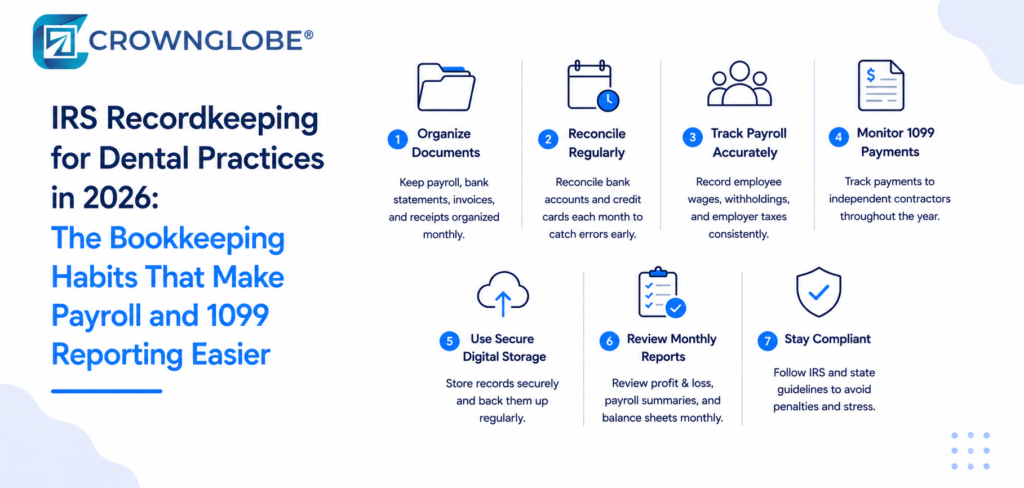
Reconcile Bank Accounts Every Month
One of the most effective dental bookkeeping best practices is performing monthly bank reconciliations.
This process helps ensure:
- Transactions are recorded accurately
- Missing expenses are identified
- Duplicate entries are removed
- Financial reports remain reliable
Waiting until the end of the year often creates a lot of work to clean things up and that can lead to the accounting team making mistakes with the financial reports of the company.
Maintain Organized Digital Documentation
The IRS accepts digital records when they are maintained properly.
Practices should securely retain:
- Receipts
- Vendor invoices
- Payroll reports
- Tax filings
- Loan agreements
- Equipment purchase documentation
Many practices now leverage Finance Automation solutions to make document storage, retrieval, and organization significantly easier.
Separate Employees and Contractors Correctly
Figuring out if someone is a worker or not is a deal when it comes to following the rules.
A lot of people make the mistake of not telling the difference, between employees and independent contractors.
Maintaining accurate records for each group supports:
- Payroll compliance
- Accurate 1099 reporting
- Consistent tax filing
Practices that are uncertain about classification requirements should consult an accountant for dentists who understands healthcare practice compliance.
Collect W-9 Forms Before Payments Begin
One of the simplest dental practice bookkeeping tips is also one of the most effective.
You should get the W-9 forms, from a contractor before you pay them for the time.
Waiting until January can cause problems, like missing information delayed filings and extra work to follow up.
How Technology Improves Dental Recordkeeping
Technology has transformed dental accounting and bookkeeping over the past several years. Modern dental accounting service providers now use cloud-based systems to help practices manage dental accounts more efficiently while improving compliance and reporting accuracy.
Platforms such as QuickBooks for dentists and Xero provide improved visibility into transactions, expenses, and financial reporting.
However, software alone does not create compliance.
Even the best dental accounting software needs to be set up checked regularly and reconciled often.
Many practices strengthen reporting accuracy by combining:
- QuickBooks Bookkeeping
- Xero Bookkeeping
- Remote accounting support
- Finance Automation
- Power BI Visualization dashboards
This combination helps create cleaner records while reducing the administrative burden placed on practice owners and staff.
Common Recordkeeping Mistakes That Create Problems
Waiting Until Year-End
One of the most common issues we encounter is delayed bookkeeping.
When records are updated months after transactions occur, important details are often lost or overlooked.
Mixing Personal and Business Expenses
Combining personal and business transactions complicates tax preparation and reduces the accuracy of financial reporting.
Missing Contractor Documentation
Incomplete vendor records frequently create delays and frustration when preparing 1099 forms.
Skipping Monthly Financial Reviews
Practices that review their financial reports every month are typically able to identify and correct issues before they become significant compliance concerns.
Many growing practices rely on outsourced accounting support and Financial Statements Preparation services to maintain consistent reporting throughout the year.
Building an IRS-Ready Dental Practice
Strong compliance is not about reacting to deadlines.
It is about creating repeatable systems that work throughout the year.
A reliable dental bookkeeping process should include:
- Monthly reconciliations
- Payroll reviews
- Contractor tracking
- Expense categorization
- Financial statement reviews
- Document retention procedures
- Ongoing tax planning discussions
These habits help build a base for payroll reporting, tax filing and growing your practice over time, with payroll reporting and tax filing.
When practices build these routines into their operations the practices find that year-end preparation becomes a lot smoother and the practices have less stress.
Why Better Recordkeeping Improves More Than Compliance
Many practice owners initially focus on recordkeeping because of tax requirements.
However, organized financial records also support:
- Cash flow management
- Profitability analysis
- Budget planning
- Staffing decisions
- Expansion strategies
- Loan applications
This is one reason many practices eventually move toward specialized accounting services for dentists and experienced accountants for dental practices instead of relying solely on general bookkeeping support.
You can find information in resources like Should Dentists Outsource Payroll and Bookkeeping?. Tax Planning Tips, for Dental Practice Owners to get practical next steps.
Conclusion
IRS compliance gets easier when you keep records all year round not once a year.
Strong dental bookkeeping is very important for practices. It helps them keep track of payroll records and organize information about contractors. This also helps with tax filings. Reduces the risk of problems with the law. Good recordkeeping is necessary for a practice to be financially successful, in the term. Dental bookkeeping is something that helps practices all year.
Whether your practice operates in New Jersey, Pennsylvania or anywhere else, in the US organized records lead to decisions, cleaner reporting and less stress.
The businesses that focus on bookkeeping now usually have fewer problems, with reports, clearer financial views and more confidence later.
FAQ Section
What records should dental practices keep for IRS compliance?
Dental practices should retain payroll records, W-9 forms, contractor payment records, bank statements, invoices, receipts, tax filings, payroll tax reports, and financial statements.
Why is dental bookkeeping important for payroll reporting?
Accurate dental bookkeeping helps ensure payroll expenses, taxes, benefits, and employee compensation are recorded properly and reported accurately.
When should a dental practice collect W-9 forms?
Practices should collect W-9 forms before making payments to contractors rather than waiting until year-end.
How long should dental practices keep financial records?
Record retention requirements vary based on the type of record and specific circumstances. Practices should consult their tax advisor regarding current IRS record retention guidelines.
Can bookkeeping help simplify 1099 reporting?
Yes. Consistent bookkeeping helps track contractor payments throughout the year, making 1099 preparation more accurate, organized, and efficient.
Should dental practices outsource bookkeeping?
Many growing practices benefit from outsourced accounting services because they provide stronger compliance controls, improved reporting accuracy, and access to specialized expertise.