One question we often hear from dental practice owners is:
“If production keeps increasing, why doesn’t it always feel like the practice has more cash?”
The answer usually comes down to understanding three key financial metrics:
- Production
- Collections
- Adjustments
These numbers show up in every dental practice management system but people often get them wrong or look at them separately.
If you do not have dental bookkeeping and you are not keeping track of your money, it is hard to tell if more patients are really making your dental business, make more money.
Once you see how these metrics connect you can easily find revenue gaps make collections better and get a picture of your practices financial health.
Why These Metrics Matter in Dental Accounting
Dental practices have a unique financial structure compared to many other businesses.
Revenue is influenced by several moving parts, including:
- Insurance reimbursements
- PPO agreements
- Patient payments
- Payment plans
- Write-offs
- Treatment acceptance rates
Because of these variables, production alone never tells the complete story.
Strong dental accounting helps practice owners understand their finances. It connects production, collections and adjustments into one picture. This way they can see what drives profitability. Dental accounting is more than basic reports. It gives a financial view of every area, in the practice. Many practices that invest in professional bookkeeping services for dentists and structured bookkeeping for dental practices discover that better reporting uncovers opportunities that were previously hidden.
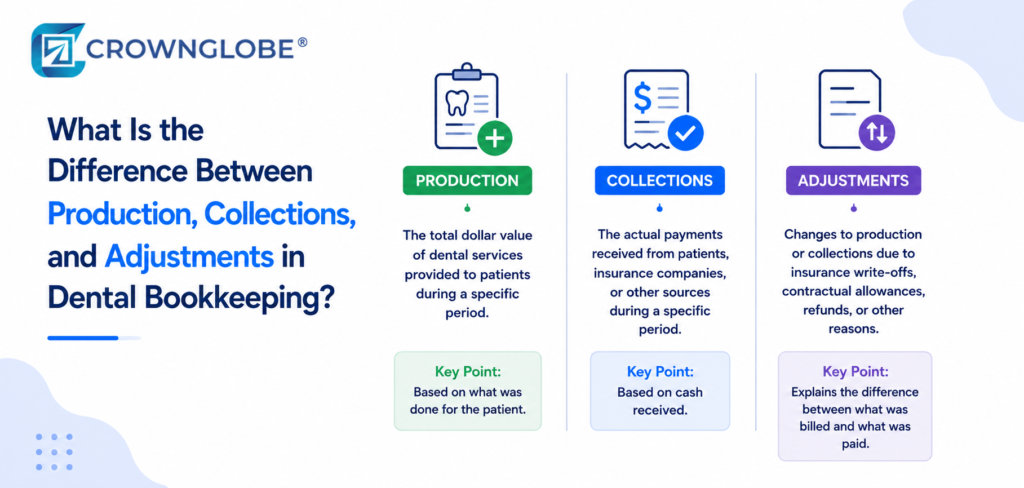
Quick Answer: Production vs. Collections vs. Adjustments
Production
The total value of services performed before any deductions are applied.
Collections
The actual cash received from patients and insurance providers.
Adjustments
Reductions to production resulting from contractual agreements, insurance write-offs, discounts, or billing corrections.
A practice can report strong production while struggling with collections, which often creates cash flow pressure.
Likewise, excessive adjustments can quietly reduce profitability even when production appears healthy on the surface.
What Is Production in Dental Bookkeeping?
Production represents the total value of treatment and services delivered to patients.
Examples include:
- Exams
- Cleanings
- Fillings
- Crowns
- Implants
- Orthodontic treatment
If a practice does $100,000 worth of treatment, in a month then the production is $100,000.
Production is a measure of clinical activity and patient care delivered.
What it is not, however, is cash received.
That distinction is where many practice owners unintentionally misinterpret performance.
Why Production Matters
Production helps practices evaluate:
- Provider performance
- Treatment acceptance rates
- Scheduling efficiency
- Growth trends
Many practices rely on production reports to measure doctor and hygienist performance over time.
When combined with accurate Financial Statements Preparation and monthly reporting, production data becomes far more valuable for planning and strategic decision-making.
What Are Collections?
Collections represent the money that actually comes into the practice.
This includes:
- Patient payments
- Insurance reimbursements
- Payment plan receipts
A medical practice may give treatment worth $100,000, in a month. It only gets $87,000 from the medical practice during that same month.
Collections measure what actually reaches the bank account.
From a cash flow standpoint, collections are often more important than production because they determine the resources available to operate and grow the practice.
Why Collections Matter
Collections directly influence:
- Cash flow
- Payroll obligations
- Operating expenses
- Debt servicing
- Growth initiatives
This is why experienced dental accountants look closely at how money they collect not just how much work they do.
Strong collection performance usually means a system, efficient billing and effective revenue cycle management.
What Are Adjustments?
Adjustments reduce production before revenue becomes collectible.
Common examples include:
- PPO contractual write-offs
- Insurance fee schedule reductions
- Courtesy discounts
- Billing corrections
- Professional discounts
- Bad debt write-offs
For example:
Production: $100,000
Adjustments: $20,000
Net Production: $80,000
Collections: $78,000
In this scenario the practice can only collect $80,000 because contractual adjustments have already reduced the amount they can collect.
This is why understanding adjustments is such an important part of dental accounting and bookkeeping.
How Production, Collections, and Adjustments Work Together
A simple way to view the relationship is:
Production → Adjustments → Net Production → Collections
Understanding this flow helps practice owners answer important questions:
- Are insurance contracts reducing profitability?
- Are collection processes working effectively?
- Is treatment acceptance improving?
- Are write-offs increasing?
- Is cash flow keeping pace with production growth?
These are questions every dental practice should review on a monthly basis.
Many successful practices use a combination of Bookkeeping services, Virtual CFO guidance, and financial dashboards to monitor these metrics consistently.
Warning Signs That Your Numbers Need Attention
Production Is Growing but Cash Flow Is Not
This often points to:
- Collection challenges
- Insurance reimbursement delays
- Accounts receivable issues
Adjustments Are Increasing Rapidly
A growing adjustment percentage may indicate:
- Unfavorable PPO agreements
- Coding issues
- Billing errors
Collections Percentage Is Declining
A lower collection ratio may signal:
- Follow-up inefficiencies
- Aging receivables
- Delayed insurance claims
These issues often become visible through structured dental office accounting processes and timely financial reporting.
The Role of Technology in Tracking These Metrics
Today’s dental practices have access to far more reporting capabilities than ever before.
Platforms like QuickBooks, for dentists, Xero and integrated practice management systems help track performance and monitor trends easily.
Software alone is not enough to give you a picture of your money.
Even the advanced dental accounting software needs to be set up correctly and the numbers have to be checked and understood properly by the dental accounting software.
Many practices combine:
- QuickBooks Bookkeeping
- Xero Bookkeeping
- Finance Automation
- Power BI Visualization
- Remote accounting support
These tools give us a view of what is happening with production and money at the same time including how much money we are making and the flow of cash.
How Better Dental Bookkeeping Improves Profitability
Accurate dental bookkeeping helps practice owners answer critical questions such as:
- Which providers generate the strongest margins?
- Are collections keeping pace with production?
- Which insurance contracts create the largest adjustments?
- Are accounts receivable increasing too quickly?
- Is cash flow supporting future growth plans?
Without reliable bookkeeping for dentists, these answers can be difficult to find. This is why many growing practices work with a specialized dental bookkeeper or accountant for dental practice management to gain deeper visibility into performance. Strong dental practice bookkeeping helps make decisions and leads to long-term growth, for a dental practice.
Best Practices for Monitoring Production, Collections, and Adjustments
Review Reports Monthly
Do not wait until year-end.
Monthly reporting, for bookkeeping is very important because it helps us see what is going on and fix issues before they become big problems by looking at production and collections and adjustments together.
Monitor Collection Percentage
Many well-performing practices aim to collect more than 95 percent of net production.
Track Adjustments Separately
Not all adjustments are created equal.
Understanding why adjustments happen often helps us find ways to make the company more profitable.
Reconcile Financial Reports
Production reports should consistently align with accounting records.
Many practices utilize Catch Up Bookkeeping services when discrepancies arise between practice management systems and financial statements.
Use Financial Dashboards
Financial trends are easier to understand and act upon with the help of visual reporting tools, like these reporting tools.
Many businesses use Power BI Visualization and Finance Automation solutions to make reports more accurate and help people make decisions with Power BI Visualization and Finance Automation solutions.
Why This Matters More Than Ever
Dental practices need to have a picture of their money situation because labor costs are going up insurance is getting more expensive and they have to be more careful, with the money they have.
Practice owners who understand how production, collections and adjustments work gain an advantage.
They are better positioned to:
- Improve cash flow
- Increase profitability
- Make informed hiring decisions
- Evaluate expansion opportunities
- Negotiate insurance contracts more effectively
For help articles like Why Your Dental Clinic Needs a Dedicated Accountant, What to Expect from a Specialized Dental Practice Accountant and Cash vs. Accrual Accounting: Choosing for Your Dental Clinic provide useful tips, for dental clinics that are growing.
Conclusion
Production, collections and adjustments each represent a part of your practices financial story.
Production reflects the value of treatment delivered.
Collections show the cash your practice actually receives.
The adjustments explain why those two numbers, the adjustments and the numbers are often different.
When you have dental bookkeeping, reliable financial reporting and specialized dental accounting services you get a clearer picture of how profitable your dental practice is and how well its doing in the long run. This helps you manage your clinics finances better because you understand where your money is coming from where you need to make adjustments and how collecting payments affects your cash flow.
The successful dental practices look at production, collections and adjustments together to make smart business decisions not just focus on production.
FAQ Section
What is production in dental bookkeeping?
Production is the total value of dental services performed before adjustments, write-offs, or collections are considered.
What is the difference between production and collections?
Production measures services provided, while collections measure the actual cash received from patients and insurance companies.
What are adjustments in dental accounting?
Adjustments are reductions to production caused by insurance contracts, write-offs, discounts, billing corrections, or other reductions.
Why are collections important for dentists?
Collections directly affect cash flow, profitability, payroll funding, and overall financial health.
How can dental bookkeeping improve collections?
Accurate dental bookkeeping helps identify unpaid claims, aging receivables, billing issues, and collection inefficiencies before they become larger financial problems.
What reports should dental practices review monthly?
Practice owners should regularly review:
- Production Reports
- Collections Reports
- Adjustment Reports
- Profit and Loss Statements
- Balance Sheets
- Accounts Receivable Aging Reports
- Cash Flow Reports