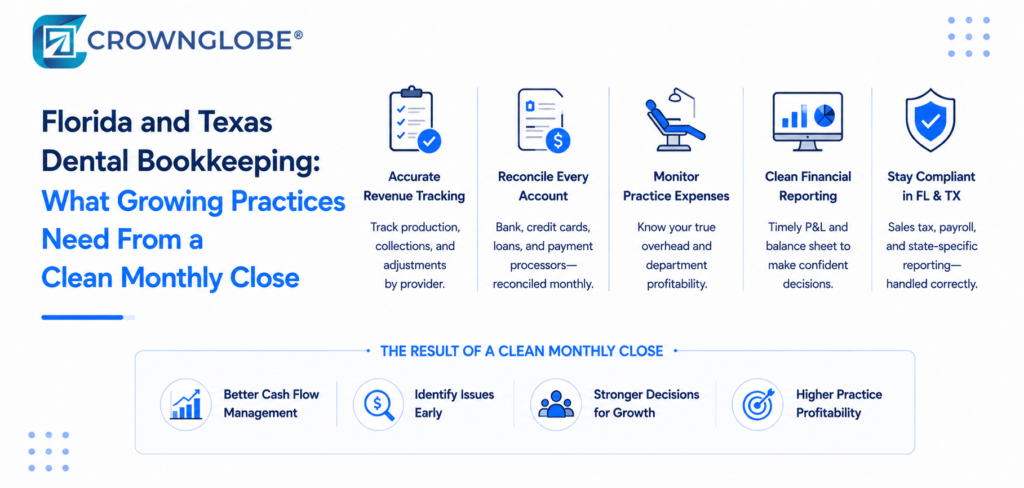
Florida and Texas are getting people, doctors and businesses which is great, for dental practice owners but also brings new financial challenges.
Most dentists focus on care and running their practice. As their practice grows bookkeeping gets neglected. This leads to financial reports cash flow problems and stress during tax season. Dentists and their teams miss chances to make financial decisions. Dental practices need to do bookkeeping so they can stay on top of their finances with the bookkeeping.
In our experience a big difference, between practices that grow steadily and those that feel unsure is how good their financial reports are.
And that begins with a clean monthly close.
Whether you run one office in Tampa or many, across several states good dental bookkeeping helps. It gives you a picture of your finances so you can make smart business decisions with confidence. Accurate bookkeeping is key.
What Is a Clean Monthly Close?
A monthly close involves reviewing, reconciling and finalizing all activity for a month that has been completed.
For a dental practice, this typically includes:
- Reconciling bank accounts
- Reconciling credit card transactions
- Verifying insurance deposits
- Matching patient payments
- Reviewing payroll entries
- Recording loan payments
- Tracking equipment purchases
- Categorizing expenses accurately
- Reviewing accounts receivable balances
- Preparing financial statements
When this process is completed correctly, practice owners receive reliable financial reports that accurately reflect the health of the business.
Without a structured monthly close, financial statements become educated guesses instead of tools you can confidently use to make business decisions.
Why Dental Practices Have Unique Bookkeeping Challenges
Dental bookkeeping is really different from the bookkeeping that most other businesses use for their finances.
A typical dental office has to deal with a lot of money coming in from places and they have to keep track of all the financial things, including:
- Insurance reimbursements
- Patient payments
- Payment plans
- PPO adjustments
- Production reporting
- Collections reporting
- Laboratory expenses
- Associate compensation
- Hygiene department performance
- Equipment financing
General bookkeeping methods often miss details that affect the profitability of a business and the accuracy of its reports.
A specialist dental bookkeeper knows how things, like production reports and insurance activity and collections and accounting records all work together for offices. The job of the team is to make sure all the financial information tells one correct story, about the money.
This is one reason many growing practices eventually move toward specialized dental accounting services and dedicated accounting services for dentists rather than relying on generic bookkeeping support. The combination of accurate dental bookkeeping services and industry-specific expertise creates a stronger financial foundation for long-term growth.
Signs Your Monthly Close Process Needs Improvement
Many practice owners assume their books are in good shape because the bank account balance looks healthy.
Unfortunately, that assumption can create costly blind spots.
Here are several warning signs that your monthly close process may need attention.
Financial Reports Arrive Weeks Late
If your Profit and Loss statement comes in four to six weeks after month-end you are making decisions, with data, not current performance numbers.
Insurance Deposits Do Not Match Production Reports
This could mean there are posting errors, delayed claims or problems, with adjustments or reconciliations that need to be fixed away.
Accounts Receivable Continues to Increase
A growing receivables balance can mean trouble collecting payments, delays from insurance or errors, in reporting all of which hurt cash flow.
Payroll Costs Feel Unpredictable
Without proper payroll reconciliation, labor expenses become difficult to monitor and control.
Tax Preparation Requires Major Cleanup
If your accountant spends significant time cleaning up the books before filing taxes, bookkeeping processes likely have not been maintained consistently throughout the year.
These challenges commonly appear in practices that have expanded faster than their accounting systems and processes.
What Florida and Texas Dental Practices Should Review Every Month
A clean monthly close should deliver more than compliance.
It should provide meaningful business insight.
Profit and Loss Statement
Your Profit and Loss statement helps you understand:
- Revenue trends
- Payroll expenses
- Supply costs
- Laboratory expenses
- Marketing spending
- Net profitability
The goal is not simply to determine whether revenue increased. You also want to understand whether your practice is becoming more profitable as it grows.
Balance Sheet
Many dentists spend most of their time reviewing income statements and overlook the balance sheet.
However, the balance sheet often provides critical information about:
- Loan obligations
- Cash reserves
- Equipment financing
- Credit card balances
- Outstanding liabilities
Reviewing the balance sheet on a basis can really help you find financial risks with the balance sheet before they turn into big issues, with the balance sheet.
Cash Flow Performance
Revenue and cash flow are not always the same thing.
A practice can report strong production numbers while simultaneously experiencing cash flow pressure due to delayed insurance reimbursements or growing receivable balances.
This is why many growing dental practices combine professional Financial Statements Preparation services with Virtual CFO services to monitor both profitability and liquidity.
Accounts Receivable Aging
One of the most valuable yet overlooked reports in dental accounting is the aging report.
Practice owners should regularly review:
- Current receivables
- 30-day balances
- 60-day balances
- 90-day balances
- Insurance aging balances
Aging receivables can really hurt the profitability and cash flow of a company even when the production numbers look good.
How Accurate Dental Bookkeeping Supports Growth
Growth brings opportunities but at the same time growth also makes things more complicated.
Additional providers, more staff, higher patient volume, and multiple locations all create additional financial activity.
Without structured bookkeeping for dentists, growth can quickly create confusion instead of increased profitability.
A well-managed monthly close helps practice owners answer important questions such as:
- Which providers generate the strongest margins?
- Which locations perform best financially?
- Are labor costs growing faster than revenue?
- Are collections keeping pace with production?
- Does cash flow support future expansion plans?
These answers become much easier to find when bookkeeping data is timely, accurate, and consistent.
Many growing practices achieve this through Outsourced Accounting services that provide reliable monthly reporting without building a large internal accounting department.
The Role of Technology in Modern Dental Accounting
Many of todays leading practices are using cloud-based accounting systems and automation tools to get things done.
Platforms, like QuickBooks and Xero can help improve reporting accuracy if used correctly.
However technology alone does not solve accounting problems on its own.
The best dental accounting software still needs to be set up and checked regularly to work properly with dental accounting software.
This is where Finance Automation services become especially valuable for improving reporting speed and accuracy.
Automation can help practices:
- Reduce manual data entry
- Improve transaction accuracy
- Accelerate month-end close processes
- Minimize reporting delays
- Improve visibility into financial performance
When paired with Power BI Visualization dashboards, practice owners get time for financial insights right away instead of waiting for quarterly reviews.
Common Dental Bookkeeping Mistakes That Hurt Profitability
Many dental practices lose visibility into their financial performance because of avoidable bookkeeping mistakes.
Mixing Personal and Business Expenses
Combining personal and business spending creates reporting inaccuracies and unnecessary complications during tax preparation.
Not Reconciling Insurance Deposits
Insurance payments need to be looked at and classified correctly so that the Insurance payments are reported accurately.
Ignoring Small Balance Adjustments
Minor discrepancies might seem small. They can add up over time and impact the accuracy of financial statements.
Delayed Bookkeeping Entries
Waiting months to update the accounting records makes the financial reports, from the accounting records less useful and less reliable.
Poor Chart of Accounts Structure
A designed chart of accounts limits your ability to analyze performance and identify trends, with the chart of accounts.
Experienced accountants for practices and specialist accountants, for dentists work to prevent problems that can affect the profitability of dental practices and the decision-making of dentists.
Should Dental Practices Outsource Bookkeeping?
As practices grow managing bookkeeping tasks becomes too much for internal staff to handle.
Outsourcing can provide:
- Consistent monthly reporting
- Improved financial accuracy
- Reduced administrative workload
- Stronger compliance processes
- Access to specialized dental accounting expertise
This is especially valuable for multi-location practices and owner-dentists who would rather focus their time on patient care, leadership, and growth initiatives.
For businesses using QuickBooks, having dedicated QuickBooks Bookkeeping support can help improve reporting while keeping track of daily operations.
Companies that use Xero can really benefit from Xero Bookkeeping expertise that helps them keep their records clean and accurate.
Why Monthly Financial Visibility Matters More Than Ever
The dental industry is dealing with a lot of problems, like costs and staffing issues and insurance reimbursement pressures and more competition.
In this environment I need to review financials often, than just once a year.
Practice owners need monthly visibility into:
- Revenue performance
- Cash flow trends
- Payroll expenses
- Collections
- Profitability
- Overhead management
A clean monthly close transforms bookkeeping from a compliance requirement into a strategic business tool.
The successful dental practices do not just focus on numbers.
Companies use financial information to make better decisions improve the profitability of the company and create sustainable growth, for the company.
Conclusion
Dental bookkeeping is really a lot more, than just keeping dental records in order.
It helps you understand your practices money situation clearly. This clarity makes your practice healthier and more profitable. To get this clarity you can work with a bookkeeper, an accounting service or a full-service accounting firm that knows practices. They provide reports, which help you make smart decisions to grow your practice.
For growing practices throughout Florida and Texas, a clean monthly close creates confidence in every major financial decision. Accurate bookkeeping is really important for a business because it helps with things like monitoring cash flow and evaluating profitability and it provides the foundation, for growth of the business.
When financial reports are, on time, accurate and useful practice owners can see what they need to focus on delivering patient care and building a better business.
FAQ Section
What is dental bookkeeping?
Dental bookkeeping is the process of recording, organizing, and reconciling financial transactions specific to dental practices, including insurance reimbursements, patient payments, payroll, supplies, and operating expenses.
Why is bookkeeping important for dentists?
Accurate bookkeeping helps dentists understand profitability, manage cash flow, prepare for taxes, monitor overhead costs, and make informed business decisions.
How often should dental practices close their books?
Most dental practices should complete a full monthly close. Monthly reporting provides timely financial insights and helps identify issues before they become larger financial problems.
Can dental bookkeeping help improve profitability?
Yes. Accurate dental bookkeeping helps identify unnecessary expenses, collection issues, payroll inefficiencies, and cash flow challenges that may be reducing profitability.
Should dentists outsource bookkeeping?
Many growing practices benefit from outsourcing bookkeeping because it provides access to specialized expertise, improves reporting accuracy, and reduces administrative workload.
What financial reports should dentists review monthly?
Dentists should regularly review:
- Profit and Loss Statement
- Balance Sheet
- Cash Flow Reports
- Accounts Receivable Aging Reports
- Payroll Reports
- Provider Performance Reports