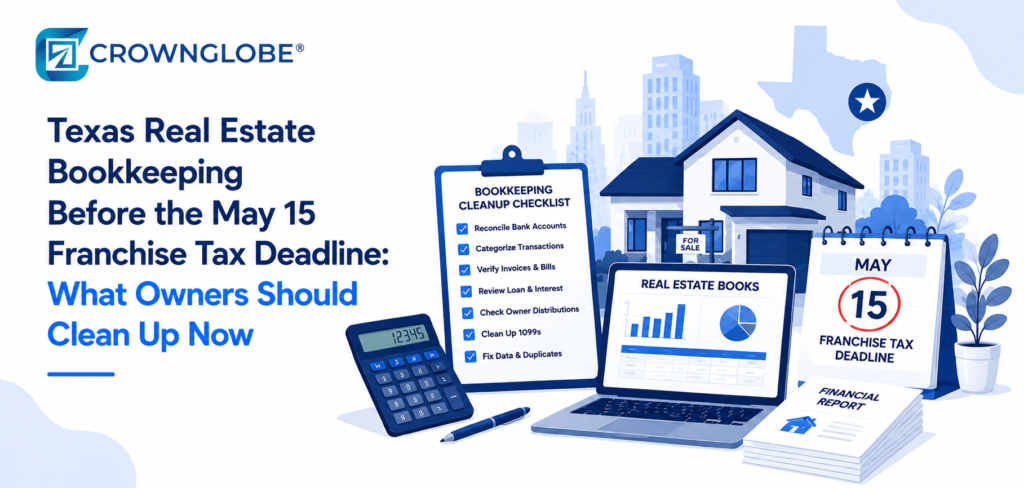
If you own a Texas real estate business waiting until the last few weeks before May 15 to review your Texas real estate business books can create stress and costly filing mistakes for your Texas real estate business. Your Texas real estate business accounting records should already be organized, reconciled and ready to support reporting, for your Texas real estate business by the time the franchise tax deadline arrives.
Before you file take time to review your bank accounts, property income and expenses owner distributions, loan balances, entity information and financial statements, for the bank accounts and financial statements. These areas are often where reporting issues surface.
Strong real estate bookkeeping is more, than filing; it helps with accurate records avoiding compliance issues making smart business decisions and eliminating surprises during tax season.
For Texas real estate businesses Texas real estate businesses face a big problem, and it is not the franchise tax filing itself, for Texas real estate businesses. The real problem is realizing too late that the books are incomplete, outdated, or filled with unresolved accounting issues.
Why the Texas Franchise Tax Deadline Matters for Real Estate Businesses
Texas real estate businesses operate under different structures, like LLCs and partnerships and brokerage firms and property management companies and Texas real estate businesses also have holding companies and multi-entity investment groups.
Most owners spend their time focused on acquiring properties and managing tenants. Then the bookkeeping, for their properties gets pushed aside until tax season arrives for their properties.
Unfortunately, that approach can create significant risk.
A franchise tax filing is only as reliable as the accounting records behind it.
Accurate financial reporting is essential, for people who own properties manage a brokerage oversee commercial assets or operate several real estate entities.
This is where professional real estate accounting becomes valuable. Whether you need real estate bookkeeping and accounting support from a real estate accountant to have accurate financial records for compliant tax reporting and stronger business decisions, for your real estate business.
When your books are clean and up to date, you can:
- Prepare accurate franchise tax filings
- Support tax return positions with confidence
- Identify reporting issues before they become problems
- Improve lender and investor reporting
- Generate reliable financial statements
- Track profitability by property, project, or business line
- Reduce compliance and audit risk
Businesses that do their bookkeeping all year round usually have an easier time filing, than businesses that rush to clean up before the deadline.
The Most Common Real Estate Bookkeeping Problems Found Before Filing
After reviewing countless real estate books before filing deadlines, certain issues appear again and again.
Unreconciled Bank Accounts
Many real estate companies have accounts, such, as operating accounts, security deposit accounts, reserve accounts, escrow accounts and financing accounts.
When these accounts are not reconciled regularly the Bank Transactions begin to pile up. It becomes really tough to verify the Bank Transactions.
Common problems include:
- Duplicate transactions
- Missing deposits
- Incorrect transfers between accounts
- Uncategorized expenses
- Outstanding items that should have cleared months earlier
Before filing season, every balance sheet account should be supported by accurate records and documentation.
Incorrect Property Expense Classifications
Another common bookkeeping for real estate issue involves expense categorization.
Real estate businesses frequently mix together:
- Repairs and maintenance
- Capital improvements
- Property management expenses
- Marketing costs
- Professional service fees
- Financing-related expenses
While these differences may seem small wrong classifications can cause financial statements and create extra complications during tax preparation.
An experienced real estate accountant should check expense categories before filing deadlines to ensure consistency and accuracy, with real estate expenses.
Missing Loan Reconciliations
Debt is a part of many real estate businesses, like debt.
You should review mortgage balances and construction loans and bridge financing and investor notes and lines of credit carefully before you file anything.
During year-end reviews, businesses often discover:
- Loan balances that do not match lender statements
- Interest expenses recorded incorrectly
- Principal payments categorized as expenses
- Missing financing transactions
These errors directly impact financial statement accuracy and should be corrected before tax filings are prepared.
Review Property Income Before Filing
Revenue reporting errors can create major problems for real estate companies.
Before filing, owners should carefully review:
- Rental income
- Property management fees
- Leasing commissions
- Brokerage commissions
- Late fee income
- Application fees
- Investor contributions mistakenly recorded as revenue
One of the most overlooked issues occurs when owner contributions are recorded as income.
This mistake can artificially inflate revenue distort business performance. Affect tax reporting.
Strong property accounting processes help ensure income is categorized correctly from the start rather than requiring corrections later. This is especially important for businesses involved in rental property accounting, property management bookkeeping, and accounting for rental properties, where revenue sources and ownership structures can become increasingly complex.
Verify Owner Contributions and Distributions
Real estate businesses often move money between ownership groups, related entities and investment structures.
Without proper bookkeeping controls, these transactions can quickly become difficult to track.
Before the franchise tax deadline, review:
- Shareholder distributions
- Member draws
- Capital contributions
- Intercompany transfers
- Partner distributions
- Owner reimbursements
These balances should match ownership records and supporting documentation.
This review becomes even more important for businesses operating multiple entities. Many firms handling investment properties, brokerage operations, or property management activities rely on structured bookkeeping for property management and consistent landlord accounting practices to keep transactions organized across entities.
Many Texas investors use separate LLCs to protect assets and manage risk. Accurate intercompany accounting helps ensure that the structures remain properly documented and compliant, with regulations.
Make Sure Your Financial Statements Are Decision Ready
Many business owners view financial statements as documents created solely for tax purposes.
In reality, they are some of the most valuable management tools available.
Accurate financial reporting helps answer important business questions such as:
- Which properties are generating the strongest returns?
- Which assets are consuming excessive cash?
- Is occupancy translating into profitability?
- Are debt obligations increasing faster than revenue?
- Is the portfolio producing enough cash flow to support growth?
Before filing deadlines, owners should review:
- Profit and Loss Statement
- Balance Sheet
- Cash Flow Statement
- Property-level reporting
- Entity-level reporting
This is why many growing firms invest in professional financial statement preparation support. Reliable reports provide far more value than simply helping with tax compliance. They also help owners evaluate profitability, support financing discussions, and improve overall commercial real estate accounting and portfolio management decisions.
Real Estate Investors Should Review Entity Structures
As real estate businesses grow, their entity structures often become more complex.
Over time, an owner may accumulate:
- Holding companies
- Property-specific LLCs
- Management companies
- Investment partnerships
- Development entities
What begins as a simple structure can evolve into something much more complicated.
Before filing season, it is worth reviewing whether:
- Each entity remains active
- Ownership percentages are accurate
- Entity records are current
- Financial activity is properly separated
- Individual books are maintained for each entity
This review frequently uncovers bookkeeping issues that affect both compliance and reporting accuracy.
Why Last Minute Cleanup Costs More
Many real estate owners think that they can put off cleaning up their bookkeeping until it is time to do their taxes.
Delaying cleanup usually makes things more expensive and complicated, for the cleanup process.
When months of transactions build up accountants and bookkeepers have to spend extra time looking into fixing and checking transactions.
A problem that takes five minutes to fix today may require several hours of investigation six months later.
That is why many growing firms seek professional catch up bookkeeping support before filing deadlines instead of waiting until their tax preparer uncovers issues. For businesses managing multiple properties or brokerage operations, professional real estate bookkeeping services often identify reporting problems long before they impact tax filings or lender reporting.
The sooner problems are identified, the easier and more cost-effective they are to resolve.
A Practical Texas Franchise Tax Readiness Checklist
Before May 15, every Texas real estate owner should complete the following review.
Balance Sheet Review
- Reconcile all bank accounts
- Verify loan balances
- Reconcile credit card accounts
- Review owner equity balances
- Validate intercompany transactions
Revenue Review
- Verify rental income
- Confirm commission income
- Review property management fees
- Identify non-operating income
- Separate owner contributions from revenue
Expense Review
- Review repairs and maintenance classifications
- Confirm capital improvement treatment
- Verify interest expense balances
- Review professional service fees
- Confirm payroll and contractor expenses
Entity Review
- Update ownership records
- Verify officer information
- Confirm entity records remain current
- Document multi-entity transactions properly
Completing these steps before the filing deadline can help reduce reporting risk improve accuracy and ensure a smoother tax filing process.
Conclusion
The Texas franchise tax deadline is more than a filing requirement. This is a chance for you to check the health of your records and find issues with your financial records before they become big problems, with your financial records.
Texas real estate owners can reduce compliance risk. Gain greater confidence, in their business decisions by reconciling accounts and reviewing Texas real estate income and expense classifications and validating Texas real estate owner transactions.
Strong real estate bookkeeping supports tax filings improves visibility into property performance and creates a stronger financial foundation, for future growth.
FAQs
What bookkeeping records should Texas real estate businesses review before filing?
Review bank reconciliations, loan balances, income records, expense classifications, owner distributions, and current financial statements.
Can bookkeeping mistakes affect Texas franchise tax reporting?
Yes. Incorrect classifications, unreconciled accounts, and inaccurate financial statements can lead to filing errors and compliance issues.
Why is real estate accounting important before the franchise tax deadline?
Accurate real estate accounting ensures your tax filing reflects the true financial position of the business and helps identify reporting issues early.
Should real estate investors maintain separate books for each LLC?
In most cases, yes. Separate books help improve reporting accuracy, simplify compliance, and support better decision-making.
When should a business seek professional bookkeeping assistance?
If accounts are unreconciled, reports are delayed, or multiple entities are involved, professional support is often beneficial before filing deadlines.