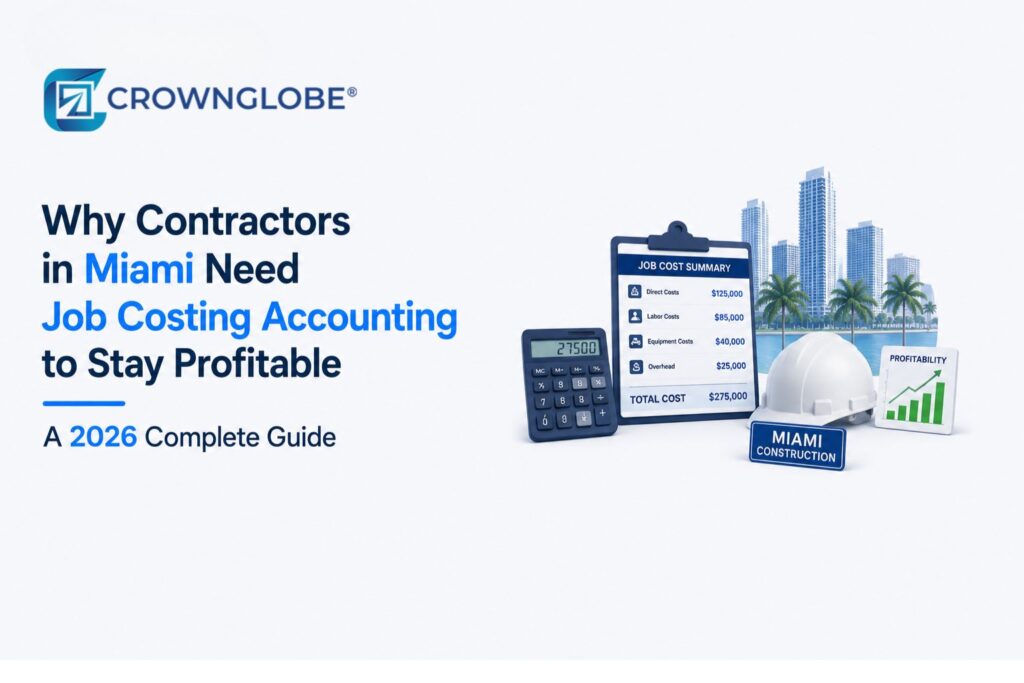
If you run a contracting business in Miami whether you build homes, run a remodeling crew, operate an HVAC company, manage electrical projects, handle plumbing work, or run a general construction firm you already know one thing:
- Your profit is made or lost on each job.
- Not annually.
- Not quarterly.
- Not monthly.
- Job by job.
And yet, most contractors in Miami operate without one of the most important financial systems in the entire construction industry:
Job costing accounting.
Without job costing, you are essentially running blind. You do not know which projects are profitable, which projects are draining cash, which crews are efficient, which materials are over budget, or which jobs are underpriced.
After ten years of writing about construction accounting, contractor finance, and Miami’s unique cost structure, I can confidently say:
The number one reason contractors in Miami lose money is the lack of job costing.
This guide explains what job costing is, why it is essential in 2026, how it impacts cash flow, how it prevents IRS and payroll issues, and exactly how to set up a proper job costing system that protects your profit.
Why Contracting in Miami Is Financially Risky Without Job Costing
Miami is one of the most expensive, competitive, and unpredictable contracting markets in the United States.
- Contractors face:
- Rapidly changing material prices
- High labor costs
- Subcontractor shortages
- High insurance costs
- Hurricane related disruptions
- Permit delays
- Traffic delays
- Seasonal demand swings
- High competition
- Clients who demand fast turnaround
This creates a perfect storm.
A contractor might do twenty jobs in a year, and only discover at the end of the year that ten of those jobs lost money.
Why?
Because the books were never tracked at the job level.
What Is Job Costing and Why It Matters
- Job costing is a detailed accounting method that tracks:
- Labor cost
- Materials cost
- Subcontractor cost
- Equipment cost
- Overhead allocation
- Profit margin
- for each individual job.
- Instead of looking at financials broadly, job costing shows how profitable each project truly is.
- If you do not use job costing, your numbers are always misleading.
- Job costing reveals the truth about your business.
- Here are the biggest financial problems caused by poor or nonexistent job costing.
- Miami has volatile material prices due to hurricanes, supply chain delays, and port congestion.
- Material overages destroy contractor profit.
- Without job costing, subcontractor expenses spiral out of control.
- This is the most dangerous problem.
- Underpricing is one of the biggest reasons contractors go broke.
- If you do not track these, you lose profit instantly.
- Without it, you will always have unpredictable cash flow.
- Job costing separates business overhead from job expenses.
- Job costing allocates equipment cost correctly.
- Missing these creates incorrect job profitability.
- You may think your business is profitable, when in reality:
- Half of your jobs break even
- A few big jobs cover all losses
- Small jobs hurt cash flow
- Overhead is not accounted for
- Mispriced jobs bleed profit
The Twenty Nine Reasons Contractors Lose Money Without Job Costing
1. Underestimating Material Costs
- Without job costing, you cannot:
- Compare estimate vs actual
- Track overages
- Identify vendor price increases
- Predict future project costs
2. Labor Overruns That Go Unnoticed
- Contractor labor is expensive in Miami:
- Skilled labor
- Unionized workers
- Specialized trades
- High hourly rates
- Without job costing, you cannot track:
- Overtime
- Inefficiency
- Crew performance
- Rework costs
3. Subcontractor Overpayment
- Contractors often:
- Pay subs before verifying work
- Forget to track change orders
- Miscalculate subcontractor hours
- Lose documentation
4. No Visibility on Which Jobs Lose Money
- You assume:
- Busy is profitable
- Big projects equal big profit
- But without job costing, you cannot see:
- Profit killers
- Underpriced jobs
- Inefficient crews
- Cost overruns
5. Incorrect Pricing and Bidding
- Most contractors price jobs based on:
- Gut feeling
- Experience
- Market rate assumptions
- Without job costing, you cannot calculate:
- True cost
- Accurate margin
- Required markup
- Overhead allocation
6. No Tracking of Change Orders
- Miami clients often request:
- Add ons
- Upgrades
- Design changes
- Rework
7. Cash Flow Problems
- Job costing prevents:
- Late payroll
- Supplier issues
- Inventory shortages
- Overdrafts
- Emergency borrowing
8. No Tracking of Job Deposits vs Expenses
- Contractors take:
- Deposits
- Progress payments
- Final payments
- Without job costing, you cannot track:
- Whether the deposit covers initial expenses
- Whether progress payments match cost
- Whether final payments deliver profit
9. Mixing Job Expenses and Business Expenses
- Contractors often mix:
- Fuel
- Tools
- Materials
- Office supplies
- Admin expenses
10. Not Tracking Equipment Usage
- Contractors incur costs for:
- Trucks
- Excavators
- Mixers
- Generators
- Scaffolding
- Trailers
11. Not Tracking Permits and Fees
- Every Miami job includes:
- City permits
- County permits
- Inspections
- Licensing fees
12. No Tracking of Deliveries and Freight
Material delivery fees add up.
Ignoring them erodes margins.
13. No Tracking of Rework Costs
Rework is common in construction.
Without job costing, you never see the financial damage.
14. Inconsistent Payroll Allocation
- Workers may work:
- Half day on Job A
- Half day on Job B
Without allocation, payroll becomes inaccurate.
15. Not Tracking Job Profitability in Real Time
Quarterly or annual reports are too late.
By the time you discover a job lost money, it is over.
16. Inaccurate Tax Deductions
- Job costing supports accurate:
- COGS
- Depreciation
- Labor allocation
- Job expenses
- This reduces tax liability.
- Work in progress (WIP) reduces tax risk and improves reporting accuracy.
- Without job costing, WIP becomes a guess.
- Job costing reveals which types of jobs make you the most money.
17. Incorrect WIP Reporting
18. No Way to Compare Job Types
- You cannot evaluate:
- Bathroom remodels
- Kitchen remodels
- Roofing jobs
- HVAC installs
- Electrical upgrades
- Add ons
19. No Tracking of Small Jobs vs Large Jobs
- Sometimes small jobs are more profitable.
- Sometimes large jobs bleed money.
- Job costing tells you which to focus on.
20. Poor Estimation Accuracy
Estimating becomes guesswork.
Job costing improves estimates with actual historical data.
21. Vendor Overcharging Goes Unnoticed
Contractors often pay whatever vendors bill.
Job costing catches hidden increases.
22. No Accountability for Crew Performance
- Job costing shows which crews:
- Work fast
- Produce fewer errors
- Stay within budget
- Generate higher profit
- This helps with staffing decisions.
- IRS notices follow quickly.
- Without job costing, your financials are not correct.
- Contractors need P and L for each job.
- Without cost codes, your reports are useless.
- Without projections, you will always face cash shortages.
- Job costing allocates overhead properly.
- Most contractors never realize which jobs destroy profitability until it is too late.
- When job costing is implemented properly, contractors gain:
- Below is the fully optimized system Miami contractors should use.
- These tools track job costs automatically.
- Use PO systems or job purchase orders.
- Attach invoices to cost codes.
- Not monthly or quarterly.
- This shows where jobs went wrong.
- Every job must cover part of the overhead.
- This is the real financial heartbeat of your contractor business.
- If you read this “Construction Payroll Explained Overtime, Prevailing Wage and Compliance Rules in Miami” .
23. Higher IRS Risk
- Incorrect job tracking leads to:
- Incorrect COGS
- Incorrect payroll allocation
- Incorrect subcontractor reporting
24. Inaccurate Financial Statements
25. Not Preparing Job Level Profit and Loss
26. Not Separating Cost Codes
- Cost codes include:
- Labor
- Materials
- Subcontractors
- Equipment
- Overhead
27. No Cash Flow Projection Per Job
- Every job requires:
- Materials
- Labor
- Permits
- Sub contractor payments
28. Incorrect Overhead Allocation
- Overhead includes:
- Insurance
- Rent
- Office staff
- Marketing
- Fuel
- Tools
29. Not Knowing Which Jobs Are Draining Your Business
How Job Costing Protects Profitability
- Accurate profit on each job You instantly see which projects are worth repeating.
- Improved estimating Better bids lead to higher win rates and higher profit.
- Stronger cash flow You know exactly when payments are due and when expenses hit.
- Fewer IRS issues Accurate reporting prevents notices.
- Better material planning No more overspending or supplier surprises.
- Better crew scheduling Labor allocation improves drastically.
- Major increases in profitability Most Miami contractors see profit rises of ten to thirty percent after job costing.
The Complete Job Costing System for Miami Contractors
Step 1 Use Construction Accounting Software
- Use software made for contractors:
- QuickBooks Online + Knowify
- Buildertrend
- Jobber
- Contractor Foreman
- Procore
- Sage Intacct Construction
Step 2 Create Cost Codes for Every Job Category
- Include:
- Labor
- Materials
- Subs
- Equipment
- Permits
- Freight
- Overhead allocation
Step 3 Track Labor Daily With Time Tracking Apps
- Use:
- TSheets
- Clockify
- Workyard
- Workers must clock into specific jobs.
Step 4 Track Materials at the Job Level
Step 5 Track Subcontractor Payments Per Job
Step 6 Update Job Cost Reports Weekly
Step 7 Compare Estimate vs Actual Cost Constantly
Step 8 Include Overhead Allocation in Every Job
Step 9 Create a Job Level Profit and Loss Statement
Frequently Asked Questions Contractors Ask About Job Costing
Do all contractors need job costing?
Yes. Every contractor loses money without it.
How often should job costs be updated?
Weekly. Monthly is too late.
Does job costing reduce taxes?
Yes. It improves accuracy and reduces IRS risk.
Which software is best for job costing?
QuickBooks with Knowify, or Buildertrend for larger contractors.
Does job costing help with bidding?
Yes. It makes your bids more accurate and more profitable.
Can job costing increase profit?
Absolutely. Contractors often see ten to thirty percent higher margins.
Conclusion
Contractors in Miami operate in one of the most financially challenging markets in the United States. Material volatility, subcontractor shortages, heavy competition, and unpredictable project timelines all contribute to profit instability. But the single most important factor that determines whether a contractor thrives or struggles is whether they track job profitability accurately.
- Job costing accounting is no longer optional.
- It is the difference between profit and loss.
- Between growth and collapse.
- Between financial clarity and chaos.
Crownglobe continues to help Miami contractors implement complete job costing systems, reduce waste, prevent cash flow shortages, and build construction businesses that stay profitable year-round.
Job costing is not just accounting.
It is your financial blueprint for long term success.