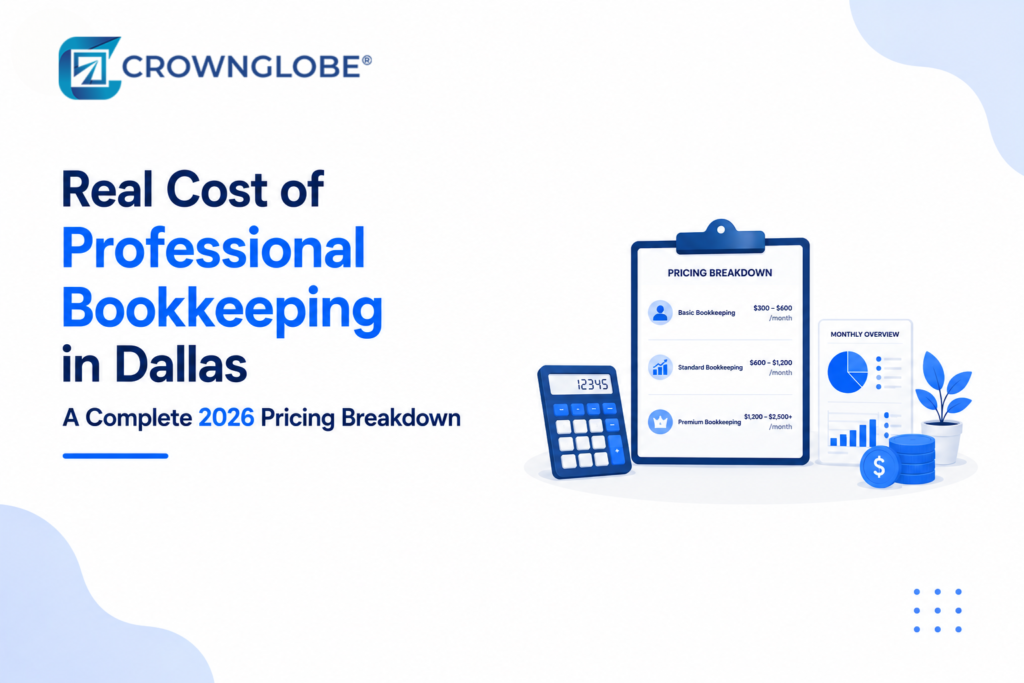
One of the most common questions Dallas business owners ask is simple yet critical:
How much should bookkeeping cost in Dallas?
If you ask ten different bookkeepers, accountants, or CPA firms, you will get ten different answers. The truth is that bookkeeping pricing is one of the most inconsistent service categories across Texas, especially in the Dallas Fort Worth Metroplex where service levels, experience, and industry specialization vary widely.
Some Dallas business owners pay far too much for basic bookkeeping.
Others pay far too little and end up with messy books that cause IRS problems, tax penalties, cash flow issues, and expensive cleanup work later.
After studying the Dallas market for years, working with hundreds of small and mid-sized businesses across Dallas, Plano, Frisco, Irving, Richardson, Arlington, and Addison, one fact stands out:
Most Dallas business owners have no accurate benchmark for bookkeeping pricing.
This 2026 guide solves that problem.
This is the most detailed and transparent breakdown of bookkeeping costs you will find for the Dallas market.
- In this guide you will learn:
- What bookkeeping should cost based on your business size
- What affects bookkeeping pricing in Dallas
- What services should be included
- What hidden fees to watch out for
- Whether hourly billing or fixed monthly pricing is better
- What industries pay more or less
- When to upgrade from basic bookkeeping
- Whether you need bookkeeping, accounting, or CFO services
- How to avoid overpaying or underpaying
Let us break it down with clarity and accuracy.
Why Bookkeeping Costs Matter for Dallas Businesses in 2026
Dallas is booming. The business environment is fast, competitive, and expanding. That also means:
- More transactions • More employees • More vendors • More revenue streams • More tax obligations • More financial complexity
- With everything moving at high speed, bookkeeping becomes the foundation for:
- Cash flow • Profitability • Tax compliance • Financial decision making • Loan applications • Investor discussions • Operational planning
When bookkeeping is done correctly, everything else works smoothly.
When bookkeeping is done incorrectly, everything else suffers.
This is why Dallas business owners must understand what they are paying for and whether the value matches the price.
Average Bookkeeping Costs in Dallas for 2026
Here are accurate market ranges based on hundreds of real Dallas clients and competitive research.
Small Businesses (up to 1M in revenue)
500 to 1200 per month
- These businesses usually have:
- Low to moderate transaction volume
- One or two bank accounts
- Minimal payroll
- Limited vendors
- Basic sales tax needs
- Ideal for:
- Solo owners
- Service-based businesses
- Small retail shops
- Consultants
- Freelancers
- Boutique businesses
Growing Businesses (1M to 5M in revenue)
1200 to 2500 per month
- These businesses typically have:
- Higher transaction volume
- Multiple payment platforms
- Multiple bank accounts
- Payroll with several employees
- Vendor and subcontractor complexity
- Monthly reporting requirements
- Ideal for:
- Restaurants
- Contractors
- Real estate agencies
- Healthcare practices
- Ecommerce shops
Established or Multi Location Businesses (5M to 10M)
2500 to 4500 per month
- These companies usually need:
- Advanced accounting
- Inventory tracking
- Sales tax across multiple jurisdictions
- Job costing
- Cash flow forecasting
- CFO oversight
- Department level reporting
- Ideal for:
- Multi location restaurants
- Construction companies
- Medical groups
- Retail chains
- Manufacturing companies
Complex or Multi Entity Businesses (10M and above)
4500 to 9000 per month
- These companies require:
- Consolidated financials
- Advanced reporting
- Multi state compliance
- Multi entity structures
- Dedicated accounting support
- Budgeting and forecasting
- Strategic advisory
- Ideal for:
- Real estate holdings
- Private equity backed firms
- Hospitality groups
- Multi vertical companies
What Determines Bookkeeping Pricing in Dallas
Bookkeeping is not a one size fits all service.
Pricing depends on several variables.
- Below are the factors that affect cost the most.
- The biggest factor in Dallas bookkeeping pricing.
- Restaurants, retail, ecommerce, and contractors tend to have high volume.
- More accounts equal higher pricing.
- your bookkeeping cost increases.
- These require specialized reconciliations.
- Certain industries cost more because they require specialized systems.
- Restaurants POS integration, food cost, tips.
- Construction Job costing, materials, labor allocation.
- Real Estate Commission tracking, 1099s.
- Healthcare Insurance reimbursements.
- Ecommerce Marketplace reconciliation, sales tax.
- Some industries simply take more time and expertise.
- Texas sales tax is straightforward for some businesses but extremely complex for others.
- pay more for sales tax accounting.
- expect higher fees.
- If the books are messy, outdated, or incorrect, a cleanup fee is required before monthly service begins.
- Cleanup fees in Dallas usually range between: 1000 to 5000
- depending on the size of the mess.
- There are two pricing models.
- Hourly bookkeeping is common among solo bookkeepers and small firms.
- Rates range between: 40 to 95 per hour
- Hourly pricing only works for very small businesses with minimal activity.
- This is the modern standard.
- Dallas businesses prefer this model.
- A professional bookkeeping package must include the following.
- Monthly Transaction Categorization Everything must be properly labeled, categorized, and matched.
- Bank and Credit Card Reconciliation Every account reconciled every month.
- Sales Tax Tracking Texas Comptroller compliance as required.
- Year End Tax Support Your books must be tax ready for your CPA.
- Email and Phone Support Communication is part of the service.
- Document Management Digital receipts, vendor bills, and statements must be organized.
- A professional bookkeeping firm should give clear, upfront pricing with no hidden charges.
- At this stage, you need full accounting , not just bookkeeping.
- You have read this “Texas Tax Rules Dallas Entrepreneurs Must Understand Before Hiring an Accountant”.
- Because complexity varies based on industry, number of accounts, transaction volume, and reporting requirements.
1. Transaction Volume
- More transactions mean:
- More categorization
- More reconciliation
- More data cleanup
- More bookkeeping hours
2. Number of Bank and Credit Card Accounts
- Each account requires:
- Monthly reconciliation
- Balance verification
- Transaction matching
3. Payroll Complexity
- If you have:
- Many employees
- High turnover
- Multiple pay rates
- Overtime rules
- Tips
- Bonuses
4. Use of Merchant Platforms
- Platforms include:
- Square
- Stripe
- Clover
- Toast
- Shopify
- Amazon
- PayPal
5. Industry Complexity
6. Sales Tax Requirements
- Businesses with:
- Multiple locations
- Multiple city taxes
- High retail volume
7. Financial Reporting Requirements
- If your business requires:
- Monthly financial statements
- Cash flow forecasting
- Budget variance analysis
- Custom reporting
- Department level segmentation
8. Cleanup Work
Hourly vs Monthly Bookkeeping Pricing in Dallas
Hourly Bookkeeping
- Hourly bookkeeping is risky because:
- You do not know the final cost
- Hours can be inflated
- There is no incentive for efficiency
- Cleanup is endless
- Owners cannot budget properly
Monthly Fixed Pricing
- Monthly bookkeeping gives you:
- Predictable costs
- Defined services
- Clear deliverables
- Monthly financial statements
- No surprise bills
What Should Be Included in Bookkeeping Fees in Dallas
- Merchant and POS Reconciliation
- This includes:
- Square
- Stripe
- Shopify
- Amazon
- Toast
- PayPal
- 4. Monthly Financial Statements
- These include:
- Profit and Loss
- Balance Sheet
- Cash Flow
- AR Aging
- AP Aging
Hidden Bookkeeping Fees Dallas Business Owners Should Watch Out For
- Many bookkeepers add surprise charges. Watch out for:
- Extra fee for phone calls
- Cleanup charges without explanation
- Additional fee for payroll integration
- Extra costs for sales tax
- Charges for year end work
- Extra fees for monthly reporting
- Fees for every small revision
- Add ons for merchant reconciliation
When Should a Dallas Business Upgrade From Basic Bookkeeping
- Businesses should upgrade when any of the following occur:
- Revenue exceeds 500k
- Transaction volume spikes
- Hiring increases
- Vendor base grows
- Working with multiple payment platforms
- Sales tax becomes complex
- Expansion begins
- Owner cannot understand financials
- Cash flow becomes unstable
Conclusion
Dallas is one of the most business friendly and fastest growing cities in the country. But with opportunity comes financial complexity. Bookkeeping is no longer an optional administrative task. It is the foundation for compliance, clarity, and profitable decision making.
- Understanding the true cost of bookkeeping helps owners:
- Avoid overpriced services
- Avoid unqualified cheap bookkeepers
- Select the right provider
- Build a stable financial system
- Improve cash flow
- Reduce tax liability
- Position the business for long-term growth
Crownglobe helps Dallas businesses build financially strong systems with accurate bookkeeping, monthly accounting, payroll integration, and proactive tax planning.