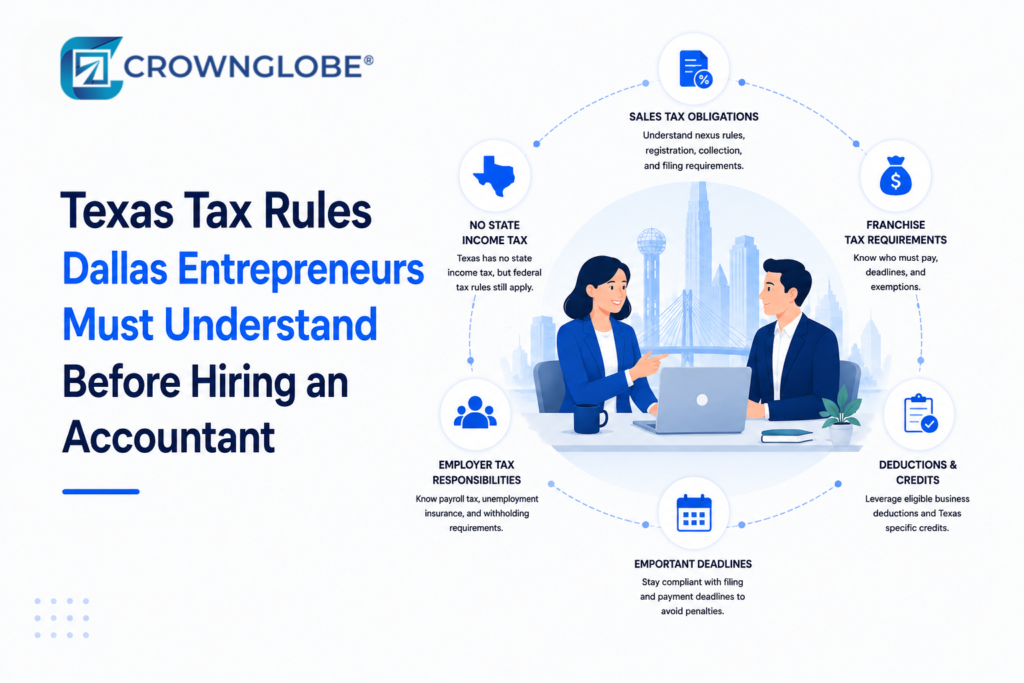
Texas is one of the most business friendly states in the country, and Dallas is one of the fastest growing entrepreneurial hubs in the United States. The combination of no personal state income tax, lower regulatory pressure, strong consumer spending, and rapid population growth makes Dallas a perfect environment for starting and scaling a business.
But there is a misconception that Texas has simple tax rules because it has no income tax. That is not true.
Texas has several state level tax and reporting requirements that can significantly impact how a Dallas business operates, grows, and pays taxes. Most new entrepreneurs do not understand these compliance requirements until they are hit with notices, penalties, or unexpected tax bills.
As someone who has analyzed thousands of Dallas and Texas-based businesses, one thing is clear:
If you do not understand Texas tax rules before hiring an accountant, you will end up choosing the wrong accountant and paying more than you should.
This guide gives Dallas entrepreneurs a complete breakdown of the most important Texas tax rules to understand before selecting any accounting firm.
Whether your business is located in Downtown Dallas, Uptown, Plano, Frisco, Richardson, Addison, Irving, Arlington, or anywhere in the DFW Metroplex, these rules apply to you.
Let’s break them down one by one.
1. Texas Has No Personal State Income Tax, But That Does Not Mean No Taxes
Many entrepreneurs move to Texas believing they will pay far fewer taxes. While it is true there is no state income tax for individuals, Texas collects revenue in other ways.
- The biggest one is the Texas Franchise Tax , which is essentially a business tax similar to a gross margin tax.
- Most business owners do not know this until tax season approaches and their accountant asks: “Where are your franchise tax records?”
- Avoiding penalties starts with understanding this system.
- Many Dallas entrepreneurs form LLCs without realizing that forming an LLC triggers franchise tax filing responsibilities.
- This is where mistakes begin.
- This surprises most Dallas business owners.
- Texas does not tax your profit.
- Texas calculates franchise tax based on your revenue margin , using one of the following methods:
2. Texas Franchise Tax Applies to Most Dallas Businesses
- The Texas Franchise Tax applies to:
- LLCs
- Corporations
- S Corporations
- Partnerships
- Professional Associations
- Certain non-US entities doing business in Texas
- It does not apply to:
- Sole proprietors
- General partnerships owned entirely by individuals
- Certain exempt organizations
3. Texas Franchise Tax Is Based on Revenue, Not Profit
- Total revenue times seventy percent
- Total revenue minus cost of goods sold
- Total revenue minus compensation
- Total revenue minus one million dollars (simplified EZ method for certain filers)
Choosing the wrong margin method can cost thousands.
Your accountant must know which method benefits your business.
4. Texas Franchise Tax No Tax Due Threshold for 2026
Texas allows small businesses to avoid paying franchise tax entirely if total revenue is below a certain threshold.
For 2026, the threshold is expected to remain near:
1.23 million dollars
- If your revenue is under that limit:
- Your business owes zero dollars
- But you still must file a No Tax Due Report (unless exempt)
Failure to file still triggers penalties even if you owe nothing.
Many Dallas business owners mistakenly believe:
“I do not owe tax. I do not need to file.”
That is incorrect.
You do need to file.
And Texas will penalize you for not filing.
5. Penalties for Not Filing Franchise Tax in Texas
- Texas franchise tax penalties include:
- 50 dollars penalty for not filing a report
- 5 percent penalty for late payments
- 10 percent penalty after thirty days
- Interest accrues on unpaid tax
- Even if your tax is zero, the 50 dollar penalty applies for failing to file.
- These penalties are extremely common among Dallas startups.
- The base Texas sales tax rate is: 6.25 percent
- This brings the total sales tax rate in many Dallas locations to: 8.25 percent
- Dallas business owners must know their exact rate based on business address.
- Texas does not take late payments lightly.
- Texas economic nexus threshold is typically: 500,000 dollars in sales
- Your accountant must confirm compliance.
- Dallas employers must comply with federal payroll rules and Texas state requirements.
- Misclassification is one of the most common audit triggers in Dallas.
- Many small businesses incorrectly classify workers as contractors when they are legally employees.
- Your accountant must know the difference.
- Texas Franchise Tax Deadline: May 15 every year
- Late filing leads to immediate penalties.
- If the deadline falls on a weekend or holiday, the deadline moves to the next business day.
- Many Dallas business owners forget this deadline because federal taxes are due April 15.
- This one-month difference causes confusion and missed filings.
- Texas has no income tax but has high property taxes.
- Many do not know they must file a Texas Business Personal Property Rendition.
- Missing this filing leads to unnecessary tax assessments.
- Understanding Texas incentives can save thousands.
- The right accountant helps you assess eligibility.
- This is a huge advantage.
- But many out of state accountants misunderstand Texas rules.
- Your accountant must be Texas experienced.
- Texas allows combined reporting in certain situations.
- Incorrect handling leads to Texas Comptroller notices.
- These are essential.
- Do you specialize in Texas franchise tax? A general accountant is not enough.
- Do you understand Texas sales tax rules for my industry? Especially important for restaurants, retail, and ecommerce.
- Will you manage tax planning or just tax filing? Filing alone is not enough.
- Do you offer monthly accounting or only annual cleanup? Annual cleanup is a financial disaster.
- Do you work with Dallas-based businesses regularly? Local experience matters.
- Do you understand multi-state operations? Many Dallas businesses operate across states.
- Do you provide entity structure guidance? This prevents thousands in tax overpayment.
- Do you help with Texas Workforce Commission compliance? Critical for employers.
- If you read this “Best Rated Accounting Firms in Dallas 2026 What Sets Them Apart”.
6. Texas Sales Tax Rules Are More Complex Than They Appear
- Texas sales tax applies to:
- Retail sales
- Restaurants
- Cafes
- Bars
- Contractors in certain cases
- Hotels
- Digital goods in some cases
- Parking services
- Short term rentals
- Entertainment
- Many services depending on category
- But Dallas has additional local taxes from:
- Cities
- Counties
- Transit districts
- Special purpose districts
7. Dallas Businesses Must File Sales Tax Based on Frequency
- Texas assigns filing frequency based on revenue:
- Monthly
- Quarterly
- Annually
- If you file late:
- Penalty starts at 5 percent
- Increases to 10 percent
- Additional fees apply
- Interest accrues
8. Marketplace and Ecommerce Sales Tax Rules Apply in Texas
- If you sell on:
- Amazon
- Walmart Marketplace
- Shopify
- Etsy
- eBay
- TikTok Shop
- Texas requires sales tax collection if your:
- Business is located in Texas
- Sales exceed economic nexus thresholds
9. Texas Employer Payroll Rules Dallas Entrepreneurs Must Know
- Texas requires:
- Texas Workforce Commission reporting
- Unemployment insurance tax
- New hire reporting
- Wage reporting
- Accurate overtime calculations (federal rules apply)
- Employee vs contractor classification
- This leads to:
- Penalties
- Back taxes
- Interest
- Payroll audits
10. Texas Has Strict Deadlines for Franchise Tax Filing
11. Dallas Property Tax Rules Affect Businesses
- Dallas business owners must understand:
- Business personal property tax
- Inventory tax
- Equipment and machinery tax
- Valuation notices
- Protest deadlines
12. Texas Has Generous Tax Advantages for Certain Businesses
- Some of these include:
- Texas enterprise zones
- Manufacturing exemptions
- Agricultural exemptions
- Renewable energy credits
- R&D tax credits
- Historic preservation incentives
13. Texas Does Not Require Annual Corporate Income Tax Filing
- If your accountant is not familiar with Texas law, they may:
- File unnecessary returns
- Miss required franchise filings
- Misclassify your business
- Fail to optimize margin method
14. Multi Entity Businesses in Texas Have Special Rules
- Many Dallas entrepreneurs structure businesses as:
- Holding companies
- Multi LLC structures
- Operating companies
- Real estate entities
- Your accountant must know:
- Whether your entities file separately
- Whether they file combined
- Whether margin apportionment applies
- Whether shared expenses complicate the structure
15. Before Hiring an Accountant, Dallas Entrepreneurs Must Ask These Questions
Frequently Asked Questions About Texas Tax Rules
Does Texas have a state income tax?
No. Texas has no personal state income tax.
Do all Dallas businesses need to file franchise tax?
Most do, except sole proprietors and certain general partnerships.
Do I need to collect sales tax in Dallas?
If your business sells taxable goods or services, yes.
How do I know if I need monthly or quarterly sales tax filing?
Texas assigns frequency based on your revenue. Your accountant must confirm.
Does every LLC in Dallas need a franchise tax report?
Yes, unless exempt.
Are payroll taxes different in Texas?
Yes. Texas unemployment and new hire rules apply.
Conclusion
Texas may not have a personal income tax, but that does not mean Dallas business owners have a simple tax environment. Franchise tax, sales tax, payroll compliance, and industry specific regulations make Texas more complex than many entrepreneurs expect.
- Understanding these tax rules before hiring an accountant helps you:
- Avoid penalties
- Choose the right accounting partner
- Structure your business correctly
- Reduce tax liability
- Stay compliant
- Grow with confidence
Crownglobe helps Dallas entrepreneurs navigate all Texas tax requirements, build compliant accounting systems, and scale their businesses with complete financial clarity.