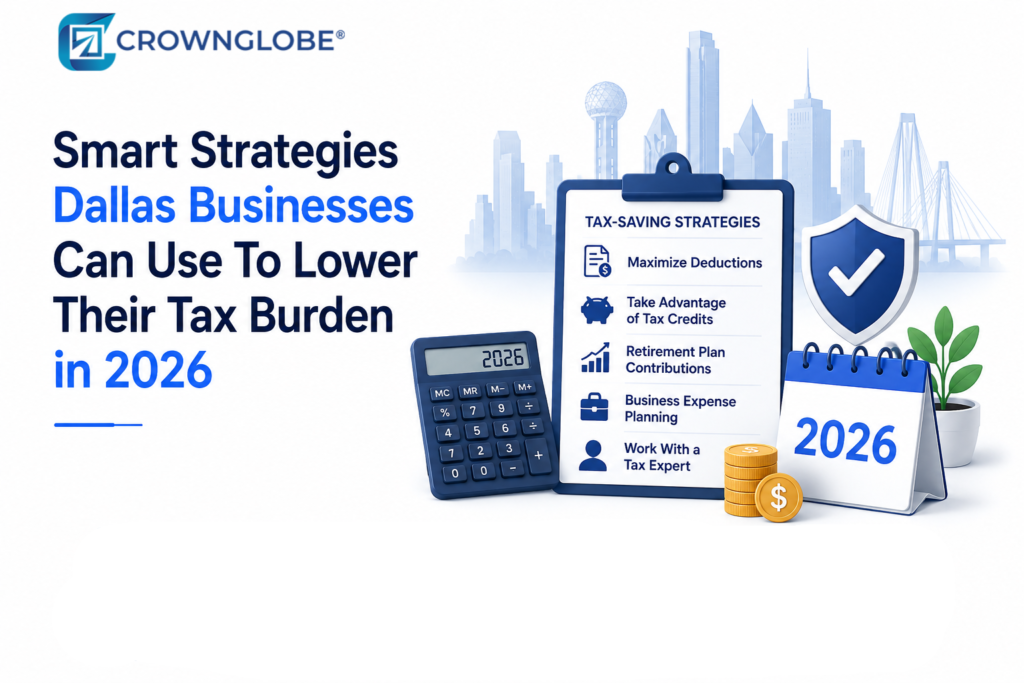
If you run a business in Dallas, you already know how quickly revenue grows in this market. Dallas businesses scale fast. But so does tax liability. While Texas does not have a personal income tax, Dallas business owners still face significant tax obligations through:
- Federal income taxes
- Texas franchise tax
- Texas sales tax
- Payroll tax
- Business personal property tax
- Multi-state income tax in some industries
- Federal self-employment taxes for LLC owners
And here is the truth most Dallas business owners do not realize:
Your tax bill is not determined at tax time. It is determined throughout the year.
The biggest mistake business owners make is waiting until March or April to think about taxes. By then, it is too late. Your books are already closed. Your numbers are already locked. Your opportunities to reduce tax liability are already gone.
This is why successful Dallas businesses invest heavily in proactive tax strategy, not reactive tax filing.
This guide breaks down the most effective ways Dallas business owners can legally reduce their tax burden in 2026. Whether you operate in Plano, Addison, Uptown, Frisco, Irving, Garland, or Downtown Dallas, these strategies apply to your business.
- Let us break down the smartest tax strategies that truly work for Dallas companies.
- Your business structure has a major impact on how much tax you pay.
- The right choice can reduce your tax liability by thousands per year.
1. Choose the Right Business Entity Structure for 2026
- Dallas businesses typically choose between:
- Sole proprietorship
- Single member LLC
- Multi member LLC
- S Corporation
- C Corporation
- Multi-entity structure
S Corporation Election for LLCs
One of the most powerful tax-saving strategies for Dallas owners is electing S Corporation taxation. Why? Because it reduces self-employment tax.
- A typical LLC owner pays:
- 15.3 percent self-employment tax
- Plus federal income tax
- But with an S Corporation:
- Only your reasonable salary is subject to payroll taxes
- The rest flows as distributions not subject to self-employment tax
- This can save:
- 5000 to 25,000 per year
- depending on revenue.
Your accountant must calculate a proper salary level based on IRS requirements.
Multi-Entity Structure for High-Growth Businesses
- Dallas businesses in industries like:
- Real estate
- Construction
- Restaurants
- Logistics
- E-commerce
- Professional services
- Healthcare
- often benefit from separating:
- Operating business
- Real estate holding
- Intellectual property
- Management company
- This allows:
- Better liability protection
- Better tax positioning
- Better asset protection
A tax strategist should evaluate this annually.
2. Use Section 179 and Bonus Depreciation Before Limits Change
For years, Dallas businesses enjoyed generous bonus depreciation.
But starting in 2026, bonus depreciation continues to phase down.
- That means:
- The earlier you invest in equipment
- The more tax savings you capture
Section 179 allows Dallas businesses to deduct the full cost of qualifying assets immediately, up to the annual limit.
- This applies to:
- Machinery
- Equipment
- Software
- Vehicles
- Tools
- Furniture
- Office equipment
Used strategically, this deduction alone can save tens of thousands in tax.
3. Use Retirement Accounts to Reduce Taxable Income
Dallas business owners often underestimate how powerful retirement plans are for reducing taxable income. These plans can save a significant amount of tax while building long-term wealth.
- Strategies include:
- Solo 401(k)
- For owners with no employees besides spouses.
- You can contribute:
- Salary deferral
- Profit sharing
- Catch-up contributions
- Total potential contribution:
- 66,000+ depending on income
- SEP IRA
- Great for businesses with fewer employees.
- Traditional IRA Contributions Smaller contributions but still useful.
- Cash Balance Plans For high-income business owners needing major tax deductions.
- Dallas doctors, attorneys, consultants, and real estate professionals use these plans to reduce federal tax liability significantly.
- Payroll mistakes are a major cause of unnecessary taxes.
- Dallas businesses with employees should schedule quarterly payroll strategy meetings.
- Texas and the federal government offer a wide range of tax credits that Dallas companies often miss.
- Common money-saving credits include: R&D Credit
- Work Opportunity Tax Credit (WOTC) For businesses hiring eligible employees.
- Energy Efficiency Credits For upgrading equipment or facilities.
- Tax credits reduce tax dollar for dollar, making them extremely valuable.
4. Optimize Payroll for Tax Efficiency
- Smart payroll planning includes:
- Paying owners a reasonable salary under S-Corp
- Avoiding excessive payroll that increases payroll tax
- Tracking overtime correctly
- Managing contractor vs employee classification
- Using accountable plans to reimburse expenses tax-free
- Leveraging pre-tax employee benefits
- Good payroll planning saves:
- Federal income tax
- Payroll tax
- State unemployment tax
- Medicare and Social Security tax
5. Use Tax Credits Available to Texas Businesses
- Not just for labs. Qualifies for many industries including:
- Tech startups
- Software companies
- Engineering firms
- Manufacturers
- Construction companies
- Ecommerce companies creating new systems
6. Reduce Taxes With Smart Expense Categorization
Most Dallas businesses overpay taxes due to poor bookkeeping.
If your expenses are not categorized correctly, you lose deductions.
- Smart expense tracking includes:
- Vehicle and mileage tracking
- Travel expenses
- Meals related to business
- Home office deduction
- Utilities
- Software subscriptions
- Marketing and advertising
- Payroll taxes
- Insurance
- Professional services
- Continuing education
- Each category must be:
- Correct
- Documented
- Assigned to proper accounts
A good bookkeeper prevents missed deductions.
A bad one costs you money.
7. Take Advantage of the Home Office Deduction
Dallas has more remote workers, home-based businesses, and independent contractors than ever. The home office deduction is a legitimate tax reduction strategy when used properly.
- You can deduct:
- Rent
- Utilities
- Internet
- Repairs
- Furniture
- Workspace improvements
- The IRS requires that the space be:
- Regularly used
- Exclusively used for business
- Document everything properly to avoid issues.
- Most Dallas business owners do not know this rule exists.
- This is a smart strategy for S-Corp owners.
- Overpaying hurts your cash flow.
8. Use Accountable Plans to Pay Yourself Tax Free
- An accountable plan allows your business to reimburse you for:
- Mileage
- Home office
- Cell phone usage
- Travel
- Supplies
- These reimbursements are:
- Tax-free for you
- Deductible for the business
9. Make Quarterly Estimated Tax Payments Correctly
- Underpaying estimated taxes creates:
- Penalties
- Interest
- IRS notices
- Dallas owners must calculate quarterly taxes based on:
- Net income
- Payroll
- Business type
- Texas franchise tax
- Multi-state income
Most business owners rely on guesswork.
You need monthly accounting to estimate correctly.
10. Use Tax Loss Harvesting for Investments
- Dallas business owners with investment portfolios can reduce taxes using:
- Loss harvesting
- Capital gain planning
- Asset allocation
- Strategic selling deadlines
- This applies to:
- Stocks
- Crypto
- Real estate
- Business investments
Tax harvesting can save thousands in capital gains tax.
11. Understand Texas Franchise Tax to Avoid Overpaying
Texas franchise tax is based on margin NOT profit.
Dallas businesses can reduce their franchise tax by selecting the correct calculation method.
- Options include:
- Revenue times seventy percent
- Revenue minus cost of goods sold
- Revenue minus compensation
- EZ method
- Your accountant must test each method to see which results in the lowest tax.
- Without proper tracking, you risk penalties or overpayment.
- The biggest tax savings happen in Q4, not in April.
- Smart planning saves more than any tax software ever could.
- This is why Dallas businesses increasingly choose outsourced accounting over traditional once a year tax preparers.
- If you read this “Restaurant and Café Tax Reduction Strategies Every Dallas Food Business Should Use”.
- No, but businesses still owe federal tax, payroll tax, franchise tax, and other obligations.
12. Track Sales Tax Properly Across Dallas Jurisdictions
- Sales tax errors are extremely common in:
- Restaurants
- Retail
- Ecommerce
- Service providers
- Avoid overpaying by ensuring:
- POS systems track tax correctly
- Marketplace facilitator rules are followed
- Nexus rules are reviewed
- Monthly reconciliation is completed
13. Perform Year End Tax Planning Before December 31
- Year end planning helps you:
- Accelerate expenses
- Delay income
- Purchase equipment
- Maximize retirement contributions
- Optimize payroll
- Evaluate entity structure
- Identify credits
14. Work With a Dallas Accountant Who Specializes in Tax Strategy
- The biggest tax savings happen when you work with accountants who:
- Understand Texas laws
- Know IRS compliance rules
- Perform monthly accounting
- Implement strategic planning
- Understand multi entity structuring
- Know high growth industries
Conclusion
Dallas is one of the most advantageous places to run a business in America. But without proper tax planning, even Dallas companies leave thousands of dollars on the table. Lowering your tax burden is not about loopholes. It is about strategy, structure, timing, accurate accounting, and proactive planning.
- When you apply the strategies in this guide, your business can:
- Reduce federal taxes
- Reduce franchise tax
- Maximize deductions
- Avoid penalties
- Strengthen cash flow
- Improve profitability
Crownglobe helps Dallas businesses implement these strategies through monthly accounting, tax planning, payroll optimization, entity structuring, and advisory tailored to Texas businesses.