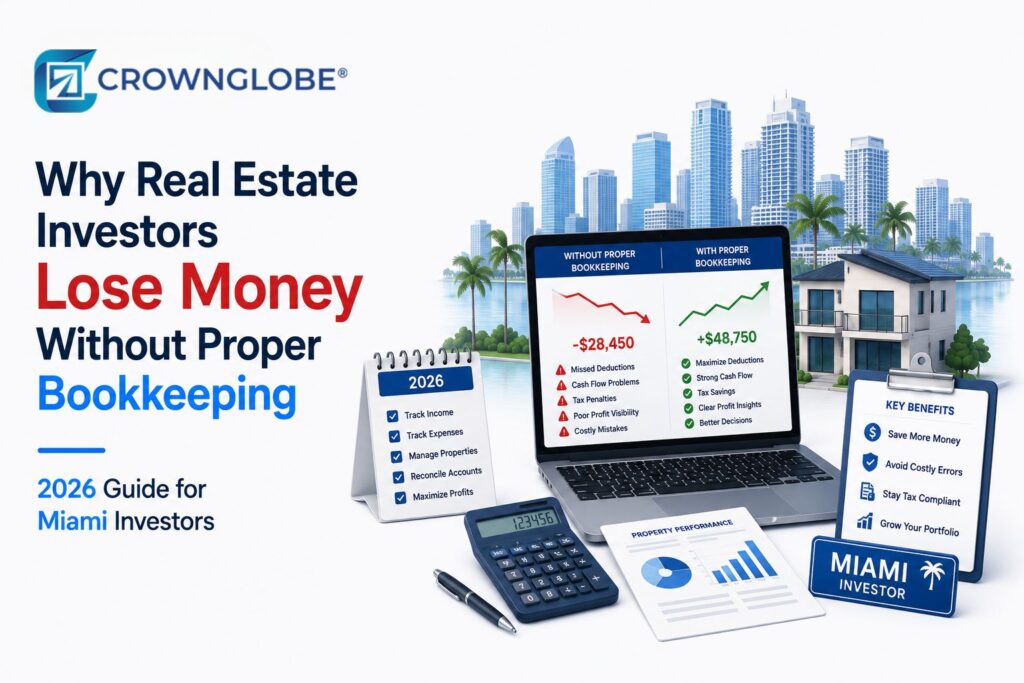
Miami has become one of the hottest real estate markets in the country. Investors from across the US, Latin America, and Europe continue to pour money into Miami’s short term rentals, long term rentals, multifamily units, fix and flips, new construction projects, and commercial properties. Business is booming. Prices fluctuate fast. And opportunities are everywhere.
But beneath all the excitement is a harsh financial truth.
Real estate investors lose more money from poor bookkeeping than from bad tenants, vacancies, or market dips.
This is not an exaggeration.
As someone who has spent more than ten years writing about real estate accounting, investor strategy, and Miami tax filings, I have seen hundreds of investors leave tens of thousands of dollars on the table simply because their books were incomplete or outdated.
Real estate looks profitable on the surface. Rental income comes in. You pay the bills. Cash flow seems fine. But the financial blind spots created by poor bookkeeping quietly eat away at profit, increase tax liability, cause IRS problems, and reduce the return on investment dramatically.
This guide reveals the exact reasons why Miami investors lose money, the risks they do not see, and how proper bookkeeping protects your cash flow, equity, and tax position in 2026 and beyond.
The Number One Reason Investors Lose Money Poor Bookkeeping
Miami investors usually think their biggest risks are:
- Property management costs
- Vacancies
- Tenant issues
- Repairs
- HOA increases
- Market fluctuations
- Rising interest rates
These are all valid.
But none of them destroy profit the way poor bookkeeping does.
Most real estate investors operate with:
- Spreadsheet tracking
- Random receipts
- Missing invoices
- No depreciation schedule
- No mileage logs
- Incomplete expense records
- Personal and rental expenses mixed together
- No separation between projects
- No books for each property
This leads to one result:
Higher taxes and lower profit every year.
Real estate is one of the most powerful tax advantaged assets in America.
But you only unlock those benefits when bookkeeping is accurate.
Why Real Estate Investors Must Have Precise Monthly Books
Real estate is different from other industries. You are dealing with:
- Depreciation
- Mortgage interest
- Escrow adjustments
- Insurance premiums
- CAM fees
- HOA dues
- Repairs and maintenance
- Utilities
- Property taxes
- Capital improvements
- Asset revaluation
- Tenant deposits and refunds
- Construction costs
- Land improvements
- Rental income fluctuations
- Airbnb cleaning fees
- Platform commissions
- If you do not track these correctly every month, your numbers will never be accurate.
- Proper bookkeeping is not optional.
- It is the backbone of every profitable investment portfolio.
- Below are the real financial dangers most Miami investors never see until it is too late.
- Depreciation is the biggest tax benefit in real estate.
- Missing depreciation can cost investors between 5000 and 25000 per year, depending on property value.
- Most investors miss it because bookkeeping cannot support accurate depreciation schedules.
- Investors often skip proper breakdowns due to poor bookkeeping.
- Miami is a top Airbnb market.
- This leads to underreported expenses and inflated taxable income.
- Bookkeeping errors cause most of these penalties.
- is deductible.
- But without monthly logs, investors lose thousands in deductions.
- This is a massive IRS red flag and the most common investor mistake.
- you need separate books per property.
- One spreadsheet cannot handle this.
- Proper books show the true numbers.
- Escrow fluctuations can significantly change your expense profile.
- Quarterly bookkeeping misses these changes.
- Poor books create incorrect profit numbers.
- And the IRS taxes based on what is reported, not what is accurate.
- These are major deductions when tracked monthly.
- Poor bookkeeping leads to incorrect basis and higher capital gains tax.
- Most investors get basis wrong because their books are wrong.
- Bad records can ruin your exchange eligibility.
- Most investors think cash flow is: Rent minus expenses.
- It is not.
- You only know real cash flow with real books.
- These are deductible but often missing.
- This is one of the most expensive investor mistakes.
- Your bank balance tells you nothing about true profit or tax impact.
- Quarterly or annual books provide no clarity.
- Bad books cause unexpected costs with no financial buffer.
- These deductions are huge.
- LLC and S Corporation decisions require clean books.
- Bad books lead to wrong structure and higher taxes.
- Poor bookkeeping is the number one audit trigger.
- Proper bookkeeping pays for itself many times over.
- If you read this “How Real Estate Agents Can Automate Payroll and Save Ten Plus Hours Monthly” .
- And when your numbers are wrong, everything else is wrong:
- Your cash flow
- Your tax filings
- Your deductions
- Your capital gains
- Your depreciation
- Your investor reporting
- Your property analysis
- Your refinancing plan
- Your sale timing decisions
Twenty Five Reasons Real Estate Investors Lose Money Without Proper Bookkeeping
1. Missed Depreciation The Most Expensive Mistake
You can deduct:
- Residential rental depreciation over 27.5 years
- Commercial depreciation over 39 years
- Appliances
- Fixtures
- Furnishings
- Renovations
- Roof replacements
- HVAC systems
- Flooring
- Water heaters
- Electrical systems
2. Incorrect Tracking of Capital Improvements vs Repairs
The IRS treats these differently:
- Repairs are deductible immediately
- Capital improvements must be depreciated
Small bookkeeping errors easily lead to:
- Overpaying taxes
- IRS correction notices
- Audit triggers
3. Missed Mortgage Interest Deductions
Mortgage statements include:
- Loan principal
- Mortgage interest
- Escrow
- Insurance
- Taxes
4. Missing HOA, Insurance, and Property Tax Write Offs
When these are not recorded monthly:
- Deductions disappear
- Year end becomes chaotic
- Tax return inaccuracies occur
5. Incorrect Airbnb Income Tracking
But investors often fail to track:
- Commissions
- Cleaning fees
- Platform fees
- Guest refunds
- Maintenance charges
- Utilities
- Occupancy taxes
6. Missing 1099 NEC Requirements for Contractors
The IRS penalizes investors for:
- Not issuing 1099s
- Late 1099 filing
- Incorrect contractor reporting
7. Not Tracking Mileage and Travel
Travel to:
- Showings
- Inspections
- Supply stores
- Repair sites
- Meetings
- Closings
8. Not Separating Personal and Rental Expenses
9. Incorrect Tracking for Multi Property Portfolios
If you own:
- Multiple rentals
- Multiple Airbnbs
- Multiple flips
- Multiple construction projects
10. Underestimating Vacancy and Bad Debt
Many Miami investors think their net cash flow is higher than it actually is because they never factor in:
- Vacancy
- Tenant turnover
- Unpaid rent
- Bad debt write offs
11. Missing Escrow Adjustments
12. Overstated Profit Leading to Higher Taxes
13. Not Tracking Short Term Rental Operational Expenses
Airbnb and VRBO properties require tracking of:
- Cleaning
- Consumables
- Laundry
- Supplies
- Amenities
- Furniture
- Decor
- Repairs
- Utilities
14. Incomplete Construction Cost Tracking for Flips
Construction bookkeeping must include:
- Permits
- Materials
- Subcontractors
- Inspections
- Waste disposal
- Improvements
- Architect fees
- Engineering
- Staging
- Closing costs
15. Wrong Basis Calculation for Property Sale
Basis affects:
- Depreciation
- Capital gains
- Tax owed on sale
- 1031 exchange calculations
16. Incorrect 1031 Exchange Tracking
You must track:
- Replacement property deadlines
- Closing costs
- Exchange fees
- Depreciation carryover
- Property improvements
17. Not Knowing Actual Cash Flow
Actual cash flow includes:
- Principal
- Interest
- Escrow
- Fees
- Repairs
- CapEx reserves
- Insurance
- Depreciation impact
- Vacancy
- Utilities
- Property management costs
18. Misreporting Property Management Fees
Management fees vary widely between:
- Long term tenants
- Airbnbs
- Short term guests
- Lease up fees
- Renewal fees
- Cleaning management fees
19. Using Bank Balance Instead of Financial Reports
20. No Monthly Profit and Loss Reports
Monthly P and L tells you:
- Rent trends
- Seasonal dips
- Expense increases
- Return on investment
- CapEx planning
- Negative performance alerts
21. No Maintenance or Repair Budgeting
22. No CapEx Planning
- Roof.
- HVAC.
- Plumbing.
- Electrical.
- Major appliances.
- You must plan for these expenses based on accurate books.
23. Missed Interest Deduction for HELOC and Investment Loans
Investors often forget to categorize:
- Interest
- Refinance fees
- Points
- Loan origination fees
24. Incorrect Entity Structure
25. IRS Audits Triggered by Inaccurate Reporting
Real estate is heavily audited due to:
- High deductions
- High income
- Depreciation
- 1099 requirements
- Cash activity
How Proper Bookkeeping Saves Miami Real Estate Investors Thousands
Clean books allow investors to:
- Claim full depreciation
- Maximize deductions
- Reduce taxable income
- Lower IRS audit risk
- Improve cash flow
- Track property performance
- Plan CapEx strategically
- Qualify for better refinancing
- Sell properties with accurate basis
- Execute 1031 exchanges correctly
Frequently Asked Questions About Real Estate Bookkeeping
Do real estate investors really need monthly bookkeeping?
Yes. Real estate has too many moving parts for quarterly books to stay accurate.
Can bad bookkeeping increase my tax bill?
Absolutely. Missed deductions and incorrect depreciation significantly increase taxes.
Can AI automate real estate bookkeeping?
Yes. AI automates most entries, but human oversight is still needed.
Is bookkeeping different for Airbnbs?
Yes. Short term rentals require different tracking for fees, commissions, and occupancy taxes.
Can I fix years of bad books?
Yes. Cleanup can be done in weeks with the right accounting system.
Conclusion
Real estate is one of the most profitable investment vehicles in America, especially in Miami where property values, rental demand, and investor activity continue to rise. But without proper bookkeeping, even the best properties lose money. Missed deductions, incorrect depreciation, inaccurate cash flow, and IRS problems slowly erode returns until the investment no longer performs the way it should.
When your books are accurate, your taxes drop, your cash flow improves, and your ability to grow your portfolio increases dramatically.
Crownglobe continues to help Miami real estate investors structure their finances properly, track income and expenses monthly, remain IRS compliant, and build wealth through accurate accounting systems that support smart decision making.
Proper bookkeeping is not a cost.
It is a wealth building tool.