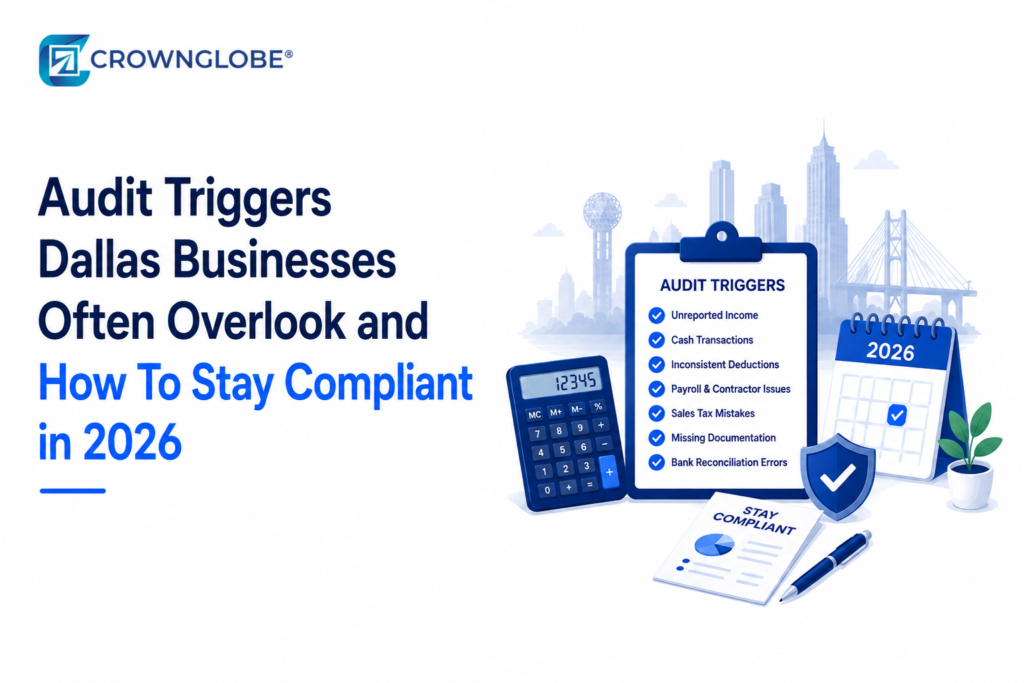
If you run a business in Dallas you may already sense that IRS oversight feels tighter this year. You would be right. The IRS is aggressively reviewing small business filings in 2026 and many owners are receiving notices for issues they never considered risky.
From construction crews in Mesquite to medical practices in Irving to restaurants in Uptown, Dallas businesses across all industries are discovering that even small inconsistencies can trigger a review. IRS systems are smarter. Data matching is faster. And the margin for error has narrowed.
If your tax refund already shrank this year or if you received unexpected adjustments, you can review this “Why Dallas Tax Refunds Shrink and What Filers Need To Know in 2026” for a deeper look at what changed.
Now let us explore the real reason you are here. The audit triggers most Dallas owners overlook and the steps you must take to stay fully compliant.
Why IRS Audit Activity Is Increasing in Dallas
Featured Snippet Answer
IRS audits are rising in Dallas because the agency has new enforcement funding, advanced AI tools, and stronger data sharing with the Texas Comptroller. This allows the IRS to detect mismatches in income, payroll, and deductions faster than ever before.
Now let us go deeper.
The IRS Has New Technology That Tracks Small Inconsistencies
- Advanced IRS systems can now compare
- Bank deposits
- Sales records
- 1099 payments
- W2 filings
- Texas Franchise Tax numbers
- Historical income patterns
- Industry benchmarks
If a Dallas business reports numbers that fall outside expected ranges the system flags it.
Dallas Has a High Concentration of Small Businesses
The Dallas Fort Worth metro is one of the hottest business markets in the country. More businesses means more IRS monitoring. Industries like construction, real estate, logistics, ecommerce, and dining all have natural audit triggers built into their operations.
Texas Data Sharing Creates More Audit Alerts
- Texas and federal systems communicate more than many owners realize. The IRS can see
- Franchise Tax filings
- State payroll reports
- Sales activity trends
- When your federal return and state filings do not line up the audit probability increases instantly.
- Snippet List Dallas businesses often face audits due to
- Now let us break down each one.
Audit Triggers Dallas Owners Commonly Overlook
- Income that does not match bank deposits
- Incorrect or missing 1099 filings
- Large year to year income swings
- High cash volume operations
- Improper contractor and employee classification
- Unusually high deductions
- Incomplete mileage or travel logs
- Real estate depreciation errors
- Personal expenses logged as business expenses
1. Income That Does Not Match Bank Deposits
This is the number one trigger for small business audits. IRS systems compare your reported income with your bank activity. If deposits are higher than revenue the IRS assumes unreported income.
- This issue is common in
- Restaurants
- Retail stores
- Contractors
- Medical offices
- Online sellers
Often the business did nothing wrong. They simply categorized deposits incorrectly or logged them late.
2. Incorrect or Missing 1099 Filings
Dallas companies rely heavily on contract workers. But when
- 1099 forms are missing
- Contractor names and SSNs do not match
- Payments do not align with filed forms
- the IRS flags the return.
- This is especially common among Dallas based
- Dallas businesses with seasonal work such as HVAC companies or event based businesses often experience this trigger.
- Even if the business is honest IRS algorithms assume higher risk.
- Construction businesses
- Transportation companies
- Real estate teams
- Creative agencies
- IT firms
3. Large Year to Year Income Swings
- When income jumps or drops significantly the IRS wants to know why. Without documentation the agency may assume
- Underreporting
- Expense manipulation
- Missing revenue
4. High Cash Volume Operations
- Cash based industries are always audit targets. That includes
- Restaurants
- Retail shops
- Convenience stores
- Food trucks
- Service based businesses that accept cash on site
5. Contractor or Employee Misclassification
This is one of the most dangerous mistakes a Dallas business can make. If someone should be an employee but is paid as a contractor the IRS considers that a compliance violation.
Penalties can be significant and IRS systems catch misclassification faster now that payroll and 1099 data are shared electronically.
6. Unusually High Deductions Without Support
- Dallas owners sometimes deduct
- Travel
- Meals
- Vehicles
- Repairs
- Supplies
- Home office expenses
but do not keep proper documentation. The IRS looks for deduction patterns that do not align with the size or type of business.
7. Incomplete Mileage or Travel Logs
Mileage is one of the most commonly misused deductions. If mileage is estimated rather than documented the IRS reduces or disallows the deduction entirely.
- Many Dallas contractors and real estate agents learn this the hard way.
- These mistakes trigger IRS adjustments and sometimes audits.
- It creates audit risk instantly.
- This is exactly why so many Dallas companies discover problems only after an IRS notice arrives.
8. Real Estate Depreciation and Cost Basis Errors
- Dallas has a large real estate investor community. But depreciation is complicated. Many investors
- Use incorrect basis
- Depreciate land accidentally
- Forget improvements
- Miscalculate bonus depreciation
9. Personal Expenses Mixed With Business Expenses
- This is a silent killer of tax compliance. When owners use business accounts for personal spending or vice versa the IRS sees
- Red flags in spending patterns
- Inconsistent categories
- Unverifiable deductions
Why Dallas Businesses Fail Compliance Without Realizing It
- Most owners do not make intentional mistakes. They simply do not have
- Monthly bookkeeping
- Accurate records
- Timely reconciliations
- Strong payroll systems
- Documentation for deductions
If your cash flow has already felt tight this year go back to “If Your Dallas Business Is Cash Flow Tight Accounting Might Be the Problem” because cash flow stress is often the first sign of hidden compliance errors.
How Dallas Businesses Can Avoid IRS Audits in 2026
Featured Snippet Checklist
Dallas businesses can avoid audits by
- Reconciling bank accounts monthly
- Filing accurate 1099 and W2 forms
- Strengthening payroll compliance
- Documenting deductions thoroughly
- Keeping mileage and travel logs
- Updating depreciation schedules
- Separating personal and business expenses
- Conducting yearly tax strategy reviews
- Now let us expand these.
- hit the bank every month.
- Everything from W2 accuracy to deposit timelines must be maintained perfectly.
- Real estate investors in Dallas must be especially careful.
1. Reconcile Bank Accounts Every Month
- This is the single most effective way to eliminate audit risk. You must know what
- Deposits
- Withdrawals
- Transfers
- Expenses
2. Strengthen Your 1099 System
- You should
- Verify contractor information
- Track payments accurately
- File forms early
- Match payments to 1099 totals
3. Fix Payroll Timing and Compliance
- Payroll errors lead to
- IRS penalties
- State penalties
- Audit risk
4. Document Every Deduction
- If you cannot prove it you cannot deduct it. That includes
- Meals
- Travel
- Mileage
- Equipment
- Repairs
- Supplies
5. Keep Mileage Logs and Travel Documentation
- Mileage should reflect
- Date
- Purpose
- Destination
- Miles traveled
- Reconstructed logs do not count.
6. Update Depreciation Schedules Annually
- This includes
- Equipment
- Vehicles
- Buildings
- Improvements
7. Separate Business and Personal Financial Activity Completely
Use separate cards and accounts. Always.
8. Conduct a Year End Tax Strategy Session
Most problems start in December and are discovered in April. Fix them early not late.
Dallas Case Example of an Audit Trigger
A Dallas based digital agency received an audit notice because their reported revenue dropped thirty percent while bank deposits increased eighteen percent. The owner was shocked because the business had never been audited before.
- The cause was simple
- Deposits were incorrectly labeled
- Client retainers were recorded months late
- Some expenses were duplicated
Once the books were cleaned up the agency passed the audit but the process took four months and created enormous stress.
Audit Proofing Checklist for Dallas Businesses
- Clean monthly reconciliations
- Accurate contractor payments
- Proper payroll classification
- Updated depreciation
- Documented deductions
- Mileage logs
- Strong bookkeeping
- Separate personal expenses
- Quarterly tax projections
- Year end tax planning
For a deeper look at how tax planning can turn compliance into real savings move to “How One Dallas Company Saved Over Fifty Thousand Dollars Through Better Tax Planning”.
Frequently Asked Questions
Why are Dallas businesses facing more audits in 2026?
Because the IRS now uses advanced analytics and shares data with the Texas Comptroller making it easier to detect mismatches and compliance issues.
What is the most common audit trigger for Dallas companies?
Income that does not match bank deposits. This is the first thing IRS systems analyze.
Can poor bookkeeping really cause an audit?
Yes. Inaccurate or inconsistent financial records often create red flags the IRS interprets as risk.
Are real estate investors targeted more often?
Yes. Depreciation issues and rental deductions lead to frequent IRS questions for Dallas investors.
How can I reduce my audit risk fast?
Reconcile monthly, keep clean documentation, fix payroll compliance and update your bookkeeping processes immediately.
Conclusion
IRS audits are rising in 2026 and Dallas businesses must be ready. The days of casual bookkeeping and loose recordkeeping are over. The IRS expects accurate numbers consistent documentation and clean payroll compliance.
The good news is that audit risk drops dramatically when your accounting foundation is solid. Dallas businesses that reconcile monthly track revenue correctly update depreciation and document deductions rarely face audit issues.