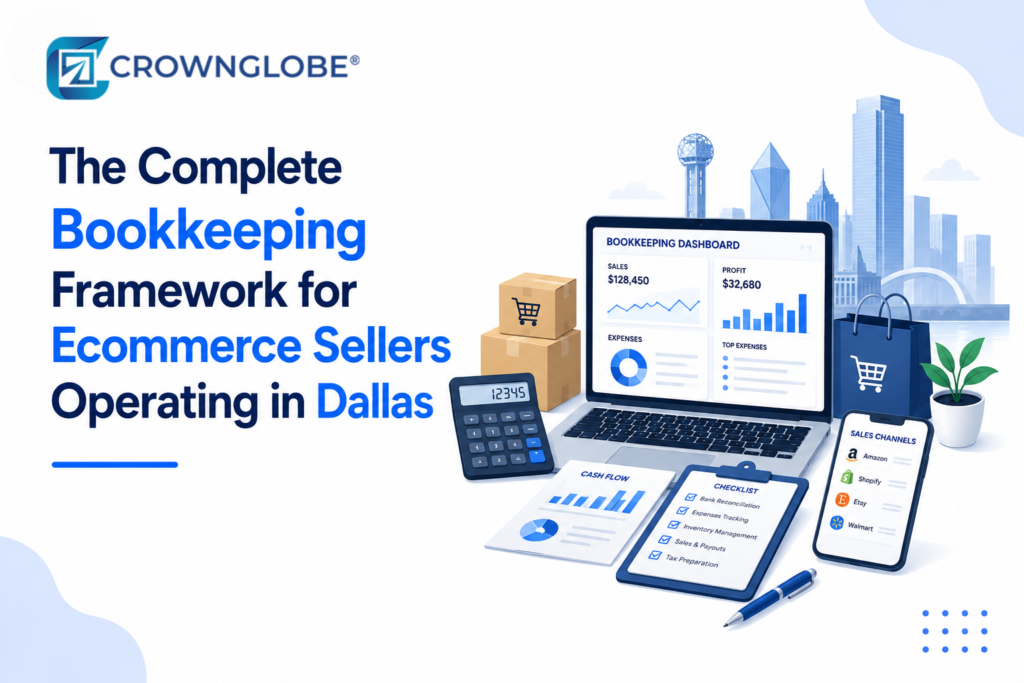
The ecommerce industry in Dallas has exploded in recent years. Whether you sell through Shopify, Amazon, Etsy, Walmart, eBay, or your own website the opportunity is massive. More consumers are shopping online. More businesses are joining the ecommerce space. And Dallas continues to be one of the fastest growing logistics and fulfillment hubs in the country.

But with that growth comes a new reality. Ecommerce companies face some of the most complex accounting challenges of any modern business model. High transaction volume, multiple payment gateways, constant refunds, platform fees, complicated sales tax rules, inventory movement, and shipping costs create chaos when bookkeeping systems are weak.
If you read this “Why Consistent Financial Reporting Prevents Cash Flow Crises for Dallas Businesses”, you already understand how critical it is to have accurate monthly reports. Ecommerce takes this need to an entirely new level.
This complete bookkeeping framework will help every Dallas ecommerce seller build a strong foundation for accuracy, profitability, and compliance in 2026.
Why Ecommerce Accounting Is Harder in Dallas
Snippet Summary
Ecommerce bookkeeping is difficult because of platform integrations, multi-state sales tax rules, high transaction volume, constant returns, complex inventory movement, and inconsistent payment timing.
- Let us break these challenges down.
- differently.
- Without proper integration your accounting data becomes fragmented and unreliable.
- One miscalculation can create hundreds or thousands in penalties.
- This movement must be tracked daily or weekly to maintain accurate cost of goods sold.
1. Multiple Selling Channels Create Fragmented Data
- Dallas ecommerce sellers often sell on
- Shopify
- Amazon
- Etsy
- Walmart
- TikTok
- eBay
- Each platform reports
- Sales
- Fees
- Taxes
- Refunds
- Chargebacks</lirequently Asked>
2. Sales Tax Compliance Is Complicated
- Even though Texas has no income tax, sales tax is extremely strict. Ecommerce sellers must track
- Dallas sales
- Texas statewide sales
- Out of state sales
- Marketplace facilitator rules
- Remote seller nexus
- Multi state compliance
3. Inventory Is Constantly Moving
- Ecommerce inventory is affected by
- Sales
- Returns
- Lost items
- Warehouse transfers
- Damaged goods
- Amazon FBA adjustments
- Shipping errors
4. Platform Fees and Settlement Reports Are Complex
- Amazon fees
- Shopify payment fees
- Etsy listing fees
- Walmart commission fees
- Payment processor fees
must be reconciled to deposits. Without consistent bookkeeping the numbers will never match.
5. High Volume Transactions Overwhelm Traditional Bookkeeping
- Every day ecommerce sellers process
- Orders
- Refunds
- Partial refunds
- Shipping charges
- Sales tax
- Discounts
- Promotions
- Traditional accounting cannot keep up without automation.
- Snippet List The ecommerce bookkeeping framework includes
- Let us walk through each step.
- to your accounting system automatically.
- This level of detail creates accurate reporting.
- This is the most critical step.
- Dallas ecommerce sellers lose money when inventory is inconsistent.
- Incorrect COGS leads to incorrect profit.
- Too many Dallas ecommerce sellers only track product cost and ignore everything else.
- Reconciliation ensures your books match actual money received.
- This removes manual errors.
- to maintain compliance.
- Dallas ecommerce businesses cannot rely on quarterly or annual reporting because the industry moves too fast.
- Proper planning must be done before December.
- A Dallas based Amazon and Shopify seller with fourteen SKUs noticed profit was shrinking even though sales were growing.
- The difference came entirely from accurate bookkeeping.
- If any of these apply the solution is clear You need a complete bookkeeping framework.
The Complete Bookkeeping Framework for Dallas Ecommerce Sellers in 2026
- Platform integration
- Clean chart of accounts
- Daily or weekly inventory tracking
- Accurate cost of goods sold
- Reconciliation of sales channels
- Automated expense categorization
- Proper sales tax compliance
- Monthly financial reporting
- Cash flow forecasting
- Year end tax strategy
1. Integrate All Sales Channels Into One Accounting System
- Use accounting platforms that sync directly with your ecommerce channels such as
- QuickBooks Online
- Xero
- Zoho Books
- Use integration apps like
- A2X
- Webgility
- Link My Books
- These tools match
- Sales
- Fees
- Refunds
- Payouts
- Taxes
2. Build a Clean Ecommerce Chart of Accounts
- A Dallas ecommerce chart of accounts must include
- Sales revenue by channel
- Payment processing fees
- Platform fees
- Shipping income
- Shipping expense
- Advertising and marketing
- Merchant fees
- Refunds and chargebacks
- Inventory purchases
- Warehouse fees
- Packaging and supplies
3. Track Inventory Daily or Weekly
- Inventory must show
- Beginning inventory
- Purchases
- Sales
- Adjustments
- Returns
- End inventory
- Cost per SKU
4. Calculate Cost of Goods Sold Correctly
- Your COGS must include
- Product cost
- Shipping from supplier
- Customs and duties
- Amazon FBA fees
- Packaging
- Labeling
- Freight
5. Reconcile Sales Channels to Bank Deposits
- Deposits from Shopify, Amazon, or Etsy rarely match sales totals. They include
- Fees
- Refunds
- Adjustments
- Chargebacks
- Platform payouts
6. Automate Expense Categorization With AI
- As covered in Blog 23 titled How Artificial Intelligence Is Reshaping Accounting for Dallas Businesses in 2026, AI solves most ecommerce bookkeeping problems by
- Categorizing expenses
- Reconciling accounts
- Flagging unusual charges
- Matching payouts
- Detecting duplicate expenses
7. Maintain Sales Tax Compliance for Dallas and Beyond
- Sales tax for ecommerce requires
- Collecting the right rate
- Tracking taxable and nontaxable sales
- Filing Dallas and Texas returns
- Monitoring out of state thresholds
- Using marketplace facilitator rules
- Ecommerce sellers must use
- Avalara
- TaxJar
- or built in platform tools
8. Produce Monthly Financial Reports
- Monthly reporting includes
- Profit and loss statements
- Balance sheets
- Cash flow statements
- Inventory valuation
- Channel performance
- Ad spend analysis
9. Build a Cash Flow Forecasting System
- Cash flow forecasting protects ecommerce sellers from
- Seasonal dips
- Ad spikes
- Inventory resupply
- Returns and refunds
- Platform reserve holds
- Forecasting helps you know
- When to reorder
- How much to invest in ads
- When to expand
- When to conserve cash
10. Conduct Year End Tax Planning for Ecommerce
- Ecommerce sellers often miss deductions such as
- Shipping supplies
- Software subscriptions
- Influencer payments
- Advertising fees
- Platform charges
- COGS adjustments
Real Example of a Dallas Ecommerce Transformation
- After rebuilding their bookkeeping framework we discovered
- Incorrect COGS
- Unreconciled Amazon settlements
- Misreported advertising costs
- Inaccurate sales tax filings
- Overstated revenue
- Missing inventory adjustments
- Within ninety days
- Profit increased by twenty two percent
- Cash flow stabilized
- Sales tax filings were corrected
- Inventory accuracy improved
- Ad spend became more efficient
Signs Your Ecommerce Business Needs This Framework
- You only see numbers at tax time
- You do not know your true profit per product
- Your cash flow swings constantly
- Your deposits do not match sales
- Your inventory numbers never make sense
- You rely on your Shopify dashboard as your financial report
- Your accountant only updates books quarterly
- You do not track sales tax obligations
- You are unsure how much you can safely reinvest
Frequently Asked Questions
Why do Dallas ecommerce sellers struggle with accounting?
Because the industry has rapid transactions, multiple platforms, complicated sales tax, and constant inventory movement that overwhelm traditional bookkeeping methods.
Which accounting software is best for ecommerce?
QuickBooks Online or Xero with A2X integration works best for Dallas ecommerce sellers.
How often should ecommerce books be updated?
At least weekly for inventory and monthly for financial reports.
Can AI help with ecommerce bookkeeping?
Yes. AI categorizes expenses, reconciles payouts, identifies errors, and improves accuracy.
Conclusion
Dallas ecommerce sellers operate in one of the most dynamic and demanding business models in the world. Without a complete bookkeeping framework the business becomes unpredictable and risky. But with accurate reporting, proper integration, strong inventory tracking, AI automation, and monthly financial reviews, ecommerce sellers gain control over cash flow, taxes, profitability, and growth.
The right bookkeeping framework transforms chaos into clarity and confusion into strategic confidence.