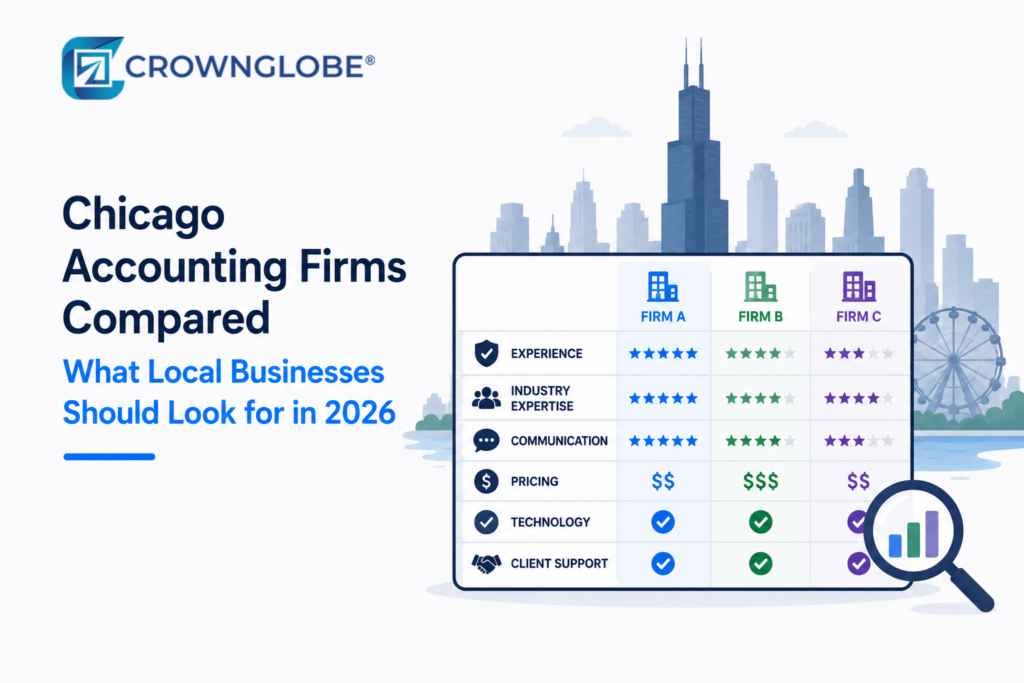
Chicago accounting firms vary widely in expertise, pricing, services, and industry specialization. This guide compares what matters most to Chicago business owners in 2026 when choosing the right accounting partner, including compliance strength, technology, advisory depth, and real world business impact.
When comparing Chicago accounting firms in 2026, business owners should evaluate industry experience, Illinois and Chicago compliance knowledge, real time reporting tools, transparent pricing, advisory support, tax planning capability, and the firm’s ability to deliver accurate monthly financials. These factors determine long term financial health and stability.
Introduction
Chicago remains one of the most competitive business markets in the United States. With higher minimum wages, complex tax rules, and increasing IRS enforcement, business owners cannot afford accounting mistakes.
But with hundreds of accounting firms across Chicago ranging from solo CPAs to mid sized firms to national brands the challenge is identifying which partner will actually strengthen your business and support your growth.
This guide compares what truly matters when evaluating Chicago accounting firms in 2026, so you can choose a partner that provides clarity, control, compliance, and confidence.
1. Industry Specialization Matters More Than Ever
No two industries share the same financial workflow.
A generalist accountant may not understand:
- Restaurant tip allocation rules
- Construction job costing
- Chicago retail tax categories
- Logistics per-load profitability
- Property level reporting for real estate
- Healthcare reimbursement practices
- Restaurants Require POS mapping, COGS analysis, labor compliance, and multi tax category setup.
- Construction and Contracting Need job costing, WIP reporting, retainage accounting, and certified payroll.
- Logistics, Transportation, and Freight Require tracking driver settlements, fuel, maintenance, and load profitability.
- Real Estate Portfolio Owners Need CAM reconciliation, rent roll matching, and asset allocation.
- Ecommerce Sellers Need marketplace facilitator mapping and multi channel integration.
When comparing firms, always ask: Do they have five or more clients in your industry?
- Local compliance is one of the biggest differentiators.
- A strong Chicago accounting firm must understand:
- Mistakes in these areas lead to penalty letters from IDOR, the IRS, or the City of Chicago.
- The best Chicago accounting firms in 2026 are technology powered.
- Analytics must be accessible, clear, and available 24 by 7.
- If a firm still relies heavily on spreadsheets or manual entry, it will slow down your business.
- Quarterly accounting may be cheaper, but monthly accounting provides real visibility.
- When comparing firms, confirm whether they offer a monthly close.
2. Illinois and Chicago Compliance Expertise is Non Negotiable
Illinois Requirements
- Sales and use tax returns
- State income tax withholding
- Estimated corporate taxes
- Annual reporting for LLCs and corporations
- Unemployment insurance
- Workers compensation audits
Chicago Specific Rules
- Restaurant tax
- Personal Property Lease Transaction Tax
- Parking and amusement taxes
- Liquor and retail food compliance
- Hospitality and accommodation taxes
3. Real Time Accounting Tools and Automation
Key features include
- Cloud based accounting software
- Automated expense categorization
- Daily or weekly reconciliations
- Real time dashboards
- OCR for receipts
- Automated AP and AR workflows
- Payroll integrations
4. Monthly vs Quarterly Accounting Support
Chicago companies that choose monthly support avoid
- Cash flow surprises
- Incorrect sales tax filings
- Missed payroll allocations
- Tax underpayment penalties
- Profitability blind spots
- Unbalanced balance sheets
Monthly reporting adds
- Clarity
- Timeliness
- Predictability
- Faster correction of mistakes
- Better decision making
5. Advisory Services Separate Great Firms from Average Firms
Basic bookkeeping keeps the lights on.
Advisory takes a business to the next level.
Advisory includes
- Cash flow forecasting
- Profit margin analysis
- Budgeting
- Multi location reporting
- Strategic tax planning
- Industry benchmarking
- Cost control strategies
- Entrepreneurs in 2026 demand accountants who not only report numbers but explain what those numbers mean and how to improve them.
- Chicago business owners frequently switch accountants because of unexpected billing.
- Before comparing firms, request a detailed scope and pricing sheet.
- Pros: Personal attention Cons: Limited bandwidth, slower responses
- Pros: Dedicated teams, scalability, specialization Cons: Slightly higher pricing but better support
- The right size depends on your business complexity.
- In 2026, accounting cannot be “email only.” Chicago businesses want:
- Your accountant should answer within twenty four to forty eight hours, not weeks.
- For taxes, renewals, and estimated payments.
- Communication is a top deciding factor when Chicago business owners compare firms.
- There is a massive difference between firms that only file taxes and those that plan taxes.
- Chicago businesses need accountants who:
- Many Chicago companies operate across:
- A critical but often ignored factor.
- Security is essential when your entire financial life is in the hands of a provider.
- Before hiring a Chicago accounting firm, analyze:
- A firm’s track record indicates its reliability.
- Use this checklist when reviewing multiple firms.
- Most small businesses benefit from mid sized firms that balance personal attention with scalability.
- Monthly for reporting, quarterly for tax planning, and annually for strategy.
- QuickBooks Online, Xero, Sage, Zoho Books, and industry specific tools like Toast, Clover, Petrosoft, and Buildium.
- Poor communication, sloppy books, incorrect tax filings, hidden fees, or lack of industry knowledge.
- Many coordinate payroll with providers like ADP, Gusto, or Paychex, ensuring accurate financial posting.
6. Transparent Pricing vs Hidden Fees
Watch out for hidden fees such as
- Extra charges per account
- Overages for transaction volume
- Separate billing for month end close
- Surprise cleanup fees
- Separate charges for payroll mapping
- Fees for sales tax returns
- Additional hourly charges for meetings
Transparent pricing should include
- Bookkeeping
- Monthly financial statements
- Advisory calls
- Payroll postings
- Sales tax categorization
- Year end support
7. Accounting Firm Size: Small vs Mid Size vs National
Solo CPAs or Small Firms
Mid Sized Chicago Firms
- National Firms
- Pros: Depth, systems, multi state support
- Cons: Higher fees, less personalized service
8. Communication and Support Standards
Consistent communication
- Monthly meetings
- Quarterly planning
- Clear escalation channels
Responsive support
Proactive reminders
9. Tax Planning vs Tax Filing
Tax filing is historical.
Tax planning is strategic.
- Run projections • Calculate estimated payments • Identify deductions • Plan depreciation • Ensure compliance • Reduce tax liability
- Most business owners pay more taxes simply because their accountant does not plan proactively.
10. Multi Location and Multi State Capabilities
- Suburbs • Indiana • Wisconsin • Michigan • Nationwide via ecommerce
- Accounting firms must handle:
- Multi jurisdiction sales tax • Multi state payroll • Consolidated reporting • Intercompany transactions • Franchise operations
- Choose a firm that scales with your business.
11. Data Security and Confidentiality
Strong accounting firms provide
- Encrypted documents
- Secure client portals
- Controlled access
- Data backup policies
- Regulation compliant storage
12. Reputation, Reviews, and Case Studies
- Google reviews
- Client testimonials
- Industry case studies
- Success stories
- Years in business
- Professional certifications (CPA, EA, CMA, etc.)
Comparison Checklist for Chicago Business Owners in 2026
Does the firm understand your industry
Do they specialize in Illinois and Chicago compliance
Do they offer monthly accounting
Do they provide cash flow forecasting
Do they offer transparent pricing
Do they use modern accounting technology
Do they integrate with your POS or payroll systems
Do they provide tax planning, not only tax filing
Do they offer strong communication and support
Can they scale with your business
If you read this
- “Best Bookkeeping Services Trusted by Chicago Businesses in 2026”.
- “Payroll Companies Chicago Business Owners Rely On in 2026”.
- “Top Accounting Providers Serving Chicago Entrepreneurs in 2026”.
- “Common Bookkeeping Errors Chicago Companies Must Avoid in 2026”.
- “IRS Enforcement Is Increasing Here Is What Chicago Business Owners Must Do”.