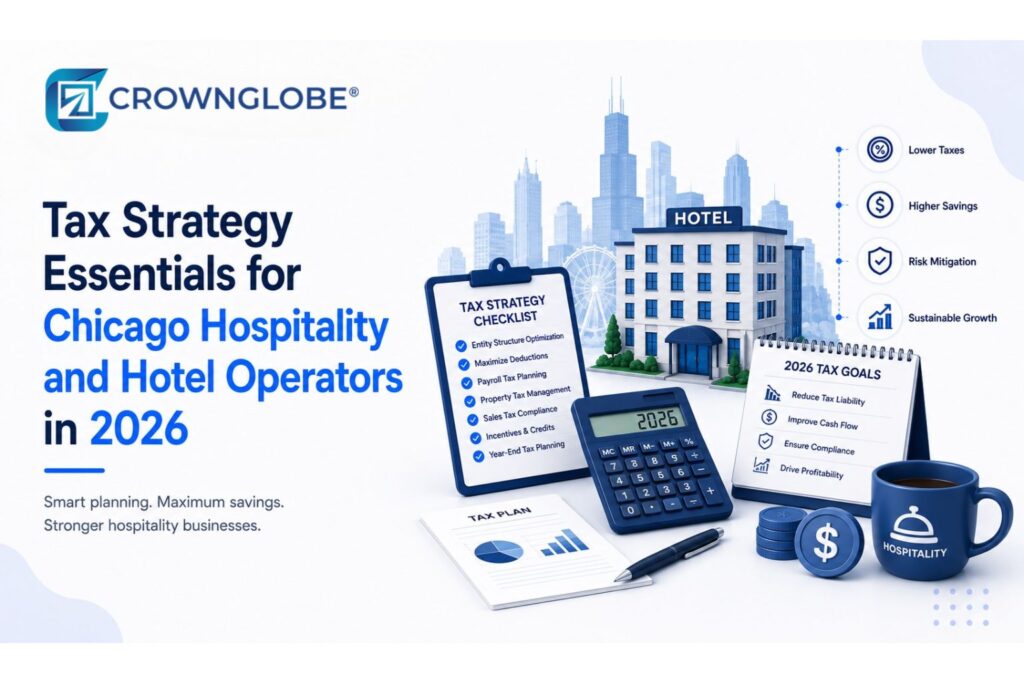
Chicago hotels, hospitality groups, and lodging operators face some of the most complex tax and compliance rules in the Midwest. This 2026 guide explains tax strategies, deductions, credits, city-specific rules, and operational frameworks that legally reduce tax liability and improve profitability.
Chicago hospitality and hotel operators can reduce their 2026 tax bill through strategic depreciation, payroll tax optimization, Illinois credits, occupancy tax planning, correct sales tax reporting, multi-entity structuring, and specialized deductions for lodging operations. This guide explains every essential strategy in detail.
Introduction
Chicago’s hospitality sector is one of the city’s strongest economic pillars, but it is also one of the most regulated and tax-heavy industries. Hotels, boutique lodges, service apartments, hostels, B&Bs, event venues, banquet halls, and hospitality groups must comply with:
- Federal taxes
- Illinois corporate and individual taxes
- Chicago city level hospitality and hotel taxes
- Occupancy and tourism taxes
- Payroll compliance rules
- Sales and use tax obligations
- Vendor and contractor rules
- Reporting for short term rental platforms
In 2026, margins are tight. Costs are rising. IRS audits are increasing.
This means hotel and hospitality operators cannot depend on basic bookkeeping they need a structured tax strategy that covers federal, state, and city obligations while maximizing every legally allowable deduction.
This guide is your complete 2026 Tax Strategy Framework for Chicago Hospitality & Hotel Operators.
1. Understand Chicago’s Hotel and Hospitality Tax Structure
Chicago imposes multiple layers of taxes on hotels and lodging providers:
A. Hotel Accommodations Tax
Charged on stays under 30 days.
B. Personal Property Lease Transaction Tax (PPLTT)
Applies to certain tech, software, or leasing components used by hotels.
C. Amusement Tax
Applies to entertainment, events, and certain facility usage.
D. Parking Tax
Applies to hotels offering paid parking.
E. Food and Beverage Tax
Applicable to in-house restaurants, bars, banquet service, and room service.
F. Liquor and Retail Taxes
Chicago’s layered tax structure makes hospitality one of the most compliance-sensitive industries.
Correct setup in your accounting and POS system prevents penalties and overpayment.
2. Reduce Taxable Income Through Strategic Depreciation
Hotels rely heavily on real estate, furnishings, fixtures, and equipment making depreciation one of the most powerful tax tools.
Eligible assets include
- Property improvements
- HVAC systems
- Elevators
- Kitchen equipment
- Furniture and fixtures
- Laundry systems
- Landscaping and exterior upgrades
- Security systems
- Technology and servers
Key strategies
A. Cost Segregation Study
Breaks down hotel property into shorter life assets, dramatically accelerating depreciation.
B. Section 179 Expensing
Allows immediate write off of qualifying equipment.
C. Bonus Depreciation
Still partially available in 2026 use it before phase downs eliminate future benefits.
D. Leasehold Improvements
Eligible for accelerated deductions.
- A single cost segregation study can legally save tens or hundreds of thousands of dollars in taxes.
- Hotels and hospitality businesses have unique expense categories that offer high tax savings when tracked correctly.
- Correct categorization maximizes deductions and avoids IRS disallowances.
3. Maximize Hospitality-Specific Deductions
Common deductible expenses
- Amenities and guest supplies
- Housekeeping costs
- Laundry and dry cleaning
- Reservation systems and PMS software
- OTA commissions (Booking.com, Expedia, Airbnb, Vrbo fees)
- Lobby and interior design expenses
- Conference and banquet supplies
- Security services
- Uniforms
- Concierge services
- Cable TV and digital entertainment
- Shuttle and transportation expenses
- Staff meals
4. Optimize Payroll Taxes and Labor Structure
Hospitality is labor-intensive.
Payroll is often 40 to 70 percent of total operating costs.
Key areas that reduce tax exposure include
A. Correct worker classification
Front desk staff, housekeeping, kitchen staff, security, bellhops each has different rules.
- B. Tip reporting compliance
- Especially critical for:
- In-house restaurants
- Room service
- Banquet operations
- Bars
C. FICA Tip Credit (if applicable)
Allows hotels to claim a credit for employer taxes paid on tips.
D. Overtime and scheduling compliance
Illinois and Chicago rules differ from federal rules.
E. Retirement plans and tax-advantaged benefits
Employers can reduce taxes by offering deductible benefit plans.
Correct payroll mapping is essential for hotels with high staff turnover.
5. Capture Illinois Hospitality and Tourism Credits
Illinois provides incentives for hotels and hospitality businesses that many operators overlook.
A. EDGE Credit
For expansion, rehiring, or capital investment.
B. Historic Preservation Tax Credits
Ideal for boutique hotels located in historic districts.
C. Tourism Attraction Credits
Several initiatives provide tax relief for qualifying hospitality businesses promoting tourism.
D. Illinois R&D Credit
Applicable to hospitality tech upgrades (booking systems, AI-driven software) if development qualifies.
- Your accountant must evaluate eligibility annually these credits can significantly reduce Illinois tax liability.
- Many successful hotel groups use multi-entity structures for tax efficiency and liability protection.
- Each entity receives specific tax benefits.
- Allows for better payroll, compliance, and tax planning.
- Hotel brands (Hilton, Marriott, Hyatt) often require specific tax pathways.
- Proper structuring drives major tax efficiencies when executed correctly.
- Hotels and lodging providers must manage:
- Correct mapping saves money and avoids penalties.
- Hotels often lose tax benefits due to poor tracking of:
- Better documentation = higher deductions.
6. Utilize Multi Entity Structuring for Hotels and Hospitality Groups
A. Separate Operations from Real Estate
- Common structure:
- LLC 1: Real estate holding
- LLC 2: Hotel operations
B. Management Companies
C. Franchise and licensing structures
7. Sales and Occupancy Tax Optimization
- Occupancy tax
- Sales tax on amenities
- City of Chicago tax categories
- Use tax on purchases lacking sales tax
- OTA-related tax reporting
- Event and banquet tax obligations
Common issues include
- Underreporting occupancy tax
- Overreporting sales tax on exempt items
- Double counting OTA revenue
- Misclassifying food and beverage sales
- Incorrect tax mapping in PMS and POS systems
8. Improve Cash Flow With Better COGS and Expense Tracking
- Linen replacement
- Guest supplies
- Food and beverage inventory
- Bar inventory shrinkage
- Maintenance supplies
- Housekeeping consumables
Strategies
- Weekly inventory counts
- Integrating PMS with accounting
- Vendor-level reconciliation
- Tracking banquet costs
- Margin analysis for F&B departments
9. Use Year Round Tax Planning Instead of Year End Cleanup
The hospitality sector cannot afford reactive tax planning.
Seasonality, occupancy changes, events, and fluctuations create tax and cash flow challenges.
Year round planning includes
- Quarterly tax projections
- Review of depreciation schedules
- Payroll compliance audits
- Sales tax and occupancy reconciliation
- Budget vs actual tracking
- Strategic renovation planning
- Adjusting revenue allocation to avoid tax spikes
- This approach saves more than any single deduction.
- Hotels often face penalties for:
- A strong accounting framework prevents every one of these issues.
- Hospitality is too complex for generalist accountants.
- Outsourcing ensures:
- Operators can finally focus on occupancy, guest experience, and expansion while accounting experts manage compliance and tax strategy.
- This is the foundation of a tax-efficient hospitality operation.
- Yes through depreciation, Section 179, and cost segregation.
- Yes Chicago Hotel Accommodations Tax plus multiple city layers.
- Yes fully deductible as operating expenses.
- Yes especially EDGE and renovation-related credits.
- Yes hospitality accounting requires specialized expertise and compliance knowledge.
10. Reduce IRS and IDOR Penalties With Proper Compliance
- Incorrect occupancy tax filings
- Misreported online booking revenue
- Vendor payments without proper documentation
- Underreported tips
- Unfiled use tax
- Inaccurate depreciation
- Missing W-9s and 1099s
11. Why Outsourcing Accounting Is Essential for Hotels and Hospitality Operators
- Accurate room revenue allocation
- PMS-to-accounting integration
- Real-time dashboards
- Proper payroll mapping
- Multi-entity accounting
- Sales and occupancy tax accuracy
- Vendor and contract reconciliation
- Monthly financial statements
- Cash flow forecasting
- Audit readiness
Tax Strategy Action Plan for Chicago Hospitality Operators
Step 1: Configure PMS, POS, and accounting software
Step 2: Clean and categorize every expense
Step 3: Optimize sales, use, and occupancy tax
Step 4: Conduct a depreciation and cost segregation review
Step 5: Track all payroll categories and tips
Step 6: Explore Illinois hospitality credits
Step 7: Review multi-entity structure
Step 8: Maintain monthly financials
Step 9: Review tax strategies quarterly
To strengthen your systems further read this
- “Tax Saving Framework for Chicago Restaurants and Cafes in 2026”.
- “Legal Ways Chicago Businesses Can Lower Their Tax Bill in 2026”.
- “Chicago Small Business Tax Filing Guide for 2026”.
- “Illinois Compliance Rules Every Chicago Business Must Know”.
- “Top Accounting Providers Serving Chicago Entrepreneurs in 2026”.