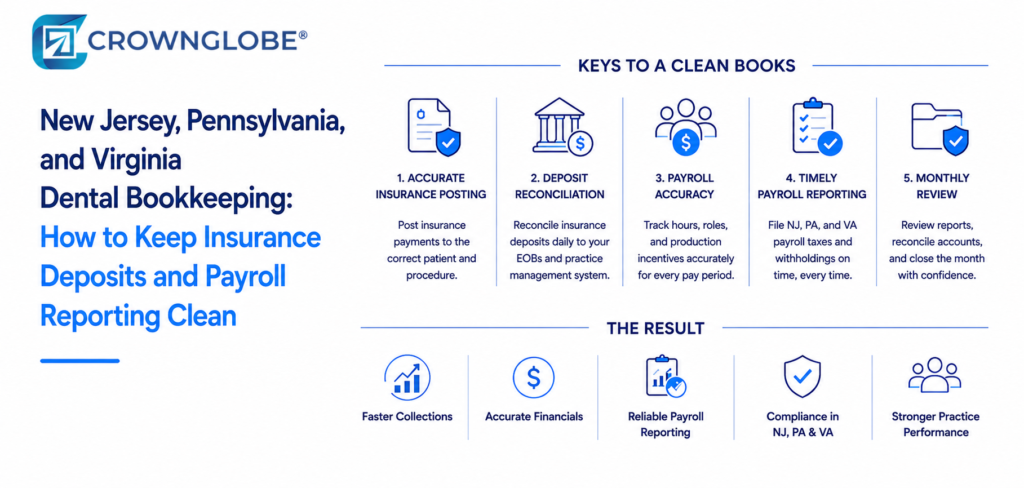
Dental practices in New Jersey, Pennsylvania and Virginia are dealing with a lot of issues. Dental practices have to handle rising labor costs and staffing problems. Dental practices also have to figure out insurance reimbursement processes and follow many rules. That is why managing money is really important, for practices now.
Patient care is the thing but insurance deposits and payroll reporting are areas where financial mistakes can start to happen with practice owners.
A missed insurance reconciliation or an overlooked payroll discrepancy may not seem like a deal, at first but insurance reconciliation and payroll discrepancy issues can really mess up your profitability and cash flow over time.
That is where structured dental bookkeeping becomes invaluable.
Bookkeeping is very important for growing practices because it helps them understand how they are doing financially and make decisions, about money.
Why Insurance Deposits Create Challenges for Dental Practices
Unlike many businesses that receive payment immediately after providing services, dental practices often rely on multiple revenue sources and delayed reimbursement cycles.
Most practices regularly manage:
- Insurance reimbursements
- Patient payments
- Payment plans
- PPO adjustments
- Write-offs
- Co-pay collections
- Outstanding insurance claims
Because insurance payments often arrive weeks after treatment is completed, accurately tracking deposits can become surprisingly difficult.
Without proper dental office bookkeeping, it becomes challenging to answer important questions such as:
- Do insurance deposits match production reports?
- Which claims are still outstanding?
- Are insurance carriers reimbursing accurately?
- How much revenue is realistically collectible?
Quick Answer: Why Insurance Reconciliation Matters
A dental practice may seem profitable, on paper. Still have cash flow problems because insurance payments are delayed or recorded wrong.
Accurate reconciliation helps ensure:
- Production reports align with collections
- Outstanding claims are monitored consistently
- Revenue reporting remains reliable
- Cash flow forecasting becomes more accurate
Many practices that invest in professional bookkeeping services for dentists find that improving insurance reconciliation alone significantly enhances reporting accuracy.
Payroll Reporting Is Often More Complex Than It Appears
Payroll is usually one of the largest expenses in a dental practice.
Between hygienists, dental assistants, front office staff and associate dentists payroll reporting gets complicated with bonuses, benefits, overtime and incentive compensation.
For practices operating across New Jersey, Pennsylvania and Virginia the payroll requirements, for these practices may also vary based on the workforce structure of these medical practices and the state-specific tax obligations of these medical practices.
Accurate payroll reporting should account for:
- Salaries and hourly wages
- Overtime compensation
- Employer payroll taxes
- Employee benefits deductions
- Retirement contributions
- Bonuses and incentive pay
- Associate production-based compensation
Without proper payroll reconciliation, understanding your true labor costs becomes difficult.
This is one reason many growing practices eventually move toward specialized dental accounting services, dental bookkeeping services, and comprehensive dental accounting and bookkeeping support rather than relying on generic bookkeeping solutions.
Common Signs Your Insurance and Payroll Reporting Need Attention
Many dental practices think that everything is okay because the dental practice is making an amount of money from dental practices.
Unfortunately problems, with reports often stay hidden until they start hurting profits.
Insurance Deposits Do Not Match Collections
If deposits do not match production or collections reports then there may be a problem, with reconciliation.
Payroll Costs Change Unexpectedly
Big changes in the payroll amount without any staffing changes usually mean there are some errors, in the reports that need to be looked at with the payroll reports.
Financial Statements Seem Unreliable
If profitability changes a lot from month, to month without a reason you should check bookkeeping accuracy.
Tax Season Requires Extensive Cleanup
When accountants spend a lot of time fixing records before filing taxes it is often because of the bookkeeping processes.
Cash Flow Feels Difficult to Predict
Strong production combined with cash shortages frequently points to reporting gaps that need investigation.
Experienced dental accountants and specialist accountants for dentists often identify these warning signs long before they become larger financial challenges.
What a Clean Monthly Dental Bookkeeping Process Looks Like
Strong bookkeeping for dentists follows a disciplined monthly process.
Each month should include several key reviews.
Insurance Deposit Reconciliation
Every insurance deposit should be matched against production and collections reports.
Payroll Reconciliation
Payroll records must match payroll provider reports and financial statements.
Bank and Credit Card Reconciliation
Every transaction should be reviewed, categorized correctly, and verified.
Accounts Receivable Review
We should always keep an eye on insurance claims and patient balances.
Financial Statement Preparation
Monthly reporting should provide clear visibility into:
- Revenue
- Payroll expenses
- Operating costs
- Profitability
- Cash flow
Practices that utilize Financial Statements Preparation services often gain a much deeper understanding of performance than those relying exclusively on annual tax reporting.
The Connection Between Dental Bookkeeping and Profitability
Many practice owners focus heavily on production numbers.
Production is important, but profitability tells the complete story.
Accurate dental accounting and bookkeeping helps answer questions such as:
- Are labor costs rising faster than collections?
- Which providers generate the strongest margins?
- Are insurance reimbursement delays affecting cash flow?
- Is overhead being managed effectively?
- Is expansion financially sustainable?
Without clean bookkeeping data, finding reliable answers becomes difficult.
This is why many successful practices choose specialized dental accounting services rather than relying on general bookkeeping support.
Technology Is Improving Dental Accounting Accuracy
Modern technology has dramatically improved financial visibility for dental practices.
QuickBooks for dentists and other systems like Xero can really help with accounting. Make reports more accurate, for dentists who use QuickBooks for dentists.
However, software alone is not enough.
The best dental accounting software is only good if you set it up correctly and keep an eye on the accounting software all the time.
Many growing practices now combine:
- QuickBooks Bookkeeping
- Xero Bookkeeping
- Finance Automation solutions
- Power BI Visualization dashboards
- Remote accounting support
Together these tools provide real-time visibility into performance they strengthen financial management, for dental clinics and they also reduce the manual workload.
Why Multi-Location Practices Need Stronger Controls
Dental groups in places, like New Jersey, Pennsylvania and Virginia are getting bigger and opening up in different locations.
Growth brings chances but it also makes things more complicated.
Common challenges include:
- Multiple payroll cycles
- Multiple bank accounts
- Different provider compensation structures
- Higher insurance claim volume
- Location-specific profitability tracking
Without standardized dental practice bookkeeping processes, financial reporting can quickly become inconsistent.
Dental practices really need accounting support and experienced accountants, for dental practices to help them with their finances.
A centralized bookkeeping process is really helpful because it helps maintain consistency across all the locations and it also improves the quality of the reports and the financial visibility of the bookkeeping process.
Compliance and IRS Considerations
The IRS continues to place significant attention on payroll reporting accuracy, worker classification, and documentation requirements.
Dental practices should regularly review:
- Payroll tax filings
- Employee classifications
- Benefits reporting
- Contractor payments
- Record retention procedures
Working with professionals who provide tax filing services and year-end finalization and annual checkup services can help reduce compliance risks and improve audit readiness.
Building a Strong Financial Foundation for Growth
The most successful dental practices do not wait until tax season to understand their numbers.
They review financial performance monthly.
They reconcile insurance deposits consistently.
They closely monitor payroll expenses.
And they use financial reporting as a management tool rather than simply a compliance requirement.
Many practices that invest in remote accounting support, virtual CFO services, outsourced accounting, and guidance from an experienced accountant for dentists gain access to stronger financial insight without increasing administrative overhead.
For practices looking to improve profitability and strengthen financial operations, resources such as How Professional Accounting Helps Doctors in Miami Scale Faster: A 2026 Medical Practice Growth Guide and Why Your Dental Clinic Needs a Dedicated Accountant provide additional practical guidance.
Conclusion
Insurance deposits and payroll reporting are two of the most critical components of dental bookkeeping.
When either process is not consistent financial reports are not reliable making profitability hard to measure and business decisions tough to make with confidence.
For practices in New Jersey, Pennsylvania and Virginia keeping clean bookkeeping is really important, for the dental practices because it helps the dental practices see their money better and makes the dental practices reports more accurate.
When the financial information is correct the owners of the practice get the confidence to make decisions about the money, which helps them make more money and build a stronger business, for the future.
FAQ Section
What is dental bookkeeping?
Dental bookkeeping involves recording, organizing, and reconciling financial transactions specific to dental practices, including insurance reimbursements, patient payments, payroll expenses, and operating costs.
Why are insurance deposits difficult to track?
Insurance payments often arrive weeks after treatment and may include adjustments, write-offs, partial reimbursements, and claim corrections, making reconciliation more complex.
How often should payroll be reviewed?
Payroll should be reviewed during every monthly close to ensure wages, taxes, benefits, and compensation arrangements are recorded accurately.
Can bookkeeping improve dental practice profitability?
Yes. Accurate dental bookkeeping helps identify collection issues, payroll inefficiencies, unnecessary expenses, and cash flow concerns that may be limiting profitability.
Should dental practices outsource bookkeeping?
Many growing practices benefit from outsourced accounting services because they provide specialized expertise, stronger financial controls, improved reporting accuracy, and reduced administrative burden.
What reports should dentists review monthly?
Practice owners should regularly review:
- Profit and Loss Statements
- Balance Sheets
- Cash Flow Reports
- Accounts Receivable Aging Reports
- Payroll Reports
- Provider Performance Reports